Showing posts with label Monetary Regime. Show all posts

Thursday, July 4, 2013

Capital Requirements and Nominal GDP Targeting

The Federal Reserve has recently moved to tighten capital requirements for banks, and I see this as a long overdue move. While others have done a very good job summarizing the minutiae of the various ratios, I want to explore what capital requirements really mean and, more importantly, what implications these requirements have on monetary policy.

First, we should be clear on what capital really is. Despite phrases such as “capital cushion” or “holding capital”, capital holdings are not the same as reserves. Capital is meant to describe a type of funding structure, not an asset allocation -- a liability, not an asset. So what is truly at stake here with the capital requirements debate is how banks fund themselves: through equity or debt.

The argument for higher equity funding comes down to reducing the incentive to run on the banks. Because debt liabilities are fixed, creditors are likely to demand their money back at the first sign of trouble. On the other hand, if the funding comes from equity, there is no similar compulsion to run, thereby preventing the fire sale spirals that characterise financial distress.

To visualize this, consider the following bank balance sheet. On the left we have the funding sources -- debt and equity -- and on the right we have the assets. In this first diagram, we see a bank that relies heavily on debt funding (95%) and has very little equity (5%) -- a situation characteristic of many banks today.

Figure 1: Highly Leveraged Bank

If the bank’s assets lose value and drop by a small amount, say 7%, because the debt quantities must stay constant, then all of the equity is wiped out and the bank is left insolvent. On the other hand, had the bank financed itself through mostly equity, then the bank would have stayed solvent and not all the equity would have been wiped out. There would have been less of an incentive to have a run on the debt and, in a time of financial stress, the bank would have avoided a fire sale. These examples illustrate why high levels of debt financing can be so problematic in a system of hard to calculate risks.

Figure 2: Insolvent Bank


Equity funding prevents sudden runs and insolvency. That is the key justification for stricter capital requirements. With this in mind, I now turn my attention to the relationship between these new financial regulations and monetary policy.

The most important relationship between capital requirements and monetary policy is that capital requirements make the financial stability and “reaching for yield” arguments against monetary easing so much weaker. If institutions are well capitalized, what are we scared of? Equity bubbles, like the 2000’s dot com bust, do not leave lasting damage. However, debt bubbles, such as the 2008 financial crisis, can trigger an extended period of deleveraging and general economic malaise. Much as Scott Sumner has recommended, capital requirements can help keep the finance out of macro. While I personally believe insights from the financial literature may reveal more light on the mechanisms of monetary policy, I do agree that the task of monetary policy should stay very separate from that of financial regulation. Monetary policy makers can direct the guidance of interest rates towards maintaining a stable level of nominal output, whereas financial regulators focus on making sure the banks do not fall apart. If institutions are reaching for yield, leave it for regulators to cut the arms off. The monetary authorities need not pay any attention to it.

Even if these capital requirements are not implemented, the mere prospect of them greatly weakens the case for using monetary policy for financial stability purposes by exposing a contradiction: if monetary policy is surgical enough for financial markets, why aren’t capital requirements?

In Jeremy Stein’s February speech on monetary policy and financial stability, he argued that it may be appropriate for monetary policy to prevent bubbles. One of his key justifications was that monetary policy can “[get] in all of the cracks” of financial markets to stamp out bubbles. However, this neglects the bluntness of monetary policy.

In my view, to the extent that interest rates get in all the cracks, they do so by reducing the financial edifice into rubble. But if I am wrong and if monetary policy is indeed precise enough to stamp out bubbles without collateral damage, then aren't capital requirements even more surgical? Indeed, while monetary policy can affect the entire economy’s consumption and investment behavior, the Mogdiliani-Miller theorem suggests that changes in the capital structure would barely have an effect on those macroeconomic aggregates. The greatest irony is that the financial types who support tighter monetary policy to control financial risks are often the same ones who are against stricter capital requirements. But these views are inconsistent. Capital requirements are tailored for financial regulation, and to the extent one supports the blunt use of monetary policy, one should support the strengthening of capital requirements even more.

On the other hand, while capital requirements may make the task of monetary policy easier, some have argued that the reduction in credit from the stronger capital requirements goes against the goal of expansionary monetary policy. First, I do not believe this is true on a purely finance theory basis. As has been discussed elsewhere, higher capital requirements are unlikely to increase funding costs. To the extent that they do raise funding costs, this reflects an efficient reduction in the government’s implicit subsidies for bank debt. Second, even if this were the case, we should remember that monetary policy is not credit policy. If there is a reduction in credit, the question for the monetary authorities is whether this reduces nominal GDP. Depending on that, the Fed should ease or tighten. Therefore, a well functioning monetary policy should fully offset the potential impact of credit shocks. The level of credit in an economy is a matter of financial organization, something far outside the domain of monetary policy. The Fed should adjust the path of interest rates depending on where they want to see nominal GDP go.

While the above discussions focus on how capital requirements make monetary policy easier, I also believe better monetary policy, especially through a nominal GDP target, can help make capital requirements simpler. It’s useful to remember that debt is an extremely important channel through which nominal shocks have real effects. Rarely are these bonds written with inflation indexing, so stabilizing nominal aggregates can help make satisfying capital requirements easier. Under a nominal GDP target, the size of the debt chunk of the balance sheet can stay roughly around the same level as the size of the equity chunk, reducing the amount of scrambling that can occur in financial markets as bank struggle to reach their regulatory goals.

To conclude, I should note that there is an elegance in the combination of nominal GDP targeting, a robust monetary policy regime, and high capital requirements, a robust financial regulatory regime. As Plosser recently noted:

In the context of monetary policy, I have long advocated simple, robust rules and transparent communications.2 Robust rules are important because they are intended to work well in a variety of environments. This reflects our limited knowledge about the true determinants of economic outcomes. Economists have also come to understand that using policies that are optimal in one specific economic model can often deliver very poor outcomes if that model proves incorrect. So a policy rule that operates well under a wide range of models is a better and more robust approach.
The same approach applies to the design of regulatory frameworks as well. Because the financial world is very complex, there is merit in simple, transparent regulatory solutions designed to work reasonably well in a wide range of situations. We want rules that regulators can enforce without having superhuman knowledge or foresight. However, we can predict with virtual certainty that private actors will seek to evade regulatory restrictions and taxes. This is often called "regulatory arbitrage." We also know that enforcement costs rise as firms' incentives to evade regulations increase.
In my view, simple mechanisms that are harder to evade — and even better, mechanisms that utilize market forces to discipline firm behavior — are superior to an elaborate list of rules that seeks to cover every possible outcome. Simple and transparent regulatory mechanisms make it easier for market participants to predict how regulators are likely to behave. This, in turn, makes it easier for regulators to credibly commit to implementing the regulations in a consistent manner.
Reading Plosser’s second and third paragraphs really shines light on some common issues such as commitment, credibility, and transparency that relate financial and monetary policy. For monetary policy, these qualities can help guide the expectations that give monetary policy its oomph. For financial regulation, these qualities limit the hidden fault lines that can make crises so severe. One can only hope that policy can combine these all these qualities to make a more enlightened monetary and regulatory framework.

Sunday, June 30, 2013

Why Nominal GDP Targeting Solves the Credibility Problem

Monetary easing at the zero lower bound seems to work in practice. But does it work in theory?

In his recent BIS speech, Rajan argues that monetary policy at the zero lower bound requires an impossible commitment. For the Fed to get real rates low enough for the economy to "lift-off", the only option is to raise expectations of future inflation. But what happens when that future arrives? Now that the economy has escaped the zero lower bound, the Fed is tempted to renege and stick to the original inflation target. Market participants, knowing this, then refuse to believe the original commitment, leaving the Fed stuck.

The same argument was made in reverse to explain why the Fed could not escape the high inflation equilibrium of the 1970's. As argued by Barro and Gordon, the Fed declares that it wants low inflation. If this is credible, then agents lower their expectations of inflation. However, this tempts the Fed into actually delivering high inflation to exploit the Philips curve relation and lower unemployment. As a result, the Fed is stuck at high inflation.

But the Fed escaped. The last release of the PCE price index came in at just 1.0% year over year, suggests that, if anything, the Fed lowered inflation too much. How did policy do this? In the case of moving from high inflation to low inflation, the solution was simple: adopt an inflation target. If the Fed only has to keep inflation from deviating from a target, then of course it will not cheat with any kind of surprise inflation. This kind of target can also be self reinforcing through a reputation mechanism, as the Fed knows that if it cheats now it will hurt more in the future. This removes the temptation to renege as unemployment deviations no longer matter. In the end, the Fed was successful. It managed to lower inflation from around 8% in the 1970's to the 2% levels we see today.

The target is just as important today. If the entire goal is to keep inflation at 2%, then of course there can be no commitment to forward guidance! But that is a criticism of inflation targeting, not forward guidance. Therefore the Fed needs to change its policy target. If the Fed decides its operating procedure no longer is to keep inflation at 2%, but rather to keep nominal GDP on a 5% trend, this drastically changes the perception of what is credible. The Fed no longer needs to "credibly promise to be irresponsible" -- it can just change the definition of responsibility.

If it seems magical that the Fed can change this definition so easily, it's because the loss functions that underpin these models of time inconsistency are arbitrary. In the Barro and Gordon case, the reason low inflation was time inconsistent was because unemployment deviations were included. Once the Fed ignored unemployment, its actions were time consistent. In the current forward guidance case, the reason high inflation is inconsistent is because the inflation rate is in the loss function. Therefore replacing inflation with a nominal GDP term would solve the time inconsistency problem now. The Fed gets to determine these costs. With the right loss function, credible policy becomes almost obvious.

The government can take steps towards this in many different ways. On the Fed side, they could come out with announcements saying that they are more concerned about stabilizing certain level variables -- for example nominal GDP. This would show that the Fed's loss function is changing, and therefore the expected policy adjusts. On the congressional side, they could pass a law that defines the dual mandate in terms of a nominal GDP target. This institutional reform would make Fed commitments to low future rates credible and help pull them out of the zero lower bound.

When nominal GDP targeting is cast as a framework for making future paths of interest rates credible, the implementation details of a nominal GDP target also become self evident. It's no longer a "whatever it takes" target, rather it becomes a template for adjusting the nominal interest rate. Raise the policy rate if nominal GDP is above trend, lower the rate if it's below. And if nominal GDP is so far below trend that your interest rate is stuck at zero, then provide forward guidance that the interest rate will be at zero until nominal GDP normalizes. Even though this is about future policy, there is no commitment problem. The promise is already optimal.

Therefore, nominal GDP target can make policy on the monetary instrument even more rule based. A well-defined target may make unconventional policies such as quantitative easing unnecessary -- forward guidance would be able to deliver similar results. As evidence, the recent whispers of Fed tapering have shown up most strongly in the forecasts of future interest rates. While this might seem peculiar because the Fed has not said anything about future rates, it is natural if QE is seen as a signal of the Fed's stance on future rates. Gavyn Davies notes:
There is evidence that this signalling effect of Fed balance sheet changes might be very powerful. If the Fed is not willing to “put its money where its mouth is” by buying bonds, then the market might take its promises to hold short rates at zero less seriously than before. According to this recent research by the San Francisco Fed, it is possible that a sizeable proportion of the total effect of QE on bond yields came from these signalling effects rather than the portfolio balance effects which have usually been emphasised by the central banks.
If this is the case, then the credibility effect of a nominal GDP target on forward guidance would be enough. Long rates across the board -- MBS, treasury, corporate debt -- could be lowered merely by the expected future path of rates without direct Fed intervention into those markets. Note that because inflation targeting would suffer from credibility issues when it comes to forward guidance, it can get stuck with a persistently negative output gap. This may end up forcing policy makers to deviate from the rule. So surprisingly, nominal GDP targeting would actually be more rule-based as a result.

Credibility is no problem at the zero lower bound. A nominal GDP target would go a long ways towards securing it -- in both practice and theory.

Monday, June 17, 2013

Rate Dependent Taylor Rules

Jean Blanchard, the head of the IMF, described pre-crisis monetary policy as having "one target, inflation, and one instrument, the policy rate." This policy rate was also not to be adjusted at will. Rather, it was to be guided by a Taylor Rule. However, this policy resulted in perverse outcomes at the worst of times. Even after the sale of Merrill Lynch and the collapse of Lehman, inflation targeting allowed commodity shocks to hold the Fed back from aggressive policy.

This failure among others has led many to view nominal GDP as the new target of choice. But as we have this new conversation, we should not forget about how to change our approach to the instrument. In particular, to what extent does the Taylor Rule still matter? In this post, I will argue that the Taylor Rule can actually be a powerful template for better policy. By modifying the Taylor Rule to be sensitive to the absolute level of the interest rate, the Fed would have a flexible yet robust policy regime that effectively harness the most important tool of monetary policy: expectations.

Section 1 reviews the concept of the Taylor Rule, Section 2 discusses the modification, Section 3 compares the new rule with the historical data, Section 4 connects the new rule to other policy proposals, and Section 5 concludes.

1. Introduction

The principle behind the Taylor rule is to adjust the short term interest rate based on inflation and the output gap. The original rule from John Taylor's 1993 article is:


Where r is the short term nominal interest rate, π is the rate of inflation over the past year, and y is the percent deviation of real GDP from its trend. From a positive perspective, this simple rule fits past Fed policy quite well. From a normative perspective, its clear description of what monetary policy was during the good times can hopefully give us better guidance on what monetary policy should be during the bad.

The Taylor Rule, because it is so simple, also helps with setting a rule-based policy. There is a long literature on the differences between discretionary and systematic policy, and the general conclusion is that systematic policy, because it can shape expectations of future inflation, is more effective at stabilizing the economy. The Taylor Rule is systematic because it is a transparent rule. This allows the central bank to shape expectations of how the Fed will act. As a result, the central bank provides markets with more certainty over the future path of economic growth.

While the coefficients are merely rules of thumb, one important note is that the coefficient on inflation should be greater than 1. This is known as the Taylor Principle. It is because real, not nominal, interest rates drive inflation. Therefore, the nominal interest rate needs to rise by more than 1% for every 1% increase in inflation to stabilize inflation. This is a good rule for most times, although down below I will argue that there are better options for low interest rate environments.

2. A Rate Dependent Taylor Rule

2.1 Motivation

A limitation of the traditional Taylor Rule is that the coefficients are constant across all values of the interest rate, inflation, and the output gap. However, the relative costs of inflation and output gaps change depending on the interest rate. When interest rates are very low, inflation has the collateral benefit of helping the central bank avoid (potentially self-imposed) policy difficulties at the zero lower bound. On the other hand, if interest rates are already very high, excessive inflation merely adds to economic uncertainty.

Therefore, the weights on the Taylor Rule should not be identical in all states of nature. Rather, because the relative costs of inflation and output gaps change depending on the interest rate, the Taylor Rule coefficients should also adjust.

This makes debates over particular coefficients quite silly. Instead of arguing over whether the output gap should have a coefficient of 0.5 or 1, the question should be how to systematically adjust those coefficients.

For example, when Nikolsko-Rzhevskyy and Papell evaluate whether Taylor Rules should justify Quantitative Easing, they conclude that a proper Taylor Rule would not. Although a Taylor Rule that heavily weights the output gap may justify QE, they argue the rule should be rejected because it would not have been hawkish enough on inflation in the 1970's. However, this implicitly assumes that policy makers cannot vary their weights on output and inflation over time. But if these changing weights can be specified in a transparent rule, then it's very likely that the optimal rule would involve both strict tightening in the 1970's and aggressive easing right now.

2.2 Specification

With the traditional rule in mind, I now propose an alternative that I call the Rate Dependent Taylor Rule. In this rule, set the instantaneous target (v) at


For some functions f and g that are weakly increasing and decreasing in the interest rate, respectively. Then set the actual rate as a weighted average of the interest rate last period and the current instantaneous target


For some θ between 0 and 1.

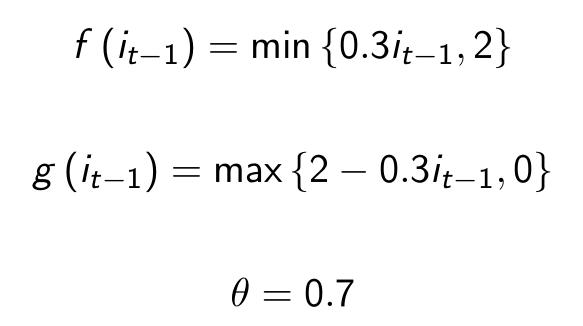
Therefore, a particular specification could be:


These response coefficients are plotted in the following chart. Observe that at the black line when the interest rate is 5, the two Rate Dependent coefficients match the traditional Taylor Rule.


There are three key design features of this specification.

First, the values of these coefficients are fixed in the range between 0 and 2. The logic behind this is to prevent excessive volatility in the interest rate. With these bounds, we also have justification for the slopes of 0.3. Recall that for the original rule, the coefficient on inflation was fixed at 1.5 and the coefficient on the output gap was fixed at 0.5. The modified rule takes on these values only if the interest rate is 5, the historical average of the federal funds rate. Therefore, the modified rule can both be more hawkish and more dovish than the original Taylor rule, contingent on economic conditions. This way, the modified Taylor rule can emulate the magnitude and volatility of the old Taylor rule, but also provide additional flexibility.

Second, when the interest rate is below 3.3, the example above actually violates the Taylor principle. This is no accident. Recall that the logic of the Taylor principle was to allow the central bank to keep a lid on inflation by ensuring that the real rate rises in response to inflation. But if interest rates are already at the low level of 2%, we actually want to encourage inflation so that the nominal rate can stay at the 5% level. Intuitively, this strengthens the negative feedback loop that keeps the nominal interest rate around 5%, giving the central bank more room to operate. 

Third, the interest rate is highly persistent. This is an issue discussed at length in Woodford's work "Optimal Monetary Policy Inertia", and there are two main justifications.

On one hand, excessive interest rate volatility can itself be harmful as agents spend more resources trying to avoid holding money. This is the argument for a Friedman rule for zero nominal interest rates, and although the argument is not as strong in the case, the logic still applies. High nominal rates can be distortionary, and thus their variance should be limited.

Moreover, without persistence it is hard for central banks to signal commitment to future interest rate paths. Future policy would be more unpredictable. Because the rate can change dramatically in response to new conditions, the Fed would not have a framework for commitment. Because one of the key selling points of a Taylor rule is to help guide expectations, to have an instrument that responds too quickly to economic conditions weakens the expectations channel. Therefore, the instrument should be persistent. In my rule, I choose a value of 0.7, which is very close to the value of 0.65 cited by Woodford.

3. Historical Comparisons

This specification is first compared against the traditional Taylor Rule and actual federal funds rate during the Great Moderation and up to the current period. Note that this isn't really a policy simulation. In fact the parameters that are rate dependent look at the actual federal funds rate in the previous period, not the rate-dependent rate. Therefore, this version gives a better picture of how the policy would give advice at each moment in time. In the future, I intend to further investigate the dynamics.


In the top panel are the various interest rates and rules. The red line is the actual effective Fed Funds rate, the gold line is the traditional Taylor Rule, and the green line is the Rate Dependent rule. The panel suggests that this interest rate rule actually fits monetary policy in the Great Moderation very well. In particular, comparing the traditional Taylor Rule with the Rate Dependent rule in the 2003-2007 period suggests that low interest rates may have been the justification for the downward deviation in the Taylor Rule.

The bottom panel shows a running time series with the coefficients in front of inflation (blue) and output gaps (magenta) changing over time. This shows that although the traditional Taylor Rule matches the policy advice of the Rate Dependent rule for the second half of the 1990's, in general they do not always correspond.

Another historical period of interest is the 1970's and 80's. In this time, inflation was far too high. Therefore, an effective rule should call for more hawkish policy. Indeed, the Rate Dependent rule does that. It would have called for interest rates in the 1970's and 1980's to be up to 10 percentage points higher than they actually were, and approximately five percent higher than what the traditional Taylor rule would have called for.

This is similar to what Evan Soltas noted about how a nominal GDP target would have called for tighter policy in the 70's. Even though the Rate Dependent rule would at times call for easier policy to stabilize output, it  is very hawkish when inflation is high. As such, it would still anchor inflation expectations with the promise of disciplined policy when inflation and the Fischer effect push up interest rates in the future.


4. Relationship with Forward Guidance, Nominal GDP Targeting, and a Virtual Fed Funds Rate

Although the Rate Dependent rule fits the historical data quite well, there is one large deviation. In the current environment, the rule says that the Fed should be easing. Hard. While the zero lower bound constrains the Fed from actually hitting the rate advocated by this rule, this does not mean the rule cannot help guide policy. In fact, the greatest appeal of the Rate Dependent rule at the current juncture would be its justification for forward guidance. If the large gap can't be closed with current short term rates, then perhaps it can be filled with future ones.

A Rate Dependent rule frames the current tightness in monetary policy by identifying a large deviations from a rule that fits the historical data. While this method may not be ideal, it shows how even the traditional framework of seeing monetary policy through instrument rules justifies aggressive easing at this juncture. 

Moreover, the theoretical reasoning behind the Rate Dependent rule is much more familiar for those who think in terms of Taylor Rules. Unlike a nominal aggregate target, the Rate Dependent rule is a concrete policy that can be implemented. It helps to assuage the concerns of John Taylor when he complains that an open ended nominal GDP target fails to give "quantitative operational guidance about what the central bank should do with the instruments." This way, the Rate Dependent rule helps to justify additional easing to a broader audience.

This alternate framing also gets around potential credibility issues nominal GDP targeting. This is not to say a nominal GDP target would  not be desirable but a 2012 Dallas Fed paper did bring up some credibility issues with such a target.  Evan Koenig, the vice president of the Dallas Fed, pointed out that the Fed does not have a good record of stabilizing nominal GDP growth. A graph from the paper is reproduced below. 


However, the historical comparisons above clearly show that the Rate Dependent rule is a good description of historical policy. Moreover the scatter plot below clearly shows that the Rate Dependent rule is also a good predictor of what a nominal GDP target would require. Therefore, the Fed can point to this rule and do a monetary two-step. While the Fed foxtrots into a more enlightened nominal GDP target, it can still maintain and demonstrate its credibility to this new policy path by justifying it with the historical experience.


The Rate Dependent rule is also a close cousin of the virtual Federal Funds rate, as advocated by my colleague Miles Kimball. In fact, the two proposals complement each other since the Rate Dependent rule provides a systematic approach for determining the virtual rate. This way, the Fed doesn't just ease when it "feels that monetary policy should be more expansionary." It would ease when it could point to the rule and say that it must.

5. Concluding Remarks

Of course, there is much work yet to be done. The above analysis is very descriptive and requires more formal modeling. In an upcoming post, I intend to discuss more about dynamics and the persistence of this rule. Doing more case study analyses of the rule in historical contexts would also be useful.

Much of the recent push for nominal GDP targets has neglected rules for the instrument. This omission runs the danger of confusion over the steps that need to be taken when a "whatever it takes" policy is declared. The Rate Dependent rule cuts through that confusion. It combines the rule based approach characteristic of traditional Taylor Rules with the recognition that the costs of inflation or output gaps can depend on the interest rate. In bridging various intellectual cousins, this policy forms a stronger basis for monetary easing now, while also committing to smart hawkishness later.

Friday, June 14, 2013

When the Zero Bound Didn't Bind


The zero lower bound didn't always bind. For three months after Lehman's collapse on September 15, 2008, the federal funds rate stayed above zero. In this period of time, the Fed managed to provide extensive dollar swaps for foreign central banks, institute a policy of interest on excess reserves, and kick off the first round of Quantitative Easing with $700 billion dollars of agency mortgage backed securities. Finally, on December 15, 2008, the Fed decided to lower the target federal funds rate to zero.

It is important to remember the sequence of these events. It is easy to think that the downward pressure on interest rates was the inevitable consequence of financial troubles. Yet the top graphic clearly contradicts this. Each of the dotted lines represents a FOMC meeting, and each of these meetings was an opportunity for monetary policy to fight back against the collapsing economy. The Fed's sluggishness to act is even more peculiar given that there were already serious concerns about economic distress in late 2007. As, the decision to wait three months to lower interest rates to zero was a conscious one, and one that helped to precipitate the single largest quarterly drop in nominal GDP in postwar history. The chaos in the markets did not cause monetary policy to lose control. Rather, the Fed's own monetary policy errors forced it up against the zero lower bound.

This is not to say those mistakes were purposeful. But in the high stakes game of central banking, even benign neglect can be dangerous. These failures in the last three months of 2008 can teach us many lessons about what should be done for future monetary policy. Only this way can we be more sure that careless mistakes won't jeopardize the future path of monetary policy.

One of the first steps would be to switch to a nominal GDP target. This would have two primary effects.

First, while this by itself is not a concrete instrument, it would be an important step in giving policy makers more freedom in responding to crises. Our current focus on inflation can cause particularly perverse outcomes when the economy comes under stress. During the September FOMC meeting right after the Lehman collapse and the Merill Lynch merger, in spite of the chaos in financial markets, the Fed chose to leave interest rates unchanged because of concerns about commodity price inflation. After such a long period of worrying economic conditions, the Fed choked because of a relative price change that was beyond the control of monetary policy to tame. A nominal GDP target would be robust to these kinds of shocks and better keep policy on track during the unfolding of a crisis.

Second, a nominal GDP target would also make policy after interest rates hit zero more credible.When the Fed is at the zero lower bound, one of the most important policy levers it has left is to adjust expectations of future interest rates. This is known as forward guidance, and is a consistent theme in the literature. In Krugman's original work on Japan's liquidity trap, he termed this kind of policy "credibly promising to be irresponsible". If this sounds peculiar, you are not alone. John Cochrane observes that
the key to stimulus when interest rates are zero is for the Fed to commit to keeping interest rates low, lower than than we and the Fed know it will want them to be when the time comes.
As a result, the Fed has a hard time committing to its forward guidance because it will want to renege in the future. However, if there were a nominal GDP target, this would remove the pressure to renege. In a sense, declaring a nominal GDP target changes perceptions of what the Fed wants.  By making policy systematic, and not discretionary, we can actually shape expectations and make the current policies of forward guidance and quantitative easing that much more effective.

Sunday, February 10, 2013

Market Monetarism and Finance

As market monetarism starts to become more mainstream, I have started to take some time to think about what yet has to be done to develop this new brand of monetary theory. One issue that recurs in my thoughts is that market monetarism needs to help develop a richer understanding of financial dynamics.

One of the strongest justifications is that a richer understanding of financial linkages would help untangle the dynamics of monetary policy under different regimes. Scott Sumner argues that monetary policy works not with long and variable lags, but rather long and variable leads. Because agents are forward looking, expectations of future nominal GDP significantly affect current economic activity. The strongest evidence for this comes from the financial markets. For the United States, Marcus Nunes has done quite a bit of work charting the immediate effects of monetary policy hints on inflation expectations:


We also see similar evidence in the international arena, whether Japanese, Swiss, Hong Kong, or American.

However, the chart is incomplete. Past studies do suggest that the effect of interest rate cuts are not felt until several months after the initial policy declaration. While there may be identification issues with those studies, they do open up the possibility that monetary policy does not act as quickly as market monetarists would hope. In this context, a hybrid approach may be more accurate. While monetary policy leads the financial sector, it is likely that monetary policy lags in other "real" sectors, such as manufacturing.

This synthesis of both monetary and financial dynamics is especially important given Lars Christensen's argument that "there is probably no better indicator for the monetary policy stance than market prices." We know from the financial literature that certain phenomena, such as excess volatility, seem to defy the typical market monetarist use of the efficient market and rational expectations hypotheses. This is not to say policy would be better guided by the arbitrary decisions of central bankers, but rather that a move to market based signals needs to be grounded on better a theoretical and empirical understanding of how monetary policy and financial signals lead other parts the real economy.

As an example of this, we can take a look at the relationship between TIPS inflation expectations and PCE inflation. For those who don't know, the TIPS spread is the interest rate differential between the 5 year inflation protected treasury and the regular 5 year treasury, and therefore is a measure of what investors expect inflation to be over a five year time horizon.

Under the rational expectations hypothesis, expected future inflation should be a reasonable estimate of actual future inflation. By the efficient market hypothesis, these expectations should then be expressed in the 5 year TIPS spread. However, for the years during which we actually have data on how the 5 year TIPS compared against the actual inflation rate, performance is quite poor:

This evidence suggests that even market forecasts can be unreliable. While they can sometimes be a good indicator of future performance, in other times they can be unacceptably wrong. In the above example, the relationship between the TIPS forecast and actual inflation was so wrong that it was negative. While such data points may be washed out in the long run, the 5 years of flawed predictive capacity that it would have given should give any policy maker pause.

However, the TIPS spread is actually quite a good predictor of contemporaneous inflation. Below I plotted each month's PCE inflation rate with that month's average TIPS spread, and find that the linear prediction (red points) does a good job of measuring current month inflation:

This suggests that while we may not be able to use market signals to predict with precision, market signals do carry significant information content. Instead of waiting for each month's CPI report with bated breath, we could simply consider the financial data that is always available to us. This resembles my conclusion from looking at forecaster data. Given that we have reasonably accurate forecast, monetary policy should target those forecasts. When bad forecasts come in, central bankers can signal that they are ready to ease monetary conditions if the bad conditions materialize themselves. The trick here is to make sure that the information hiding in market prices can make its way into policy, and a better understanding of the relationship between finance and macro is an important step in that direction.

Monday, January 14, 2013

Forward Looking Markets in Japan

Even though Shinzo Abe has not yet cemented in a new era of Japanese monetary policy, markets have already been preparing for such an event. The market response is a good illustration of how markets act in a forward looking manner.

First, we need to identify when the international community started to focus in on Shinzo Abe. For this, we can look at Google's international search intensities:


From here, we can identify the time around December 15th to be the starting point. Now let's take a look at how markets have responded since then.

First, the exchange rate. Easier monetary policy raises aggregate demand, accelerating NGDP growth and depreciates the currency. Even though the statutory monetary policy framework hasn't changed, the yen has already lost around 7% of its value relative to the dollar since December 14th:


Exhibit 2, the Stock Market. In the same time period, the Nikkei 225 index has risen over 9%. To give this some perspective, almost one-third of the gains over the course of the past year have been the result of the past month of advances.


These statistics are quite striking when you think about the policy controversy surrounding Japan's "lost decade" and the hundreds of trillions of yen that went into public works programs.

Also, these statistics are quite interesting for the "long and variable leads" perspective on monetary policy. Historically, the money supply has not had a large effect on real variables such as GDP. In fact, if you really dug into the 5 year rolling correlations, you would find that, most of the time, quarterly money supply growth actually had a negative correlation with quarterly real GDP growth in that period.


Yet just in the past month, a few "open mouth operations" have seemed to dramatically change market perceptions of monetary policy. This suggests that the mechanical money printing is quite powerless without effective expectations management. As such, there should be significant gains to Shinzo Abe's drive to change the Japanese monetary regime.

On a separate non-economic, purely speculatory note, I'm not sure how the nationalism issues brought up by Noah Smith would interact with this drive to make monetary policy more inflationary. On one hand, if monetary policy is seen as a driver to achieve national ambitions, then the nationalist drive may reinforce the increase in aggregate demand. That would be good. But the worrisome possibility, which worries me more than the possibility that Shinzo Abe will give up on monetary policy, would be that the monetary policy stimulus will be too effective and further stoke nationalist ambitions. The last thing we need is some stupid quibble over the Diaoyu islands that leads to a face-losing and economy destroying outcome for everybody.

Update 1/19/13:

Scott Sumner emails me with the following comment:

"Abe actually started pushing for a 2% inflation target during the campaign, in mid-November. The day of his first speech is the exact the the huge stock rally began, and the exact day the yen began falling sharply. I did a post that day, or perhaps the next. 
http://www.themoneyillusion.com/?p=17736 

It's hard to disentangle money printing and expectations. Think of the following thought experiment: The central bank doubles the money supply and is expected to cut it in half 3 days later. Everyone agrees that there is little effect on markets or AD. So in some sense we are always implicitly making assumptions about monetary policy. On the other hand, I can easily envision where big changes in the money supply also contain information about future expected monetary policy, even if not made explicit. So I can envision QE "working" at least to some extent, even w/o an explicit promise regarding future policy."
Looking back at the data, I should have been more careful with the timing issue. Although the November 15th spike looks minimal, it is only because the December spike was much larger. Focusing in on that one month of the Google data yields the following graph:


On the relationship between money printing and expectations management, I agree with Scott that money "printing" policies, such as QE, can have significant effects even without explicit open mouth operations. The Fed doesn't need to announce a NGDP target for those policies to have effect. But the point with Japan is that effective communications policy can enhance monetary policy. Given that money supply expansion hasn't been sufficient in the past, perhaps a more powerful target will do the trick.

Friday, September 28, 2012

The Fed Should be a Day Trader

According to  Philadelphia Federal Reserve President Charles Plosser, the economy is "immune" to the Fed's stimulus efforts. Therefore we shouldn't even try to ease. I think Matt Yglesias does a very good job with responding to this argument, so in this post I want to draw attention to another fallacy Plosser makes that, as a result, makes the shift to a forward looking monetary regime even more important.

From a Thursday morning interview, the WSJ represents Plosser's views as:
“Monetary policy shouldn’t be a day trader,” Plosser said Thursday morning in an interview with Dow Jones Newswires and The Wall Street Journal. “I don’t think that’s a healthy focus for central banks…Policy making is too focused on short-term and not long-term views.
On face, it seems sensible. Of course the Federal Reserve shouldn't act in an erratic manner like a day trader, and of course it should focus on long-term views. But does one imply the other? I would say no -- to focus on long-term views, it makes sense to act like a day traders and look at real time market expectations of the long term.

Specifically, it should make sense for the Federal Reserve to worry about long-term inflation expectations, as they, by definition, represent the long-term views of the market. Given that the 5-year breakeven is barely above 2%, this means that, given what the market perceives of the economy and policy interventions, annual inflation is forecasted to be around 2% for 5 years. Given that inflation since the 2008 peak has been around 1.1%, a period of higher than average inflation should not be problematic. By the premise of efficient markets, the relatively low breakeven suggests that the Fed should take additional action. Perhaps there is some argument for why the breakeven is skewed, but traditional deviations from efficient markets, such as momentum trading, does not seems to form the basis of any of Plosser's arguments.

Plosser's comments also point out a more glaring hole: if the Federal Reserve isn't going to use indicies looking forward to guide monetary policy, what should it do instead? If we aren't allowed to forecast using the knowledge of the market, then the Fed is left to waiting for the data to come in and then to adjust economic policy many quarters after the original shock. This is actually worse for long-term views, as it opens the possibilities for downside for the financial market that isn't controlled for with policy.

To improve on the current situation, we could subsidize and construct an NGDP futures market in order to measure market expectations of future NGDP growth, and then the Federal Reserve can use those futures as a leading indicator on whether they should ease or tighten. These futures can even help in the unwinding process, as it lets the Fed know when the money supply has increased too quickly even before the actual numbers come in. Acting like a day trader is not inconsistent with an appreciation for long term fundamentals - the trick is to find a day-to-day measure and then use it to put the economy on stable, long run foundation.


Friday, September 7, 2012

Cochrane: "Woodford Needs to Fight Harder!"

When reading John Cochrane's critique of Woodford's call for NGDP targeting, I felt it was actually a great justification for why Woodford needed to write that paper, and for why the market monetarist project is something that we need to continue to fight for.

Cochrane's largest argument rests on a credibility argument -- that there's no way for the Federal Reserve to credibly commit to a permanent expansion of the monetary base, because the market expects that the Fed will tighten to reach 2% inflation in the future. As a result, because there's no way to effectively change expectations of the future monetary base, there's no way to change the level of present NGDP.  In the words of Cochrane:
How can the Fed promise today to do something it will very much regret tomorrow, and get people to believe that promise?  More deeply, how does the Fed commit to allowing "just a bit" of inflation in the future, and not starting down the path of the 1970s again?
Cochrane must know that hose are two very different questions! When we call for a 5% NGDP target, we're not calling for the path of the 1970's -- to say so is a complete straw man. Thus, the real question is how do we convince people that the Fed won't tighten in response to mild inflation. And to me, the answer is simple: declare that the Fed is targeting NGDP.

Why? Because all of the current analysis on credibility and promises implicitly assumes that the Fed is targeting inflation! Of course, an inflation targeting Fed's promise to hold rates low until an NGDP target is hit is not credible because everybody knows the Fed will tighten in response to the higher level of inflation. If, on the other hand, if people know that the Fed is willing to tolerate higher levels of inflation because it is in their mandate, the credibility problem will go away.

The problem is that everybody is looking at the standard loss function for inflation and arguing that NGDP targeting doesn't minimize the function. If you're just trying to minimize the squared deviations from 2% inflation, of course an NGDP target is nonsensical; an NGDP target actively encourages deviations from 2% inflation to correct for past mistakes. However, if the loss function is seen as the squared deviation of actual NGDP from trend NGDP, then the promise to target NGDP is much more logical.

Formally, if the Fed's optimal policy is described by minimizing this:

(π - 2)2

Of course the Fed won't manage to minimize this:

(Y-Ytrend)2

This is why Woodford's paper is so important. It's the first step towards convincing economists and market participants that the Fed's loss function is changing. Given that Woodford presented the paper at Jackson Hole, the premier meeting on monetary policy, the paper is a key step in signalling that NGDP targeting is gaining legitimacy.  If successful, people will realize that the Fed's new policy will tolerate a temporary inflation increase in order to bring NGDP back to trend. No longer does the Fed have to "credibly promise to be irresponsible", it can just change the definition of responsibility. 

So when Cochrane argues that NGDP targeting is flawed because the Fed can just go back to inflation targeting, what he's actually saying is that academics should fight extremely hard to legitimize NGDP targeting. When a monetary policy that targets NGDP becomes as self-evident as one that targets inflation, it will be no difficulty to credibly commit to a new monetary regime.

Tuesday, August 14, 2012

How Does Paul Ryan Want to Target Inflation?

He would have to use Quantitative Easing anyways

While my previous post talked about the variety of ways Paul Ryan should prefer an NGDP target over an inflation target, I realized that a lot of the Fed's policies that Paul opposes would still be necessary in a world of inflation targeting. In his 2010 Op-Ed with John Taylor, he called the quantitative easing programs  "departures from rules-based monetary policy" that have "increased economic instability and endangered the central bank's independence." But would strict inflation targeting really solve the problem?

Below I've created a graph plotting quarterly annualized headline CPI inflation which includes commodity prices, the 2% inflation target, along with zones indicating when the two quantitative easing programs were hinted at and then executed. The dates for the QE announcements were taken from a conference paper, and they are used to show how policy and inflation were related.


As you can see, for much of the past four years, headline inflation was significantly below the 2% target traditionally set for the Fed. In response, the Fed hinted at the quantitative easing programs and drove up inflation. Yet Paul Ryan opposes these policy interventions. The question that I pose to Paul Ryan and his supporters is "what would you have had the Fed do during those time periods?" The short term interest rate was already at zero, so what would Ryan have suggested to fulfill the mandate? Paul would have been forced into unconventional monetary policy such as QE or Operation Twist just to fulfill his proposed mandate!

Under these conditions, there's no reason for Paul Ryan to not opt for an NGDP target instead. If you're going to be using unconventional monetary policy tools, you might as well use them to target a metric that is critical for stable, robust growth. An NGDP regime would be simple, rule based, and verifiable. So when choosing a monetary policy regime, why not NGDP level targeting?

Thursday, June 14, 2012

Can You Tell Me How to Get, How to Get to NGDPLT?

How quickly can bank reserves unravel?

Why are we always focused on the equilibrium, but not the disequilibrium dynamics that get us to that point? Noah Smith made this point in an old post about DSGE models, but it seems like there's a similar problem when it comes to an NGDP target. No doubt, in the end, an NGDP targeting regime would have incredible benefits, but how do we first get there? Specifically, how does the Fed adjust its balance sheet so that it doesn't trip on the "concrete steppes"?

Given the large expansion of the monetary base through excess reserves and IOR, the Fed cannot simply let all of the expansion become permanent. If the expansion were permanent, one would expect prices to be about four times higher than they were in the beginning of 2000. While I certainly support higher levels of inflation to support real growth in recessions, even I find that much inflation a bit unpalatable. It would certainly go beyond the 5% NGDP target that most market monetarists advocate and would result in massive political backlash. Most tragically, this would discredit the entire market monetarist enterprise, jeopardizing one of the most important revolutions in stabilization policy.

Thus, how do we control this unwinding? The typical market monetarist response is that a credible NGDP target establishes a bound on the expansion. The target can anchor market expectations to prevent inflation from getting out of control. But what happens when the policy is not fully credible? Again, I don't mean to say the central bank can not inflate. My concern is with the other side of the target and the possibility of above trend NGDP growth. When you're dealing with such a large expansion of reserves, you need to be cautious with how much is unwound as well as how quickly it takes place.

Ala Eggertsson-Woodford, we know the permanence of the monetary expansion is the critical determinant of the path of NGDP. This is confirmed in some private email correspondences, which brought up the possibility of banks paying higher dividends, or perhaps even venture capital as outlets for bank reserves. However, those options are not viable if the reserves aren't seen as permanent. A particularly striking line was:

The standard Keynesian story has been that in a zero interest-rate economy, it makes perfect sense for government to borrow a ton and invest now, because low rates don't last forever; well, guess what, it makes sense for the private sector too. Both the government and the private sector can think of ways to use more money, and if it wouldn't hurt for government to borrow and spend more, it won't hurt for business to borrow and spend more either.

While this means a credible expectations based regime can easily inflate, it should also remind us that controlling inflation and NGDP growth can be a non-linear task, subject to type-2 extremistan variation. We're not playing with bank balance sheets as much as we're playing with bank's beliefs. Beliefs can change on a whim. Once a certain threshold of expectations or interest rates are passed, banks will rapidly unwind their excess reserves and put their money to use. There is a critical level that we cannot observe, but once we pass it the monetary effects will be significant.

A possible argument out of this problem is that, if the banks knew what fraction of the reserves would be taken out of the system, they could plan ahead so that they don't expand by too much. However, the market is not a platonic game. There is no social planner that will only take a fraction from each bank; the banks have to reach a decentralized solution. Assuming each bank's reserves are small relative to the total stock of excess reserves, it would be in the interest of each bank to spend all of their excess reserves into higher yield assets or dividends so that they can take advantage of the limited permanent expansion of the base. It would be incredibly difficult on the part of the banks to coordinate, because how would they know the level of NGDP? Moreover, if the NGDP level overshot, why should private agents expect the Fed to step in? If central banks are inertial, the credibility of the NGDP target could be compromised. The FOMC only meets eight times a year, how could policy direct the path of NGDP well enough?

Fundamentally, there's two uncertainties that NGDPLT has to deal with. First is a band on the rate of NGDP growth. It can vary around the 5% goal. Second is the band on the timing of when the target is hit. If central banks are slow on adjusting policy, the market may see a bubble opportunity and jump in to make money. Timing is especially problematic because it's something that can cause bubbles even when market participants are rational about fundamentals.

To get around these problems, NGDPLT has to be implemented in a very careful fashion with strong forward guidance on what market participants should expect in terms of NGDP. Scott Sumner often discusses proposals for NGDP futures to help guide policy, but given these disequilibrium dynamics in the transition to NGDPLT, the futures markets are actually a prerequisite. Importantly, these NGDP futures should give information over a variety of time horizons, so banks, both central and private, can know more and plan for the future. With all this information, the central bank would need to be much more active in tuning the rates. While the instability of the rates might seem problematic, they would be instrumental in proving the credibility of the central bank in maintaining a smooth transition. This transition should also be slow, so that the return to trend growth is not too sudden. Thus, NGDP growth does not need to speed up too quickly before it's identified as "overshooting" the path that the Fed plans. It's not a simple act of "shooting for it". The Fed's balance sheet is incredibly large, so we need to be careful so that the easing process does not cause too many problems.

There is little doubt that a credible NGDP target regime with a small monetary base will yield incredible benefits for stabilization policy. But we can't let the perfect be the enemy of the good, and such a regime shift will require great caution.

Thursday, May 31, 2012

The Danger of Promises

Promises are powerful, so don't make a promise you can't keep


Evan Soltas had an interesting post on the power of promises in the context of currency bands and monetary policy, but we should also remember that banks shouldn't try to make promises they can't keep. We all should be very worried when we see graphs that show sudden decreases in volatility, as Evan shows in his post. Whenever policymakers suppress volatility, we need to wonder where those pressures have gone, and why they have disappeared. More often then not, manufactured stability leads to calm periods punctuated by sudden change; they become Type 2 extremistan regimes, as pictured below:


So why did the currency peg work? The peg only makes sense in the context of Scott Sumner's argument that the currency peg is a form of monetary policy commitment. The undervalued currency increases aggregate demand, thereby filling the output gap. However, it should be observed that, given the undervalued currency, maintaining the peg leads eventually to above trend NGDP growth and an economy that's running "hot". However, the "hot" economy would call the currency peg into question. This is a classic example of Mundell's policy trilemma. The SNB cannot pursue an exchange rate peg, independent monetary policy, and capital mobility at the same time. Conditions are stable now only because the exchange rate peg matches the objective of an independent monetary policy. However, once the output gap starts to narrow the credibility of the exchange rate peg will be questioned.

This is where the expectations channel starts creating weird dynamics. If the market expects the SNB to pursue monetary policy that prioritizes internal conditions, then the market should expect that currency to appreciate in the future as the output gap is filled. However, because of inertial central bank policy, this will only occur when the currency is undervalued to such an extent that it is no longer feasible for the central bank to maintain the peg. At that point, we should expect to see a very sudden adjustment as the SNB comes under fire from speculators. This then creates a vicious loop, as the SNB's attempts to maintain the peg only increase the supply of currency, of which speculators buy increasing amounts as they now know that the currency will appreciate.

When the SNB is forced to rebalance the currency, it will shake up markets as it unwinds its large balance sheet of foreign assets. Since the bank would have been accumulating these assets for a long time, their sudden liquidation is likely to be a "fat tail" event, which, on one hand may not cause that much damage, but on the other hand may cause positive feedback loops to devastate markets in unknown ways.

While this analysis is in the specific context of the Swiss central bank, this argument has implications for NGDP targeting in developing countries as well. The problem with the SNB's currency peg is that it prioritizes one objective (exchange rate) over all others (including NGDP). However, when domestic politics rears its head, a internal measures such as NGDP will end up trumping external measures such as the exchange rate. The crisis arises from a sudden reversal in priorities.

This exchange rate-NGDP tension is very important for developing economies. If these countries pursue capital mobility, then they may need to compromise part of their monetary policy to maintain an exchange rate band. Thus, this is another source of possible fragility in a NGDP target, as other objectives, such as the exchange rate, suddenly come to the forefront.

Edit: Evan Soltas gave me a further explanation on how the "peg" is really a floor, as well as an explanation of the general macro conditions in Switzerland. I failed to take the time to analyze them, so the conclusions are slightly different. There's still possibilities of non-linear dynamics, and those are explained in the comment thread. I've also written a new post reflecting back of these issues here.

Monday, May 21, 2012

Complexity in Monetary Policy: The Mechanisms Do Matter

Beware manufactured stability: "expectations management" is inherently fragile

A recent working paper adds to the discussion on monetary policy and growth.  In the model, monetary policy affects growth by allowing credit-intensive industries to engage in larger projects.  It does so by easing liquidity needs and, thus, giving firms the "breathing space" to invest.  The paper finds evidence for this by looking at industry-level financial constraint variables as well as the performance of the industry in response to monetary policy.  The key finding is that countercyclical monetary policy can have a significant positive impact on long run productivity growth, especially for recessions.  This result is robust to controlling for:

...the interaction between these measures of financial constraints and country-level economic variables such as inflation, financial development, and the size of government which are likely to affect the country’s ability to pursue more countercyclical macroeconomic policies (5).

Moreover, the regressions shed light on another unique internal link from monetary policy to growth: countercyclical monetary policy promotes higher levels of R+D spending.  While the model explains it through liquidity needs, the concept of "signal-processing" causing firms to invest inefficiently likely applies.  This suggests that if we really are in a "great stagnation" of growth and innovation, a stable nominal economy vis-a-vis monetary policy will be increasingly important.

To extend the model, if monetary policy exerts a diverse range of effects on what is considered money through safe asset creation, the effect of countercyclical monetary policy is probably stronger than what the interest rate would state.  By increasing liquidity through countercyclical policy, this allows firms to invest more:
The intuition for this proposition is simple. Firms need to hoard liquidity in order to weather liquidity shocks if the aggregate state is bad. This liquidity hoarding is costly...because of the lack of commitment of consumers. Reducing interest rates in bad times lowers the amount of hoarded liquidity, by increasing the ability of firms to leverage their net worth. This effect is weaker when the aggregate state is good because in that state, short-term profits are enough to cover reinvestment needs so that no liquidity needs to be hoarded to weather liquidity shocks that occur in that aggregate state of the world. Hence a higher marginal benefit of reducing interest rates in bad times relative to good times. This effect is strong enough to overcome a countervailing effect arising from the fact that lowering interest rates in bad times leads to an implicit subsidy from consumers to entrepreneurs, explaining that optimal interest rate policy is countercyclical (14, my emphasis).
And now the Nassim Nicholas Taleb homonculus starts screaming into my ear.

To what extent does this mechanism of monetary policy just create more interlocking fragilities?  I've previously argued that one of the problems with NGDP targeting is that it hides the complexity of the ecology of markets.  In this model, the world is encouraged to increase complexity because of a monetary regime that promotes more stable growth.  The firms with "unshakeable" expectations can leverage themselves to the hilt to try to maximize future growth.  But finance is fragile; what would happen if an unseen risk arises?  More seriously, although a debt crisis would wipe these firms out, nobody would be able to tell in the short run while those debt instruments are still there.

The issue here is that "average growth" is nowhere near as important as "variant growth".  While growth is stable most of the time, the impact of tail events rises as markets become more interconnected.  Leverage is inherently dangerous in an interconnected world because it enables complex cascading effects that go beyond the ability of our models to predict.  This uncertainty is heightened by the fact that even slight miscalibration errors can cause monstruous miscalculations.  These problems aren't solved by monetary policy either because financial crises are aggregate supply problems.  If credit mediation crashes, resources are no longer allocated efficiently, raising unit costs for all factors of production.

A possible way to get around this is if we can commit to more equity instead of leverage.  From Taleb's 10 principles for a Black-Swan free society:
5. Counter-balance complexity with simplicity. Complexity from globalisation and highly networked economic life needs to be countered by simplicity in financial products. The complex economy is already a form of leverage: the leverage of efficiency. Such systems survive thanks to slack and redundancy; adding debt produces wild and dangerous gyrations and leaves no room for error. Capitalism cannot avoid fads and bubbles: equity bubbles (as in 2000) have proved to be mild; debt bubbles are vicious.
This way, the net worth of companies can be converted into equity stakes, and funding can be obtained this way.  Given the outsize role of large events, this shift to a more black swan free society should occur before the adoption of monetary policies that could increase fragility.  In this world, monetary policy would allow for increased efficiency of markets while also preventing Black Swans from coming to roost.

Thursday, May 3, 2012

Semi-Liquid Money: A Regime Dependent Medium of Exchange

Money is quite the slippery liquid asset.


How does money work, and how does this relate to NGDP targeting?  Jim Hamilton recently criticized NGDP targeting as a regime without concrete foundations.  What's special about the asset purchases that would, in and of themselves, lead to an increase in NGDP expectations?  Brad DeLong got back on the issue, and commented that the key reason for why the Fed's purchases can have an effect is that the Fed can purchase assets that will not be as liquid outside of the zero lower bound.  In effect, the key transmission mechanism is the provision of liquidity for non-liquid assets, which then commits the central bank to a higher money supply in the future.

Liquidity also played a key role in a recent paper by Kiyotaki and Moore on how monetary policy affects an economy.  In their model, agents in an economy hold two assets: money and equity.  In each period, one can expect to be able to dump one's entire stock of money.  However, this does not hold true for equity.  Money is money because it is liquid.  Is currency money?  Yes, because I can spend it.  Are demand deposits money?  Yes, because I can withdraw it and go spend it.  Are stocks money?  Yes, as long as the market is stable and I can sell them.

This framework leads to a simple conclusion: what qualifies as money is regime dependent.  M1, M2, M3...M9001...M have no real meaning without knowledge of the monetary regime.  Are money market funds the equivalent of deposits at a commercial bank?  Well, for most of history, yes.  But when the market goes down and there is a flight to safety, money market funds lose the liquidity that makes money money.  An old physicist joked "Imagine how difficult physics would be if electrons could think?"  Under different monetary regimes, money can "think" in different ways!  Depending on the expectations of the agents in the market, what is considered money can quickly change.  As a result, what used to be money begins to behave in a very sporadic manner.

If money can change, old monetarist definitions of money supply make no sense.  Because what is considered "money" changes with the monetary policy regime, trying to use monetary policy to control the path of the money supply is circular!  Because there exists a continuum of assets with differing liquidity, there's no logical spot to use to mark the division between money and asset.  Even houses can be money if the market is deep and liquid enough.  If houses become important as a source of collateral, a collapse in the housing market can have effects similar to that of a monetary contraction.

In this light, Scott Sumner's argument that the tightness or looseness of monetary policy should be determined by macroeconomic conditions becomes much more concrete.  If money is now a continuum of assets with different levels of liquidity, then the stance of M1, M2, or the interest rate on any given asset become useless for determining the stance of policy.  When people point at the stock of M1 and M2 and say that monetary policy has been very loose, they miss the bigger picture that includes debt rehypothecation and the lack of safe assets.  Because there's no way to comprehensively evaluate all of these interactions on the asset level, the only way to judge monetary policy is by the final macroeconomic outcome we care about: NGDP.  Additionally, because the regime is so important for the behavior of money, more focus needs to be placed on finding the right monetary regime and less on the specific day-to-day actions.

Monetary policy must stabilize NGDP.  One way it does so is by affecting the continuum of liquidity and the assets that can serve as money.  Markets matter.  Money matters.  And most importantly, Regimes matter: for both monetary policy and the money it manipulates.