Showing posts with label Financial Regulation. Show all posts

Saturday, February 8, 2014

Why Monetary Policy Should Ignore Financial Stability

Financial stability is apparently the new hot reason to tighten monetary policy, and in this article for Quartz I go in on some reasons for why this is a horrible idea. An excerpt
Janet Yellen’s confirmation hearing showed signs that US monetary policy will soon adopt a third mandate. She said: “Overall, the Federal Reserve has sharpened its focus on financial stability and is taking that goal into consideration when carrying out its responsibilities for monetary policy.” While Yellen has traditionally downplayed this mission, the December FOMC meeting minutes also revealed a growing chorus of FOMC participants who believe that monetary policy should do more than just ensure full employment and price stability. Rather, they believe that monetary policy should look out for bubbles and pop them before they jeopardize financial stability. 
At first glance, this sounds like a good idea. After all, who wants financial instability? 
But back in 2002, Bernanke outlined several reasons why tightening monetary policy in response to bubbles is unlikely to work in practice. First, there’s no reason to believe that the Fed can accurately identify bubbles in advance. Second, even if a bubble appears, it’s not clear that raising short term interest rates could pop it. Third, even if monetary policy ends up bringing asset prices down, it is likely to do so only through hurting the livelihoods of average Americans.
Something that should be added, though, is that I still believe research on how monetary policy affects financial stability can be useful. Such research can help us better understand how monetary policy transmission might work, and what things regulators should look out for as the monetary policy landscape changes. However, none of this is any reason why the central bank should base the stock of money on the caprices of the financial markets.

Saturday, July 6, 2013

The Role of Financial Institutions

The real world of finance is not populated by the financial traders of model fame. Numerous studies in behavioral economics have identified what appear to be deviations from fully efficient markets with rational individuals. On the individual level, we know that overconfidence leads male traders to trade much more than female traders, and this has a negative effect on their returns. Therefore agents don’t seem to be optimizing -- rather they have their own idiosyncratic, but systematic, biases. On the market level, stock prices seem to exhibit strong short-run momentum while also appear to have long-run mean reverting growth rates. This suggests that there’s something going on with market participants that encourages overshooting in the short run but with corrections in the long run. 

But what has gotten me curious over the past few months is the institutional aspect. In my view, because financial markets are actually populated by institutions that have their own quirks, financial markets can deviate from textbook models in very policy relevant ways.

Most financial models that I have read about are populated by individual investors looking to maximize some expected future consumption stream subject to various constraints. Sometimes these constraints stick to describing feasible budget allocations,and sometimes they also include cognitive biases. But Wall Street doesn't look like this. Traders rarely trade by themselves -- they are usually a part of a large firm. These firms may also have different goals. Some, such as hedge funds, are just in the business of generating pure return whereas others, such as pension funds, are looking to maintain a steady stream of payments to pay out to their customers. Given that these firms have their own institutional demands, this suggests that their trading strategies could be quite different. These structural differences has implications for market efficiency.

Past papers have of course addressed some of these issues. On a within-firm basis, work on the principal-agent problem has shown how compensation schemes can affect fund manager behavior. This would suggest that many financial managers maximize not the utility of the investor, but their payoff in the compensation scheme. Some past work has also indicated that institutional investors, in this case mostly pension funds, do not seem to exhibit the herding and destabilizing behavior that for which they are criticized. However, some of these benign results are being challenged in the recent financial crisis, and this could have major implications for both financial research and monetary policy.

As an example, there have been a set of recent popular articles from the Economist and FT Alphaville on the notion of VAR shocks. VAR is a measure of financial risk that (theoretically) measures the worst case outcome for a firm. For example, a 5% weekly VaR of $5 million means that there should only be a 5% percent chance that the firm will lose more than $5 million over the course of a given week. This typically can be calculated by parameterizing a loss distribution with historical data on volatility and average yields. Even though this measure can mislead by ignoring the amount that would actually be lost in a worst-case outcome its simplicity makes it a natural candidate for institutions to use as a check against overly risky trading strategies. Therefore market moves that can impact the measurement of VAR are natural candidates for making the institutional investors jump.


Pioneering work by Hyun Song Shin, an economist at Princeton, analyzes the role of VAR and argues that it contributes to market procyclicality. Because historical data is used to calculate the VAR that goes into risk weighting, banks may end up levering up their balance sheet just as the business cycle starts to rev up and deleveraging just as the entire cycle comes crashing down. The rising tide of the business cycle makes their VAR look much smaller, therefore allowing them to put smaller risk weights on their assets. Now that the size of risk weighted assets has fallen, banks can play the risk-weighting clause on capital requirements and fund themselves through more debt. This continues until the cycle breaks, at which point VAR measurements are shocked upward by the historical data, forcing a deleveraging in order to meet capital requirements, thereby amplifying negative effects on the business cycle. In particular, this story fits the recent financial crisis very well. Past decades of relative calm made the VAR models docile and ready for the slaughter that was 2008.

I see this as an institutional bug because there’s no efficiency reason why VAR should be used in such a way to risk-weight assets. It does not make for an omniscient Q-measure to identify risk. Rather, VAR is useful because it helps institutions streamline their risk analysis. By doing so, it quite possibly improves an individual firm’s performance by avoiding worse evaluation methods. But with the procyclicality argument made above, it should be clear that a group of banks all using VAR to risk weight their assets end up creating severe negative externalities on the business cycle.

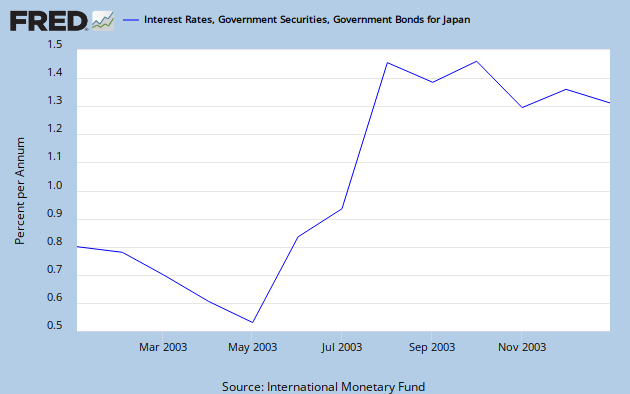
VAR shocks have also popped up in the Japanese case. Back in the 2003 bond yield volatility spike, many Japanese banks ended up selling bonds as the volatility triggered their VAR limits. This intensified the cycle of bond selling until other investors, such as pension funds and insurance companies bought up the bonds and stabilized the market. This serves as another real world example of Shin’s theory that the use of VAR in institutional settings ends up intensifying market volatility.


It should also be clear that the institutional quirks can occur in financial markets with rational arbitrageurs. If the size of institutional flows are large enough, then it may be worthwhile for the smaller traders to just ride the flows to higher returns. There may just not be enough incentive to normalize prices. If the market can stay irrational longer than individuals can stay solvent, then an individual is likely better off to just play along with the market. Given thta we see this kind of serial correlation with hedge funds in the tech bubble, the risk of individuals riding along with the irrationalities of institutions should be taken seriously. In fact, I would go far enough as to argue that the burden of proof is on those who would like to defend their financial models with only individual investors. Given that we know the real world doesn’t work like that, and that this difference can result in dramatically different conclusions, the burden must on the traditionalists to show that models of individual investing can subsume those of institutions in most cases.

To measure these effects and to calibrate new models, attention should be focused on the flow of funds in and out of these institutional investments. This way we could have a better notion of relative size and be able to measure if and how much institutional procyclicality affects markets.

I see two main policy implications of this alternative approach. First, the VAR specific quirks create a further justification for strict capital requirements. Only this way can the risk weighting problem be robustly solved. In terms of monetary policy, a thorough understanding of these institutional quirks can help guide the direction of policy. As monetarism starts to integrate more markets as data points, it becomes more and more important for central bankers to know how to interpret the financial data that comes in. By knowing what’s signal and what’s noise, central banks can better conduct forward looking policy.

In all these examples, we see how institutions -- not individual traders -- can end up driving markets. This marks a departure from traditional finance models in which everybody is just an individual playing the market. It is my hope that this kind of analysis will be useful for understanding causes of market inefficiencies and the optimal framework for financial data in monetary policy.

Thursday, July 4, 2013

Capital Requirements and Nominal GDP Targeting

The Federal Reserve has recently moved to tighten capital requirements for banks, and I see this as a long overdue move. While others have done a very good job summarizing the minutiae of the various ratios, I want to explore what capital requirements really mean and, more importantly, what implications these requirements have on monetary policy.

First, we should be clear on what capital really is. Despite phrases such as “capital cushion” or “holding capital”, capital holdings are not the same as reserves. Capital is meant to describe a type of funding structure, not an asset allocation -- a liability, not an asset. So what is truly at stake here with the capital requirements debate is how banks fund themselves: through equity or debt.

The argument for higher equity funding comes down to reducing the incentive to run on the banks. Because debt liabilities are fixed, creditors are likely to demand their money back at the first sign of trouble. On the other hand, if the funding comes from equity, there is no similar compulsion to run, thereby preventing the fire sale spirals that characterise financial distress.

To visualize this, consider the following bank balance sheet. On the left we have the funding sources -- debt and equity -- and on the right we have the assets. In this first diagram, we see a bank that relies heavily on debt funding (95%) and has very little equity (5%) -- a situation characteristic of many banks today.

Figure 1: Highly Leveraged Bank

If the bank’s assets lose value and drop by a small amount, say 7%, because the debt quantities must stay constant, then all of the equity is wiped out and the bank is left insolvent. On the other hand, had the bank financed itself through mostly equity, then the bank would have stayed solvent and not all the equity would have been wiped out. There would have been less of an incentive to have a run on the debt and, in a time of financial stress, the bank would have avoided a fire sale. These examples illustrate why high levels of debt financing can be so problematic in a system of hard to calculate risks.

Figure 2: Insolvent Bank


Equity funding prevents sudden runs and insolvency. That is the key justification for stricter capital requirements. With this in mind, I now turn my attention to the relationship between these new financial regulations and monetary policy.

The most important relationship between capital requirements and monetary policy is that capital requirements make the financial stability and “reaching for yield” arguments against monetary easing so much weaker. If institutions are well capitalized, what are we scared of? Equity bubbles, like the 2000’s dot com bust, do not leave lasting damage. However, debt bubbles, such as the 2008 financial crisis, can trigger an extended period of deleveraging and general economic malaise. Much as Scott Sumner has recommended, capital requirements can help keep the finance out of macro. While I personally believe insights from the financial literature may reveal more light on the mechanisms of monetary policy, I do agree that the task of monetary policy should stay very separate from that of financial regulation. Monetary policy makers can direct the guidance of interest rates towards maintaining a stable level of nominal output, whereas financial regulators focus on making sure the banks do not fall apart. If institutions are reaching for yield, leave it for regulators to cut the arms off. The monetary authorities need not pay any attention to it.

Even if these capital requirements are not implemented, the mere prospect of them greatly weakens the case for using monetary policy for financial stability purposes by exposing a contradiction: if monetary policy is surgical enough for financial markets, why aren’t capital requirements?

In Jeremy Stein’s February speech on monetary policy and financial stability, he argued that it may be appropriate for monetary policy to prevent bubbles. One of his key justifications was that monetary policy can “[get] in all of the cracks” of financial markets to stamp out bubbles. However, this neglects the bluntness of monetary policy.

In my view, to the extent that interest rates get in all the cracks, they do so by reducing the financial edifice into rubble. But if I am wrong and if monetary policy is indeed precise enough to stamp out bubbles without collateral damage, then aren't capital requirements even more surgical? Indeed, while monetary policy can affect the entire economy’s consumption and investment behavior, the Mogdiliani-Miller theorem suggests that changes in the capital structure would barely have an effect on those macroeconomic aggregates. The greatest irony is that the financial types who support tighter monetary policy to control financial risks are often the same ones who are against stricter capital requirements. But these views are inconsistent. Capital requirements are tailored for financial regulation, and to the extent one supports the blunt use of monetary policy, one should support the strengthening of capital requirements even more.

On the other hand, while capital requirements may make the task of monetary policy easier, some have argued that the reduction in credit from the stronger capital requirements goes against the goal of expansionary monetary policy. First, I do not believe this is true on a purely finance theory basis. As has been discussed elsewhere, higher capital requirements are unlikely to increase funding costs. To the extent that they do raise funding costs, this reflects an efficient reduction in the government’s implicit subsidies for bank debt. Second, even if this were the case, we should remember that monetary policy is not credit policy. If there is a reduction in credit, the question for the monetary authorities is whether this reduces nominal GDP. Depending on that, the Fed should ease or tighten. Therefore, a well functioning monetary policy should fully offset the potential impact of credit shocks. The level of credit in an economy is a matter of financial organization, something far outside the domain of monetary policy. The Fed should adjust the path of interest rates depending on where they want to see nominal GDP go.

While the above discussions focus on how capital requirements make monetary policy easier, I also believe better monetary policy, especially through a nominal GDP target, can help make capital requirements simpler. It’s useful to remember that debt is an extremely important channel through which nominal shocks have real effects. Rarely are these bonds written with inflation indexing, so stabilizing nominal aggregates can help make satisfying capital requirements easier. Under a nominal GDP target, the size of the debt chunk of the balance sheet can stay roughly around the same level as the size of the equity chunk, reducing the amount of scrambling that can occur in financial markets as bank struggle to reach their regulatory goals.

To conclude, I should note that there is an elegance in the combination of nominal GDP targeting, a robust monetary policy regime, and high capital requirements, a robust financial regulatory regime. As Plosser recently noted:

In the context of monetary policy, I have long advocated simple, robust rules and transparent communications.2 Robust rules are important because they are intended to work well in a variety of environments. This reflects our limited knowledge about the true determinants of economic outcomes. Economists have also come to understand that using policies that are optimal in one specific economic model can often deliver very poor outcomes if that model proves incorrect. So a policy rule that operates well under a wide range of models is a better and more robust approach.
The same approach applies to the design of regulatory frameworks as well. Because the financial world is very complex, there is merit in simple, transparent regulatory solutions designed to work reasonably well in a wide range of situations. We want rules that regulators can enforce without having superhuman knowledge or foresight. However, we can predict with virtual certainty that private actors will seek to evade regulatory restrictions and taxes. This is often called "regulatory arbitrage." We also know that enforcement costs rise as firms' incentives to evade regulations increase.
In my view, simple mechanisms that are harder to evade — and even better, mechanisms that utilize market forces to discipline firm behavior — are superior to an elaborate list of rules that seeks to cover every possible outcome. Simple and transparent regulatory mechanisms make it easier for market participants to predict how regulators are likely to behave. This, in turn, makes it easier for regulators to credibly commit to implementing the regulations in a consistent manner.
Reading Plosser’s second and third paragraphs really shines light on some common issues such as commitment, credibility, and transparency that relate financial and monetary policy. For monetary policy, these qualities can help guide the expectations that give monetary policy its oomph. For financial regulation, these qualities limit the hidden fault lines that can make crises so severe. One can only hope that policy can combine these all these qualities to make a more enlightened monetary and regulatory framework.

Tuesday, February 12, 2013

What Would Stein Do? - Monetary Policy and Financial Regulation

Should monetary policy play a role in financial regulation? Although Federal Reserve Board Governor Jeremy Stein argued in a recent speech that it does, monetary policy wonks such as Scott Sumner have not taken Jeremy's suggestions well. While I am sympathetic to both narratives, I feel that they miss the boat on what monetary policy as financial stability regulation would look like. When reading supporters such as MCK or opponents such as Ryan Avent, Matt Yglesias, and Scott Sumner, I find that the debate is focused on the short term interest rate response to financial risks. However, the focus on only the short term interest rate and its relationship with financial regulation is incredibly narrow and ignores important research on alternative monetary policy tools.

It may be useful to review the positions of the involved parties. According to M.C.K, monetary policy needs to be conducted with an eye to financial stability for two key reasons. First, extended periods of low interest rates encourage excessive lending. This causes bubbles to grow and results in large macroeconomic effects once they pop. Therefore monetary policy should be conducted to pop bubbles before they become major economic threats. Second, monetary policy is more effective than specific microprudential regulations such as inspecting bank balance sheets because financial innovation can allow banks to hide much of their conduct. Because all firms face the same set of interest rates, monetary policy has a better chance of "getting in the cracks" of financial markets and better protecting the system. Thus because monetary policy has wide reaching effects, it should be an important part of any financial regulation toolkit.

On the other side, some more Monetarist authors such as Scott Sumner or Matt Yglesias argue that using the short term interest rate as a regulatory tool is misguided because what matters most are macroeconomic variables such as nominal GDP or employment. Because monetary policy is such a blunt instrument, raising interest rates to pop a financial bubble is akin to fumigating an entire house to get rid of one patch of mold. The instrument is out of proportion with the threat. If the central bank stabilizes nominal GDP  the impact of financial crises on aggregate demand should be minimal. Moreover, it's not even certain if central banks can accurately identify bubbles. Even though the U.S. housing bubble seems obvious now, it's not exactly clear that policy makers could have identified it in real time. Therefore using monetary policy to pop bubbles is unlikely to be very effective and would result in substantial collateral damage.

Were the Fed to use monetary policy as a financial regulatory tool, the dilemma would be that one instrument, the short term interest rate, cannot simultaneously stabilize nominal GDP and the financial sector. One cannot address two problems with one tool. Fortunately, Stein has been working on an alternative policy regime to solve this problem. Once his alternative is considered, we can see how monetary policy and financial regulation can more effectively be integrated.

Stein's core proposal is that the central bank can be both a financial regulator through a combination of strict reserve requirements and paying interest on reserves. In Stein's model, the central bank can guide nominal variables through a kind of Taylor Rule for the short term interest rate while affecting the financial sector by manipulating the spread between interest on reserves and the short term interest rate.

To understand the logic behind Stein's proposal, we need to understand why the financial sector can be so unstable. Stein argues an important cause is an excess of short term debt. In particular, excessive short term debt raises the probability of fire sales, and the risk of a fire sale creates social costs that banks cannot internalize. Because reserves are required for short term debt issuance, a tax on reserves helps to constrain short term debt creation. In this way, a reserve tax helps internalize the costs of certain financial frictions, and therefore is an important tool for macroprudential regulation.

Stein proposes to implement such a reserves tax by first subjecting short term debt to stringent reserve requirements and then by varying the gap between the short term interest rate and the interest rate paid on reserves. To see why the gap between the short term interest rate and the interest on reserves is a tax on short term debt, recall the relationship between reserves and debt issuance. In a world of reserve requirements, the bank must hold a certain amount of reserves in order to issue the new debt.  Had the bank been able to lend those reserves out, they would have earned interest equal to the short term rate. This is the gross tax on reserves. But because the bank is also compensated with interest on reserves, the net reserves tax (heretofore known as the 'reserves tax') is the difference between the short term rate and the interest on reserves.

Under this framework, although both the short term rate and the interest on reserves are nominal variables, the spread between them is a real variable that serves to penalize issuance of short term debt. The pre-crisis policy of not paying interest on reserves meant that the short term rate was the entirety of the reserve tax. Therefore any desired increase in the reserve tax required the Fed to raise short term rates one-to-one. However, if the central bank were to pay interest on reserves, it can hold the short term rate constant while increasing the reserve tax.

In other words, policymakers can regulate debt maturities without deviating from existing interest rate rules. By increasing the gap between the interest paid on reserves and the short term interest rate, the central bank can penalize the issuance of short term debt without having to raise short term rates. In doing so, the central bank can try to stabilize nominal GDP while reducing short term debt fragilities. The central bank can engage in macro-prudential regulation while also staying faithful to its price stability and employment objectives.

No doubt, there are some problems with such an approach. The most obvious one is the case in which the required reserves tax is higher than the interest rate required to maintain price stability. In this case, since the interest rate cannot be lower than the rate on reserves, satisfying one mandate would necessarily ignore the other. To avoid this problem, the central bank could raise reserve requirements on short term debt. The intuition behind this is that for each additional dollar of short term debt, the bank would need more reserves. As a result, the effect of the reserves tax would be magnified, thereby lowering the optimal reserves tax below the necessary short term rate.

Another concern is that raising the reserve requirement could substantially disrupt the functioning of banks. Because banks have become used to certain reserve ratios, they would have a hard time adapting to higher reserve requirements, thereby reducing the money supply and causing more uncertainty. I see three ways central banks could mitigate this. First, they could announce the change in reserve requirements ahead of time and allow banks to more smoothly transition into the new regime. Second, the reserve requirement could be raised when there is a large supply of excess reserves, such as right now. Third, if nominal GDP slows down substantially, the Fed could engage in other "unconventional" actions such as Quantitative Easing to inject assets into the system. Moreover, raising reserve requirements as a part of deploying a new macroprudential framework may make certain Basel III requirements obsolete. In particular, the Basel III proposal of defining a stable funding ratio to limit short term debt issuance may become unnecessary when the Fed can control such a ratio with much more precision through a reserves tax. By making other reserves regulation obsolete, a new policy regime with interest on reserves could actually ease the regulatory burden on banks.

Neil Irwin, in his post on Stein, likened raising interest rates and popping bubbles to fumigating an entire house to get rid of one patch of mold. However, Stein's policy proposal would not be so dramatic. It would be more like a dehumidifier, addressing the risks of mold while still allowing people to live in the house.

Thus the debate over whether the short term rate should be used to moderate credit cycles seems a bit silly in the context of what Stein's papers have been suggesting. It is almost as if in all the arguments over what Stein said, people have forgotten to look at what he has written in the past. The alternative approach with interest on reserves and stricter reserve requirements can coexist with the price-employment mandate. In addition, such a strategy provides monetary authorities more tools to interact with the very large financial sector. In this way, the effective integration of financial regulation and monetary policy should improve macroeconomic stability, not worsen it.

Friday, June 15, 2012

Friday Roundup


Niall Ferguson takes a break from his usual Newsweek hackery and takes a look at the political constraints surrounding the Eurozone. The narrative is rather similar to previous ones regarding the decentralization of economic and political power, and all the attendant problems that arise with coordination. Killer paragraph from the article:
Imagine that the United States had never ratified the Constitution and was still working with the 1781 Articles of Confederation. Imagine a tiny federal government with almost no revenue. Only the states get to tax and borrow. Now imagine that Nevada has a debt in excess of 150 percent of the state’s gross domestic product. Imagine, too, the beginning of a massive bank run in California. And imagine that unemployment in these states is above 20 percent, with youth unemployment twice as high. Picture riots in Las Vegas and a general strike in Los Angeles.
Now imagine that the only way to deal with these problems is for Nevada and California to go cap in hand to Virginia or Texas—where unemployment today really is half what it is in Nevada. Imagine negotiations between the governors of all 50 states about the terms and conditions of the bailout. Imagine the International Monetary Fund arriving in Sacramento to negotiate an austerity program.
Capital control regimes look to be an interesting field of analysis for the future. The authors do make an important note: control over the capital account, to a certain extent, implies a control over the balance of trade. this is an important point for future negotiations, as it is a reason why capital controls should be used sparingly.


Apparently Bernanke doesn't shy away from strong language when the financial system is on the line. Although he's been relatively lukewarm about further easing to lower unemployment, he seems totally on board to do "whatever necessary" to stop the Eurozone contagion from spreading to the United States. One wonders what's the consideration preventing him from doing something similar to solve the US employment crisis.


The political argument about Glass-Steagall is quite interesting. The thesis goes that, after the merging of commercial and investing institutions, bank lobbies became much more unified, thereby warping the government towards helping the banks. This seems like an issue that would be interesting to study in a political business cycle or political DSGE model. It would make banking regulation endogenous, and the results could be quite unpredictable.


While I do think the broad enets of the efficient market hypothesis are true, I think the new concern with systemic risk is well deserved. I think viewing the EMH as a limitation on information, and not a limitation on the presence of crises is very important. Otherwise it leads to a dangerous bias, as described in the article:


There may be a deeper bias at work. In business and investing, choices under conditions of uncertainty are made all the time, and mistakes are routine. By contrast, developed country policymakers’ default stance seems to be that proactive or preemptive measures require a high degree of certainty, owing to a deep-seated belief that financial markets are stable and self-regulating. 
If one believes that market instability is rare, then it is reasonable to refuse to act unless there is a compelling case to do so. In light of experience, the view that the financial system is only exceptionally unstable or on an unsustainable path seems at least questionable.  
Unsurprisingly, the article is short on specifics on how to regulate systemic risk, but it is certainly one of the biggest issues for financial stability.

Finance is incredibly complicated, making it hard for anyone to regulate it. This is one of the issues that makes me skeptical of the argument that markets can regulate themselves when it comes to complex financial products. The payoffs are too volatile and uncertain for the market to truly know. Of course, it's unlikely that regulators know any better. However, this is no excuse for government to throw up its hands; rather, it's an opportunity to craft simpler rules that are robust to errors.


What are the systemic risks associated with money market funds? They played a large role in the liquidity crisis and financial turmoil in 2008, and thus their systemic role will be important for future analysis.


An insightful look into the failure of the Gaussian model and the real reasons why it was so destructive. Modelers never truly believed in it, and rating agencies never got around to implementing them. However, due to the demand for AAA rated assets, financial engineers gamed the system to satisfy the demand and earn hefty bonuses. It seems that the story is much more about individual incentives and corporate governance, and much less about an "equation that destroyed finance" or the financial conspiracy.

Tuesday, May 1, 2012

The Difficulties of Dodd Frank


Financial regulation is such a pain...


There's been some recent news on how slowly Dodd Frank is being put together.  From the Financial Times, we see that most of the rules have missed their deadlines by a long-shot.  the original Polk report also notes that:

Of the 398 total rulemaking requirements, 108 (27.1%) have been met with finalized rules and rules have been proposed that would meet 146 (36.7%) more. Rules have not yet been proposed to meet 144 (36.2%) rulemaking requirements.
This certainly isn't good news for the face of financial regulation.  In the face of so much opacity, it's not too hard to imagine that finance will become even more difficult.  Even though the Volcker Rule is short and cute, it's most certainly not simple.  There are attempts to gain exemptions for investments such as venture capital, and it even may be a violation of NAFTA trade rules.  If all these crucial issues hang in the balance, this may worsen uncertainty and information uncertainties within financial markets.  And given that information asymmetries are the source of many of the frictions within financial markets, the uncertainty from this piece of regulation will probably have a short-term destabilizing effect on markets.

The way that the law creates short term opacity seems to create a Second Best argument against the policies advocated by Taleb that, in theory, would help reduce market fragility.  While financial markets in a whole would benefit from Volcker Rules that separate proprietary trading from commercial banking, the way that the rule is implemented may cause it to worsen problems.  The law also poses an interesting conundrum for those who advocate rules based on heuristics, because how do you design them to be specific enough to be appropriate for the market, yet also broad enough to capture all the possible destabilizing issues?  Moreover, the possibility of policy error in the writing of the laws is huge.  What if one of the exceptions is the exception that creates a new financial product that causes the next crisis?  The fundamental issue is that we would never know until we become the turkey and suffer through the next unpredictable crisis.

Then where do we go from here?  Although financial regulation may have slipped from public awareness, it's more important than ever to ensure that our financial system is diverse and robust (maybe even antifragile?) to shocks.  Regulation must also focus on the payoffs and maybe assets of the banks, which are observable, rather than the banks' methodologies or trading strategies.  A rather elegant way to do it would be to impose a Pigouvian tax on financial monoculture, for which firms that tend to follow the market are penalized vis a vis firms that can consistently go opposite the market.  While there may be measurement issues that prevent that policy from being a full-fledged way to stop all crises, this kind of thinking about the payoff will be increasingly important when information and probabilities become more opaque.