Showing posts with label Finance. Show all posts

Tuesday, July 16, 2013

The Reach for Real Bills

Awash with liquidity and starved of paper, must financial markets slip out of control? This is the central question behind the “financial stability” argument against additional monetary easing. According to this objection, the zero bound on interest rates means that the Fed’s easing can do little for the real economy, and the cash created by open market operations just fuel a speculative excess termed a “reach for yield”. I have addressed one reason why this theory is incorrect. If QE indeed spurred a reach for yield, then the taper talk should have reversed this and caused a flight to safety. Yet after the taper dust settled, we saw cyclicals rally strongly with safe assets falling -- indicating that QE was likely encouraging healthy risk taking and not an anomalous reach. However, this evidence primarily came from equities. In this post, I want to take a different approach to expand the scope of my argument against financial stability concerns. I will start with some monetary history and discuss why thinking in terms of financial stability can be very misleading. In short, adopting financial stability approach to monetary policy is unwise and will likely worsen both the business and financial cycle.

First, let’s consider the motivating evidence for the financial stability position. Below is a chart prepared by UM alumni Naufal Sanaullah charting the loan deposit gap into US commercial banks. According to Naufal, this shows that the usual lending mechanism that we learn in intro macro doesn't work any more. No more loans are going out, and therefore nothing makes it to the real economy. And while the real economy is unaffected, this domestic savings glut drives a reach for yield as banks still need to pay their depositors.


If this theory is correct and monetary policy is completely ineffective, the Fed should taper earlier. If the costs to financial markets are great enough, and if the benefits to real economies are small enough, it may be worth it for the Fed to fumigate any excess risk in markets by raising interest rates.

Thinking in terms of financial stability may seem novel, but the Federal Reserve actually had the same debate during the Great Depression. Julio Rotemberg, in his recent paper for the NBER monetary policy conference, does a wonderful job summarizing the literature on the thought process of the Fed at that time.
Friedman and Schwartz (1963) stressed instead the substantial declines in the money supply that followed. These were, in part, the result of the Fed’s refusal to lend to banks subject to runs. In addition, and in spite of the exhortations of various Federal Reserve officials at various times, *the Fed resisted embarking in large-scale open-market purchases to offset the declines in banking.8 Under pressure of Congress, such a program was started in April 1932, though it quickly ended in August of the same year. This was rationalized on the ground that conditions were “easy” since there were ample excess reserves. Some officials thought the increase in excess reserves (and reduction in borrowing from the Fed) proved that the program was ineffective.9
Given subsequent developments, it seems likely that some members also viewed excess reserves with fear. As excess reserves accumulated in the mid-1930s these fears were openly discussed, and Friedman and Schwartz (1963, p. 523) quote extensively from a 1935 memo that clarifies their nature.* In effect, the Fed worried that banks would use these funds for speculative purposes that would ultimately be costly. *Or, as the 1937 Annual Report put it, the Board feared “an uncontrollable increase in credit in the future.”10 *These concerns were sufficiently intense that the Fed raised reserve requirements by 50% in August 1936. Further increases in 1937 left them at double their 1935 values (Meltzer 2003, p. 509).*
If you look closely, the parallels to the Fed’s dramatic QE policies and current financial stability concerns are uncanny. In both stories, the recession was identified as the result of speculative excess. In response to the crash, both times the Federal Reserve embarked on a program of monetary easing. However, in both instances excess reserves failed to budge, and this was interpreted as a sign that banks just didn’t want to lend -- the Fed was pushing on a string. Finally, as excess reserves persisted, the threat of “speculative purposes” was used to bully the Fed into tightening. The key difference between now and then is that we have a Fed that recognizes its role in supporting the real recovery. Those in 1936 were not as lucky.

Why did the Fed go on such a destructive path in the 1930’s? Rotemberg identifies the tightness of policy as a consequence of something called the “real bills doctrine”. Under the real bills doctrine, the Fed saw its role as providing credit so that there was enough, and no more, credit to invest in “productive uses”. Since the Great Depression was preceded by a speculative stock bubble, then Fed officials put a premium on making sure credit was put to “productive uses”; The real bills doctrine was the result. According to this doctrine, monetary policy should tighten in recessions when demand for credit falls so as to make sure what credit remains is put towards productive uses. Conversely, monetary policy should ease in booms because firms are looking to find credit to fund their projects. In other words, the real bills doctrine prescribed a procyclical monetary policy.

This goes to show that we need to avoid framing effects when thinking about monetary policy. Because the Great Depression was the result of an equity bubble, then the economists of the day were so concerned about bubbles that they pursued destructive monetary policy. It is just as important to not make the same mistake today. As the real bills doctrine shows, using the tools of financial economics to solve monetary problems can be very destructive.

In particular, the concern about excess reserves or a loan-deposit imbalance comes about from ignoring general equilibrium. Walras' law states that the value of excess demands add up to zero across all markets in an economy. So if there is a lack of demand in goods, it must be the result of an excess demand for money that goes into savings. But if the interest rate is low enough, it may no longer be worth it to hold onto the money as savings and people will spend it. In the limit, if people knew that all of their cash would disappear when the next day started, they would certainly spend today. There must be a real interest rate, perhaps negative, that would make people want to give up enough money to equilibrate the goods market. This conclusion now recasts the question to whether that negative rate is attainable. Once you can reach any arbitrary rate, then the money markets and good markets are sure to equilibrate.

Of course if the Fed was stuck at the current interest rate it could never attain the negative rate. But that’s where forward guidance comes into play. What forward guidance allows the Fed to do is pin down the future price level -- even if there appear to be no tools right now. This is the well known escape clause in Krugman’s original analysis of the liquidity trap. If the Fed can commit to a future policy path, the zero lower bound no longer matters.

To get a more intuitive feel for this argument, you should think in terms of an observable Fed policy rate (r) and an unobservable Wicksellian, or full employment, rate (w). The full employment rate is so named because it is the interest rate at which all resources are fully employed. In this example, I set both interest rates to be nominal, so r cannot be lower the zero. At any given instance in time, the stance of monetary policy is determined by where the policy rate, r, is relative to the Wicksellian rate, w. If the Fed rate is higher than the Wicksellian rate, the Fed is tightening. If it is lower, the Fed is easing. Dynamically, the Fed's policy stance is determined by the blue area minus the red over all time.


This gives a natural interpretation for why forward guidance works at the zero lower bound. Even though the Fed’s rate, r, is stuck at zero and is currently above the Wicksellian rate w, the Fed can still generate inflation by promising to keep Fed policy easy in the future, even when the Wicksellian rate rises. This then can move the economy to a different equilibrium. With higher expected inflation, the nominal Wicksellian rate rises since means people are willing to part with their money (read: have no excess demand for money) at higher interest rates. As a result, even though the Fed is constrained right now, it still has power over the future policy path. This goes to show that the zero lower bound is not a serious reason to discount the Fed's ability to conduct monetary policy.


To get back on track, the Fed must commit to keeping rates low until the price (or nominal GDP) level is back to trend. On the other hand, if the Fed were to raise interest rates now, this would collapse expected inflation, lowering the Wicksellian curve and knocking the economy into a low output, low interest rates environment. So even if you think the low rates environment is causing financial distortions, the only way to get higher rates in the future and to solve the apparent financial distortions of low interest rates is, ironically, to promise to keeping short rates low now.

The financial stability view gets off track because it ignores general equilibrium effects. In partial equilibrium analysis, when there's an excess stock of something, such as bank reserves, the natural response is to cut supply. But this is misleading analogy for bank reserves, because an excess supply of bank reserves actually represents an excess demand for money. Therefore the proper response is to maintain lower rates and not prematurely tighten.

Therefore the real bills/financial stability doctrine fails for three reasons. First, it identifies excess reserves as the result of reduced borrowing that the Fed cannot control, whereas the excess reserves actually are symptoms of an excess demand for money that easier monetary policy can address. Second, this misdiagnosis means we are left thinking the Fed is powerless, whereas the Fed can pin down the price level through forward guidance. Third, it ignores the general equilibrium relationship between money and goods. By prematurely raising rates, this actually depresses interest rates in the long run and worsens the excess demand for money. Bottom line? Worrying too much about financial stability concerns can exacerbate the business cycle and actually prolong a period of low rates. Instead, the Fed should keep its eyes on the real economic prize, and keep financial decisions separate from its monetary ones.

Monday, July 8, 2013

Where did the Reach for Yield Go?

Friday’s strong data caused bond yields to spike. This has caused some consternation from economic commentators, and Paul Krugman in particular has argued that the rise in interest rates will have severe economic impacts. While I want to touch on these issues, I will approach them from a different debate -- that over the "reach for yield". My thesis? The recent rebalancing in the stock market shows that the reach for yield was overstated, and that, from this, we can conclude the taper will not have a severe negative effect on growth.

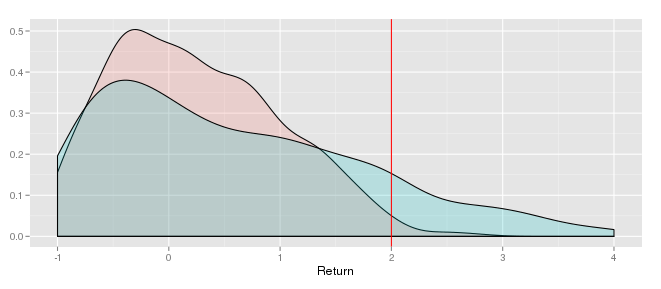
Let’s start by refreshing our memory of “reaching for yield”. In his February speech, Jeremy Stein argued that because many institutional investors need to meet nominal return requirements, these investors were reaching into riskier assets. Even though these assets may not offer high expected returns, their variance profiles offer better chances of hitting the nominal requirement. This game of distributions is illustrated below. Even though the safe red (i.e. low variance) asset has a higher expected return, the risky blue (high variance) asset has a better chance of getting the fund manager over the critical red required return line. As a result, a market wide reach for yield may result in a mispricing of risk, jeopardizing financial stability.


These arguments have been echoed by many other commentators. Here’s Martin Feldstein in the WSJ using the reach for yield as an argument to taper:
Although the economy is weak, experience shows that further bond-buying will have little effect on economic growth and employment. Meanwhile, low interest rates are generating excessive risk-taking by banks and other financial investors. These risks could have serious adverse effects on bank capital and the value of pension funds. In Fed Chairman Ben Bernanke's terms, the efficacy of quantitative easing is low and the costs and risks are substantial.
And here’s Rajan in a speech at the Bank of International Settlements
If effective, the combination of the "low for long" policy for short term policy rates coupled with quantitative easing tends to depress yields across the yield curve for fixed income securities. Fixed income investors with minimum nominal return needs then migrate to riskier instruments such as junk bonds, emerging market bonds, or commodity ETFs, with some of the capital outflow coming back into government securities via foreign central banks accumulating reserves. Other investors migrate to stocks. To some extent, this reach for yield is precisely one of the intended consequences of unconventional monetary policy. The hope is that as the price of risk is reduced, corporations faced with a lower cost of capital will have greater incentive to make real investments, thereby creating jobs and enhancing growth.
Indeed, Bernanke felt it was necessary to address these financial stability concerns at his February and May testimonies. He argued that even if low rates encourage a reach for yield, the only way to get sustainable rates in the long run is to keep rates low now. In the metaphor of Kochlerata, you need to keep the coat on until you are warm enough to take it off.

Bernanke can rest easy. Financial data since his testimonies has even further strengthened the arguments against a reach for yield. To see why, it is important to remember two stylized facts. First, "reach for yield" is a story about financial stability. Because people are going into riskier assets, this results in a systematic underpricing of risk. Second, it’s a story about increasing risk appetites. Excessively low interest rates trigger a flight *from* quality as fund managers look to hit their nominal return requirements.

But recent moves in equity prices contradict this story. The WSJ observes that defensive sectors are underperforming.
He said he still favors stocks over bonds, and has avoided "bond proxies" such as utilities, real- estate investment trusts, and other sectors with high dividend payouts
Those areas are "really expensive, and they have little to no earnings growth. They have benefited hugely from easing," he said. 
Those traditionally defensive sectors dragged on benchmarks. The sole decliners in late trading were the utilities and consumer-staples sectors, which lost 0.9% and 0.3%, respectively. Those areas were among the biggest gainers in the beginning of the year, when yields on Treasury bonds remained low.
Whereas cyclicals are responding very well:
Given the cross currents in the market, including the Fed's commitment to keeping overnight rates low at least until the unemployment rate falls through 6.5%, investors wouldn't want to overinterpret what's happened to the yield curve. But the stock market told a similar story of stronger growth expectations Friday. Shares of economically sensitive companies, like banks, retailers and manufacturers, rallied, while defensive areas, like utility and telecom shares, did poorly.
In other words, the recent taper has caused people to pivot out of safe sectors into riskier ones -- the opposite of what a reach for yield story would suggest. In fact, there appears to have been a flight *to* quality that is only recently being reversed. These movements are also consistent with recent data showing the equity risk premium, or a measure of stock market performance relative to the bond market, is at extremely elevated levels. With the taper we should expect this premium to fall as investors naturally increase their risk appetites.

Now, some may argue that there was a reach for yield in the fixed income market that is now being unwound. Indeed, mortgage rates and junk bond yields are rising:
Rates on a 30-year mortgage have climbed from 3.45% in April to more than 4% in June, according to Freddie Mac FMCC +1.97% . The 30-day average yield on new bonds sold by companies with "junk" credit ratings hit 7.72% in June, up from 5.79% in April, according to S&P Capital IQ LCD.
The risk premium on high yield bonds has also risen slightly. But there are two reasons why we should discount this observation.


First, the bond spreads will have a minimal effect on financial stability. The concern shouldn't be whether individual funds will suffer, but rather whether there has been a massive mispricing in risk. But if the risk was underpriced in the debt market, then the equity prices should have been overpriced to match the artificially low cost of capital. However, since there did not appear to be a reach for equity yield, then any reach for yield in fixed income should also have negligible effects.

Second, the high yield spread is still not outside of its historical range. Even in the 1990’s, when the Fed was never criticized for promoting a reach for yield, the spread was still very low. Therefore we should be skeptical of arguments that there was a massive mispricing in the corporate debt market to begin with.

This perspective from the reach for yield debate leads to two insights.

First, Fed policy has not been distorting financial markets. If anything, people have been too conservative on equities. Monetary policy, by encouraging risk taking, has been doing the right thing to do to help reboot the market. Even if you don’t want firms reaching for yield, they should at least be encouraged to stretch.

Second, it’s not clear if the taper will be all that “terrible” for equities. Of course, the human cost of tight monetary policy is enormous. I personally believe that the Fed should not taper in the face of such elevated levels of unemployment and depressed levels of nominal GDP. Nonetheless, the taper is likely to have only moderate impacts on the stock market, in spite of what short term correlations may suggest.

The greatest irony is that only after the Fed tightens do we realize that the Fed didn’t need to tighten at all. But now that it has, it doesn’t look like the financial impacts will be that large after all.

Saturday, July 6, 2013

The Role of Financial Institutions

The real world of finance is not populated by the financial traders of model fame. Numerous studies in behavioral economics have identified what appear to be deviations from fully efficient markets with rational individuals. On the individual level, we know that overconfidence leads male traders to trade much more than female traders, and this has a negative effect on their returns. Therefore agents don’t seem to be optimizing -- rather they have their own idiosyncratic, but systematic, biases. On the market level, stock prices seem to exhibit strong short-run momentum while also appear to have long-run mean reverting growth rates. This suggests that there’s something going on with market participants that encourages overshooting in the short run but with corrections in the long run. 

But what has gotten me curious over the past few months is the institutional aspect. In my view, because financial markets are actually populated by institutions that have their own quirks, financial markets can deviate from textbook models in very policy relevant ways.

Most financial models that I have read about are populated by individual investors looking to maximize some expected future consumption stream subject to various constraints. Sometimes these constraints stick to describing feasible budget allocations,and sometimes they also include cognitive biases. But Wall Street doesn't look like this. Traders rarely trade by themselves -- they are usually a part of a large firm. These firms may also have different goals. Some, such as hedge funds, are just in the business of generating pure return whereas others, such as pension funds, are looking to maintain a steady stream of payments to pay out to their customers. Given that these firms have their own institutional demands, this suggests that their trading strategies could be quite different. These structural differences has implications for market efficiency.

Past papers have of course addressed some of these issues. On a within-firm basis, work on the principal-agent problem has shown how compensation schemes can affect fund manager behavior. This would suggest that many financial managers maximize not the utility of the investor, but their payoff in the compensation scheme. Some past work has also indicated that institutional investors, in this case mostly pension funds, do not seem to exhibit the herding and destabilizing behavior that for which they are criticized. However, some of these benign results are being challenged in the recent financial crisis, and this could have major implications for both financial research and monetary policy.

As an example, there have been a set of recent popular articles from the Economist and FT Alphaville on the notion of VAR shocks. VAR is a measure of financial risk that (theoretically) measures the worst case outcome for a firm. For example, a 5% weekly VaR of $5 million means that there should only be a 5% percent chance that the firm will lose more than $5 million over the course of a given week. This typically can be calculated by parameterizing a loss distribution with historical data on volatility and average yields. Even though this measure can mislead by ignoring the amount that would actually be lost in a worst-case outcome its simplicity makes it a natural candidate for institutions to use as a check against overly risky trading strategies. Therefore market moves that can impact the measurement of VAR are natural candidates for making the institutional investors jump.


Pioneering work by Hyun Song Shin, an economist at Princeton, analyzes the role of VAR and argues that it contributes to market procyclicality. Because historical data is used to calculate the VAR that goes into risk weighting, banks may end up levering up their balance sheet just as the business cycle starts to rev up and deleveraging just as the entire cycle comes crashing down. The rising tide of the business cycle makes their VAR look much smaller, therefore allowing them to put smaller risk weights on their assets. Now that the size of risk weighted assets has fallen, banks can play the risk-weighting clause on capital requirements and fund themselves through more debt. This continues until the cycle breaks, at which point VAR measurements are shocked upward by the historical data, forcing a deleveraging in order to meet capital requirements, thereby amplifying negative effects on the business cycle. In particular, this story fits the recent financial crisis very well. Past decades of relative calm made the VAR models docile and ready for the slaughter that was 2008.

I see this as an institutional bug because there’s no efficiency reason why VAR should be used in such a way to risk-weight assets. It does not make for an omniscient Q-measure to identify risk. Rather, VAR is useful because it helps institutions streamline their risk analysis. By doing so, it quite possibly improves an individual firm’s performance by avoiding worse evaluation methods. But with the procyclicality argument made above, it should be clear that a group of banks all using VAR to risk weight their assets end up creating severe negative externalities on the business cycle.

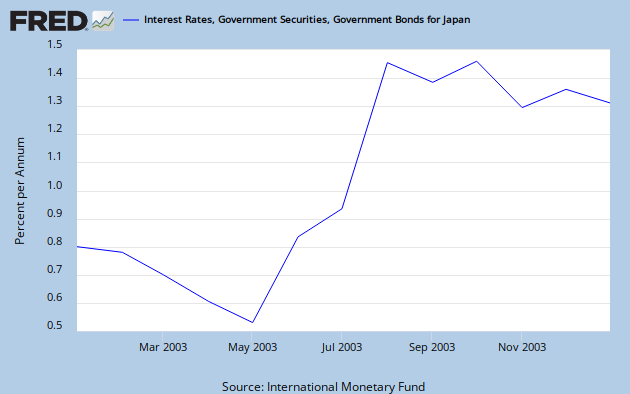
VAR shocks have also popped up in the Japanese case. Back in the 2003 bond yield volatility spike, many Japanese banks ended up selling bonds as the volatility triggered their VAR limits. This intensified the cycle of bond selling until other investors, such as pension funds and insurance companies bought up the bonds and stabilized the market. This serves as another real world example of Shin’s theory that the use of VAR in institutional settings ends up intensifying market volatility.


It should also be clear that the institutional quirks can occur in financial markets with rational arbitrageurs. If the size of institutional flows are large enough, then it may be worthwhile for the smaller traders to just ride the flows to higher returns. There may just not be enough incentive to normalize prices. If the market can stay irrational longer than individuals can stay solvent, then an individual is likely better off to just play along with the market. Given thta we see this kind of serial correlation with hedge funds in the tech bubble, the risk of individuals riding along with the irrationalities of institutions should be taken seriously. In fact, I would go far enough as to argue that the burden of proof is on those who would like to defend their financial models with only individual investors. Given that we know the real world doesn’t work like that, and that this difference can result in dramatically different conclusions, the burden must on the traditionalists to show that models of individual investing can subsume those of institutions in most cases.

To measure these effects and to calibrate new models, attention should be focused on the flow of funds in and out of these institutional investments. This way we could have a better notion of relative size and be able to measure if and how much institutional procyclicality affects markets.

I see two main policy implications of this alternative approach. First, the VAR specific quirks create a further justification for strict capital requirements. Only this way can the risk weighting problem be robustly solved. In terms of monetary policy, a thorough understanding of these institutional quirks can help guide the direction of policy. As monetarism starts to integrate more markets as data points, it becomes more and more important for central bankers to know how to interpret the financial data that comes in. By knowing what’s signal and what’s noise, central banks can better conduct forward looking policy.

In all these examples, we see how institutions -- not individual traders -- can end up driving markets. This marks a departure from traditional finance models in which everybody is just an individual playing the market. It is my hope that this kind of analysis will be useful for understanding causes of market inefficiencies and the optimal framework for financial data in monetary policy.

Friday, June 14, 2013

When the Zero Bound Didn't Bind


The zero lower bound didn't always bind. For three months after Lehman's collapse on September 15, 2008, the federal funds rate stayed above zero. In this period of time, the Fed managed to provide extensive dollar swaps for foreign central banks, institute a policy of interest on excess reserves, and kick off the first round of Quantitative Easing with $700 billion dollars of agency mortgage backed securities. Finally, on December 15, 2008, the Fed decided to lower the target federal funds rate to zero.

It is important to remember the sequence of these events. It is easy to think that the downward pressure on interest rates was the inevitable consequence of financial troubles. Yet the top graphic clearly contradicts this. Each of the dotted lines represents a FOMC meeting, and each of these meetings was an opportunity for monetary policy to fight back against the collapsing economy. The Fed's sluggishness to act is even more peculiar given that there were already serious concerns about economic distress in late 2007. As, the decision to wait three months to lower interest rates to zero was a conscious one, and one that helped to precipitate the single largest quarterly drop in nominal GDP in postwar history. The chaos in the markets did not cause monetary policy to lose control. Rather, the Fed's own monetary policy errors forced it up against the zero lower bound.

This is not to say those mistakes were purposeful. But in the high stakes game of central banking, even benign neglect can be dangerous. These failures in the last three months of 2008 can teach us many lessons about what should be done for future monetary policy. Only this way can we be more sure that careless mistakes won't jeopardize the future path of monetary policy.

One of the first steps would be to switch to a nominal GDP target. This would have two primary effects.

First, while this by itself is not a concrete instrument, it would be an important step in giving policy makers more freedom in responding to crises. Our current focus on inflation can cause particularly perverse outcomes when the economy comes under stress. During the September FOMC meeting right after the Lehman collapse and the Merill Lynch merger, in spite of the chaos in financial markets, the Fed chose to leave interest rates unchanged because of concerns about commodity price inflation. After such a long period of worrying economic conditions, the Fed choked because of a relative price change that was beyond the control of monetary policy to tame. A nominal GDP target would be robust to these kinds of shocks and better keep policy on track during the unfolding of a crisis.

Second, a nominal GDP target would also make policy after interest rates hit zero more credible.When the Fed is at the zero lower bound, one of the most important policy levers it has left is to adjust expectations of future interest rates. This is known as forward guidance, and is a consistent theme in the literature. In Krugman's original work on Japan's liquidity trap, he termed this kind of policy "credibly promising to be irresponsible". If this sounds peculiar, you are not alone. John Cochrane observes that
the key to stimulus when interest rates are zero is for the Fed to commit to keeping interest rates low, lower than than we and the Fed know it will want them to be when the time comes.
As a result, the Fed has a hard time committing to its forward guidance because it will want to renege in the future. However, if there were a nominal GDP target, this would remove the pressure to renege. In a sense, declaring a nominal GDP target changes perceptions of what the Fed wants.  By making policy systematic, and not discretionary, we can actually shape expectations and make the current policies of forward guidance and quantitative easing that much more effective.

Monday, April 8, 2013

Reaching for Yield


Reaching for yield from Yichuan Wang

This was a presentation on 'reaching for yield' that  I prepared for my investment club, Michigan Interactive Investments. The argument is the same as in Jeremy Stein's speech. In low interest rate environments, pension fund managers go into riskier assets in order to reach their benchmark yields. Therefore, this should result in high beta stocks having lower risk-adjusted returns. I test this hypothesis using stock price data from the past five years on almost all stocks listed on the U.S. exchanges, and find that there did seem to be a substantial amount of 'reaching for yield' in 2011 and 2012, and that in 2011 this phenomenon was concentrated in the large cap stocks whereas now more of the effect seems to be with the small cap stocks.

While I'm not that confident on the exact quantitative magnitudes, reaching for yield does seem like a new channel through which nominal shocks can have real effects. Given the plausible assumption that most benchmarks are nominal in nature, then deflation has the added cost of inducing excess risk taking. This suggests that after financial crises, monetary policy should be even more aggressive in order to minimize the extent of the reach for yield.

I do think this investigation brings up an important methodological issue. I believe future macroeconomic research will rely much more heavily on observations from financial markets. This was the method recently used to measure the effect of sticky prices, and this technique of disaggregating financial data to lend support to macroeconomic theories is quite intriguing. The advantage that this has over traditional data sources is that you have a much higher frequency data stream in finance. This allows more in-depth analysis on focused time periods -- something that is much harder to do with regular CPI data.

In addition, through working on this I have found data analysis through open source R to be quite powerful. I generated all the plots in the presentation with the R package ggplot2, and all the stock price data came from Yahoo Finance interfaced through quantmod. Coupled with the powerful regression algorithms in R, I could generate the desired coefficients from weighted regressions and draw them on a plot.

Tuesday, February 12, 2013

What Would Stein Do? - Monetary Policy and Financial Regulation

Should monetary policy play a role in financial regulation? Although Federal Reserve Board Governor Jeremy Stein argued in a recent speech that it does, monetary policy wonks such as Scott Sumner have not taken Jeremy's suggestions well. While I am sympathetic to both narratives, I feel that they miss the boat on what monetary policy as financial stability regulation would look like. When reading supporters such as MCK or opponents such as Ryan AventMatt Yglesias, and Scott Sumner, I find that the debate is focused on the short term interest rate response to financial risks. However, the focus on only the short term interest rate and its relationship with financial regulation is incredibly narrow and ignores important research on alternative monetary policy tools.

It may be useful to review the positions of the involved parties. According to M.C.K, monetary policy needs to be conducted with an eye to financial stability for two key reasons. First, extended periods of low interest rates encourage excessive lending. This causes bubbles to grow and results in large macroeconomic effects once they pop. Therefore monetary policy should be conducted to pop bubbles before they become major economic threats. Second, monetary policy is more effective than specific microprudential regulations such as inspecting bank balance sheets because financial innovation can allow banks to hide much of their conduct. Because all firms face the same set of interest rates, monetary policy has a better chance of "getting in the cracks" of financial markets and better protecting the system. Thus because monetary policy has wide reaching effects, it should be an important part of any financial regulation toolkit.

On the other side, some more Monetarist authors such as Scott Sumner or Matt Yglesias argue that using the short term interest rate as a regulatory tool is misguided because what matters most are macroeconomic variables such as nominal GDP or employment. Because monetary policy is such a blunt instrument, raising interest rates to pop a financial bubble is akin to fumigating an entire house to get rid of one patch of mold. The instrument is out of proportion with the threat. If the central bank stabilizes nominal GDP  the impact of financial crises on aggregate demand should be minimal. Moreover, it's not even certain if central banks can accurately identify bubbles. Even though the U.S. housing bubble seems obvious now, it's not exactly clear that policy makers could have identified it in real time. Therefore using monetary policy to pop bubbles is unlikely to be very effective and would result in substantial collateral damage.

Were the Fed to use monetary policy as a financial regulatory tool, the dilemma would be that one instrument, the short term interest rate, cannot simultaneously stabilize nominal GDP and the financial sector. One cannot address two problems with one tool. Fortunately, Stein has been working on an alternative policy regime to solve this problem. Once his alternative is considered, we can see how monetary policy and financial regulation can more effectively be integrated.

Stein's core proposal is that the central bank can be both a financial regulator through a combination of strict reserve requirements and paying interest on reserves. In Stein's model, the central bank can guide nominal variables through a kind of Taylor Rule for the short term interest rate while affecting the financial sector by manipulating the spread between interest on reserves and the short term interest rate.

To understand the logic behind Stein's proposal, we need to understand why the financial sector can be so unstable. Stein argues an important cause is an excess of short term debt. In particular, excessive short term debt raises the probability of fire sales, and the risk of a fire sale creates social costs that banks cannot internalize. Because reserves are required for short term debt issuance, a tax on reserves helps to constrain short term debt creation. In this way, a reserve tax helps internalize the costs of certain financial frictions, and therefore is an important tool for macroprudential regulation.

Stein proposes to implement such a reserves tax by first subjecting short term debt to stringent reserve requirements and then by varying the gap between the short term interest rate and the interest rate paid on reserves. To see why the gap between the short term interest rate and the interest on reserves is a tax on short term debt, recall the relationship between reserves and debt issuance. In a world of reserve requirements, the bank must hold a certain amount of reserves in order to issue the new debt.  Had the bank been able to lend those reserves out, they would have earned interest equal to the short term rate. This is the gross tax on reserves. But because the bank is also compensated with interest on reserves, the net reserves tax (heretofore known as the 'reserves tax') is the difference between the short term rate and the interest on reserves.

Under this framework, although both the short term rate and the interest on reserves are nominal variables, the spread between them is a real variable that serves to penalize issuance of short term debt. The pre-crisis policy of not paying interest on reserves meant that the short term rate was the entirety of the reserve tax. Therefore any desired increase in the reserve tax required the Fed to raise short term rates one-to-one. However, if the central bank were to pay interest on reserves, it can hold the short term rate constant while increasing the reserve tax.

In other words, policymakers can regulate debt maturities without deviating from existing interest rate rules. By increasing the gap between the interest paid on reserves and the short term interest rate, the central bank can penalize the issuance of short term debt without having to raise short term rates. In doing so, the central bank can try to stabilize nominal GDP while reducing short term debt fragilities. The central bank can engage in macro-prudential regulation while also staying faithful to its price stability and employment objectives.

No doubt, there are some problems with such an approach. The most obvious one is the case in which the required reserves tax is higher than the interest rate required to maintain price stability. In this case, since the interest rate cannot be lower than the rate on reserves, satisfying one mandate would necessarily ignore the other. To avoid this problem, the central bank could raise reserve requirements on short term debt. The intuition behind this is that for each additional dollar of short term debt, the bank would need more reserves. As a result, the effect of the reserves tax would be magnified, thereby lowering the optimal reserves tax below the necessary short term rate.

Another concern is that raising the reserve requirement could substantially disrupt the functioning of banks. Because banks have become used to certain reserve ratios, they would have a hard time adapting to higher reserve requirements, thereby reducing the money supply and causing more uncertainty. I see three ways central banks could mitigate this. First, they could announce the change in reserve requirements ahead of time and allow banks to more smoothly transition into the new regime. Second, the reserve requirement could be raised when there is a large supply of excess reserves, such as right now. Third, if nominal GDP slows down substantially, the Fed could engage in other "unconventional" actions such as Quantitative Easing to inject assets into the system. Moreover, raising reserve requirements as a part of deploying a new macroprudential framework may make certain Basel III requirements obsolete. In particular, the Basel III proposal of defining a stable funding ratio to limit short term debt issuance may become unnecessary when the Fed can control such a ratio with much more precision through a reserves tax. By making other reserves regulation obsolete, a new policy regime with interest on reserves could actually ease the regulatory burden on banks.

Neil Irwin, in his post on Stein, likened raising interest rates and popping bubbles to fumigating an entire house to get rid of one patch of mold. However, Stein's policy proposal would not be so dramatic. It would be more like a dehumidifier, addressing the risks of mold while still allowing people to live in the house.

Thus the debate over whether the short term rate should be used to moderate credit cycles seems a bit silly in the context of what Stein's papers have been suggesting. It is almost as if in all the arguments over what Stein said, people have forgotten to look at what he has written in the past. The alternative approach with interest on reserves and stricter reserve requirements can coexist with the price-employment mandate. In addition, such a strategy provides monetary authorities more tools to interact with the very large financial sector. In this way, the effective integration of financial regulation and monetary policy should improve macroeconomic stability, not worsen it.

Sunday, February 10, 2013

Market Monetarism and Finance

As market monetarism starts to become more mainstream, I have started to take some time to think about what yet has to be done to develop this new brand of monetary theory. One issue that recurs in my thoughts is that market monetarism needs to help develop a richer understanding of financial dynamics.

One of the strongest justifications is that a richer understanding of financial linkages would help untangle the dynamics of monetary policy under different regimes. Scott Sumner argues that monetary policy works not with long and variable lags, but rather long and variable leads. Because agents are forward looking, expectations of future nominal GDP significantly affect current economic activity. The strongest evidence for this comes from the financial markets. For the United States, Marcus Nunes has done quite a bit of work charting the immediate effects of monetary policy hints on inflation expectations:


We also see similar evidence in the international arena, whether Japanese, Swiss, Hong Kong, or American.

However, the chart is incomplete. Past studies do suggest that the effect of interest rate cuts are not felt until several months after the initial policy declaration. While there may be identification issues with those studies, they do open up the possibility that monetary policy does not act as quickly as market monetarists would hope. In this context, a hybrid approach may be more accurate. While monetary policy leads the financial sector, it is likely that monetary policy lags in other "real" sectors, such as manufacturing.

This synthesis of both monetary and financial dynamics is especially important given Lars Christensen's argument that "there is probably no better indicator for the monetary policy stance than market prices." We know from the financial literature that certain phenomena, such as excess volatility, seem to defy the typical market monetarist use of the efficient market and rational expectations hypotheses. This is not to say policy would be better guided by the arbitrary decisions of central bankers, but rather that a move to market based signals needs to be grounded on better a theoretical and empirical understanding of how monetary policy and financial signals lead other parts the real economy.

As an example of this, we can take a look at the relationship between TIPS inflation expectations and PCE inflation. For those who don't know, the TIPS spread is the interest rate differential between the 5 year inflation protected treasury and the regular 5 year treasury, and therefore is a measure of what investors expect inflation to be over a five year time horizon.

Under the rational expectations hypothesis, expected future inflation should be a reasonable estimate of actual future inflation. By the efficient market hypothesis, these expectations should then be expressed in the 5 year TIPS spread. However, for the years during which we actually have data on how the 5 year TIPS compared against the actual inflation rate, performance is quite poor:

This evidence suggests that even market forecasts can be unreliable. While they can sometimes be a good indicator of future performance, in other times they can be unacceptably wrong. In the above example, the relationship between the TIPS forecast and actual inflation was so wrong that it was negative. While such data points may be washed out in the long run, the 5 years of flawed predictive capacity that it would have given should give any policy maker pause.

However, the TIPS spread is actually quite a good predictor of contemporaneous inflation. Below I plotted each month's PCE inflation rate with that month's average TIPS spread, and find that the linear prediction (red points) does a good job of measuring current month inflation:

This suggests that while we may not be able to use market signals to predict with precision, market signals do carry significant information content. Instead of waiting for each month's CPI report with bated breath, we could simply consider the financial data that is always available to us. This resembles my conclusion from looking at forecaster data. Given that we have reasonably accurate forecast, monetary policy should target those forecasts. When bad forecasts come in, central bankers can signal that they are ready to ease monetary conditions if the bad conditions materialize themselves. The trick here is to make sure that the information hiding in market prices can make its way into policy, and a better understanding of the relationship between finance and macro is an important step in that direction.

Sunday, October 7, 2012

Nominal GDP Targeting: An Introduction with Market Applications

A few weeks ago, I joined Michigan Interactive Investments, the premier finance club at the University of Michigan. Every week during our meetings, we have a market update during which we sound off our opinions on recent market events. And, as readers know, I take a great interest in monetary policy and have been very vocal about the positives behind the Federal Reserve's recent moves in terms of QE3 and conditional forward guidance.

However, I find that there's a disconnect between my understanding and perception of monetary policy and that of my fellow peers at MII. My suspicion is that it has something to deal with the differences between practitioners and academics, but I am still unsure of the specific difference. As a result, I prepared a presentation on this issue and wanted to share it with the rest of the blogosphere. I consider this different from Evan's excellent post on the layman's guide to NGDP targeting for two key reasons. First, this is targeted for those who are already financially literate -- ie they know what treasury bonds and other financial indicators are. Second, it's meant to be more visual to drive the point home in a presentation.

Considering I used quite a few graphs that have been inspired by debates I've encountered through blogging, I thought it would be apropos to present it here first. I hope it is useful for explaining nominal GDP targeting to a more technical financial crowd or undergraduate economics students. As always, comments are encouraged, and I'm happy to revise the presentation if I missed something.

Tuesday, August 14, 2012

What China Could Be Building

Scott recently expressed his optimism in the Chinese growth story, and sees no reason why the recent trouble with housing markets should jeopardize its growth. As a fellow traveler in China, I have to express reservations about his outlook.

One of Scott's central arguments is that Chinese people want housing. No doubt, people want somewhere to live, and recent waves of urbanization have moved more and more of demand to the cities. However, I'm not sure why this translates into an argument that the current housing situation can't be a bubble. Just because there's a need for housing does not mean that there is enough quantity demanded at current prices. There's no physical overstock, but there's a massive market overhang at current levels. If I were a homeless person who just got a job making thousands of dollars, my first priority would certainly not be moving into a sleek urban apartment whose rent would take up almost the entirety of my income. There are other, cheaper options that are not the drivers behind the current real estate rally.

This is likely because the price of houses represents more than the discounted stream of housing services, it rather represents expectations of future growth. Financial repression and low bank deposit rates force wealthy Chinese to try to grow their wealth by investing into assets such as gold, jade, or housing. Shanghai families view housing as critical to "preserving value" in a household, and the purchase of a house may reflect excessive optimism about the future price path due to other people's purchasing, instead of expectations of the value of future housing services. Printing money wouldn't solve the issue because the real cost of those items are too high, so monetary expansion would only worsen the balance sheets of the savers with bank deposits and strengthen those who had the resources to invest in housing.

The crux of the matter is inequality. Who is buying all those consumption goods you see on TV? Who is buying houses to preserve value? Yogi Berra's quote "nobody goes there, it's too crowded" does not fully apply. Nobody goes there because it's too expensive to live for the "millions of of Chinese living in tiny ramshackle homes." But the houses give just enough return for wealthy Chinese investors, who represent a small, but incredibly influential minority.

The real risk is not that the housing won't be used, but that the crash would have secondary effects. Local governments are dependent upon land sales for revenues, meaning a housing crash could have serious implications for government. In Guangdong province, some local governments are actually tearing down mountains to make new land in the ocean, all to sell the land. This, along with the recent reversal of capital flows and possible insolvency of private wealth management firms, represents a serious liquidity risk that can have disastrous consequences.

In terms of sources, I would recommend looking at Patrick Chovanec's articles on the Chinese housing market and financial system. I don't have much time to provide the direct link for each of my claims, but if there seems like something that doesn't jive right I would be happy to explain further.

So let's answer Scott's fundamental question:
So here’s my question for all of you China skeptics that insist they are building way too much housing, infrastructure, heavy industry, etc.  What precisely do you want them to build more of?  And what are the 100s of millions of Chinese living in tiny ramshackle homes to do?  Sit tight for a few more decades while resources pour into nice urban services for the pampered elite?
I want them to start building leaf blowers, so we don't have so many Chinese people in the low productivity position of sweeping streets. I want them to start building farm equipment, so we don't have so many Chinese farmers tending the fields. I want them to build more laundry machines, to free the rural Chinese from scrubbing clothes on washboards. I want them to build electric stoves, so my Grandpa can put away the coal fired outside oven. I want them to build computers that can deliver cheaper education to the masses.

Instead of just focusing on "building," I want them to invest in human capital, so productivity can be at a level that we don't need "make work" jobs. I want them to build more schools and hire better teachers, so classes aren't as large and you're not damned if you can't make it in a top elementary school. I want productivity to be high enough that high end stores don't need more clerks than actual customers.

I want these things among many others that will only be more obvious in a freer market.

That Scott can get a haircut for $4 or an ice cream cone for 50 cents shows how low productivity and wages are in China. Yet they will not grow any faster with more housing or more state directed investments. Cheap subway rides are nice, but are they not just another sign that transportation infrastructure has been built too quickly? I'm not saying China is hitting a ceiling for growth, or that vast swaths of China are condemned to poverty. But what I am saying is that we need to worry about the systemic fragility that underpins the Chinese system, and be very, very concerned about the unknown magnitude of the downside risk.

Friday, June 15, 2012

Friday Roundup


Niall Ferguson takes a break from his usual Newsweek hackery and takes a look at the political constraints surrounding the Eurozone. The narrative is rather similar to previous ones regarding the decentralization of economic and political power, and all the attendant problems that arise with coordination. Killer paragraph from the article:
Imagine that the United States had never ratified the Constitution and was still working with the 1781 Articles of Confederation. Imagine a tiny federal government with almost no revenue. Only the states get to tax and borrow. Now imagine that Nevada has a debt in excess of 150 percent of the state’s gross domestic product. Imagine, too, the beginning of a massive bank run in California. And imagine that unemployment in these states is above 20 percent, with youth unemployment twice as high. Picture riots in Las Vegas and a general strike in Los Angeles.
Now imagine that the only way to deal with these problems is for Nevada and California to go cap in hand to Virginia or Texas—where unemployment today really is half what it is in Nevada. Imagine negotiations between the governors of all 50 states about the terms and conditions of the bailout. Imagine the International Monetary Fund arriving in Sacramento to negotiate an austerity program.
Capital control regimes look to be an interesting field of analysis for the future. The authors do make an important note: control over the capital account, to a certain extent, implies a control over the balance of trade. this is an important point for future negotiations, as it is a reason why capital controls should be used sparingly.


Apparently Bernanke doesn't shy away from strong language when the financial system is on the line. Although he's been relatively lukewarm about further easing to lower unemployment, he seems totally on board to do "whatever necessary" to stop the Eurozone contagion from spreading to the United States. One wonders what's the consideration preventing him from doing something similar to solve the US employment crisis.


The political argument about Glass-Steagall is quite interesting. The thesis goes that, after the merging of commercial and investing institutions, bank lobbies became much more unified, thereby warping the government towards helping the banks. This seems like an issue that would be interesting to study in a political business cycle or political DSGE model. It would make banking regulation endogenous, and the results could be quite unpredictable.


While I do think the broad enets of the efficient market hypothesis are true, I think the new concern with systemic risk is well deserved. I think viewing the EMH as a limitation on information, and not a limitation on the presence of crises is very important. Otherwise it leads to a dangerous bias, as described in the article:


There may be a deeper bias at work. In business and investing, choices under conditions of uncertainty are made all the time, and mistakes are routine. By contrast, developed country policymakers’ default stance seems to be that proactive or preemptive measures require a high degree of certainty, owing to a deep-seated belief that financial markets are stable and self-regulating. 
If one believes that market instability is rare, then it is reasonable to refuse to act unless there is a compelling case to do so. In light of experience, the view that the financial system is only exceptionally unstable or on an unsustainable path seems at least questionable.  
Unsurprisingly, the article is short on specifics on how to regulate systemic risk, but it is certainly one of the biggest issues for financial stability.

Finance is incredibly complicated, making it hard for anyone to regulate it. This is one of the issues that makes me skeptical of the argument that markets can regulate themselves when it comes to complex financial products. The payoffs are too volatile and uncertain for the market to truly know. Of course, it's unlikely that regulators know any better. However, this is no excuse for government to throw up its hands; rather, it's an opportunity to craft simpler rules that are robust to errors.


What are the systemic risks associated with money market funds? They played a large role in the liquidity crisis and financial turmoil in 2008, and thus their systemic role will be important for future analysis.


An insightful look into the failure of the Gaussian model and the real reasons why it was so destructive. Modelers never truly believed in it, and rating agencies never got around to implementing them. However, due to the demand for AAA rated assets, financial engineers gamed the system to satisfy the demand and earn hefty bonuses. It seems that the story is much more about individual incentives and corporate governance, and much less about an "equation that destroyed finance" or the financial conspiracy.

Sunday, May 27, 2012

Capital Spillovers: Towards a New Regime

A look at the externalities from capital controls and potential effects on international finance


The focus of this post is going to be on the arguments in a recent NBER working paper on how capital controls in one country should be evaluated on an international level.

An interesting development in the analysis of capital markets in the past few years has been a changing paradigm on the use of capital controls as macroprudential policy. Through empirical analysis, we've found various channels through which capital controls function. As per the working paper:

Some economists and policymakers have recently become more supportive of controls on capital inflows, particularly if they are aimed at limiting the appreciation of overvalued currencies and reducing financial fragilities resulting from large and volatile capital flows. This support has been bolstered by theoretical work showing that taxes on capital inflows can improve a country’s welfare by reducing negative feedback effects due to capital flow volatility (Korinek, 2010 and Jeanne and Korinek, 2010) or by adjusting the terms-of-trade to shift consumption across periods (Costinot, Lorenzoni, and Werning, 2011). This theoretical work has been supported by empirical work showing that even if capital controls cannot significantly affect the total volume of capital inflows, they can improve the country’s liability structure and increase its resilience to crises (i.e., Ostry et al., 2010).1
Yet the analysis hasn't really focused on external effects of capital controls of country on others. This is an important field of study because, as the study of customs unions or financial contagion has taught us, the effect of controls or restrictions change significantly in a second-best world populated by other states with their own policy regimes. Thus, any possible externalities from one country's capital controls are extremely important in the formulation of policy.

The paper looks at 'moderate, market-based controls on capital inflows in a country which previously had a relatively open capital account." In effect, it shies away from large scale capital controlled regimes like China.  Also, these types of capital controls are unlike the command-and-control regulations that China uses in stopping capital mobility. Instead of a quota, the controls analyzed in the paper make capital harder to move on a per-unit basis. While Chinese capital controls can be represented by a levee, the capital controls analyzed in the paper are the equivalent of making the hill a bit steeper or moving to higher ground. For more rigorous empirical analysis, the paper looks at Brazilian markets, as they are relatively deep and have been subject to multiple changes in capital restrictions over the years. The authors use the Emerging Portfolio Fund Research (EPFR) to analyze changes in mutual and bond funds.  In addition, they interview investors from a variety of backgrounds to learn about how market practitioners respond to capital controls.

An interesting nugget from the empirical analysis is that a large part of the impact from Brazilian capital controls arises from the expectation about future policy. Capital controls in Brazil lower investment in Brazil, but also in other countries that have a higher risk of implementing more capital controls. The specific wording from the paper:

Given these significant portfolio effects of capital controls on investor allocations to Brazil, it is not surprising that there are externalities on portfolio allocations to other countries as well. Confirming comments in some of the investor interviews, we find that these spillovers are heterogeneous and depend on country characteristics and the fund manager’s strategy. When Brazil increases its capital controls, investors increase their portfolio allocations to other countries that are closely linked to growth in China (through commodity or regional exports). There is also mixed evidence that investors may increase their portfolio allocations to other countries in Latin America. At the same time, increased capital controls in Brazil cause investors to reduce their portfolio allocations to countries that are perceived to have a higher risk of following Brazil’s example and implementing new controls (including countries that are traditionally open but recently imposed new controls as well as countries that traditionally have extensive restrictions on capital mobility). These results confirm that much of the effect of controls is from signalling, i.e. changes in investor expectations about government policy, even for countries that are not concurrently adjusting their capital controls (6). 
This shift in expectations then has implications for whether capital controls can be targeted. If controls cause markets to judge an entire government as heterodox, then capital flows as a would reduce all forms of foreign investment. Additionally, Brazilian capital controls may change global expectations about policy for capital controls.  This may change the allocation of funds at a global level as well.


The shift towards Chinese investments in the face of Brazilian capital requirements is quite interesting. This suggests that there's something offered by investments related to China that similar to that of Brazilian investments. This relationship is probably built on the BRICs of emerging markets, but these similar flows weren't recorded as going into Russia or India. Brazil is also unique in its central placement in South America, which is probably the reason Brazilian capital controls pushed a substantial portion of the new flows into other Latin American countries. Although their development has not kept pace with Brazil, they are likely exposed to similar risks with respect to commodity price shocks on the global marketplace. As a result, an investor might decide to shift away from Brazil, which has capital controls, to another Latin American country which would offer a similar type of investment, but with a higher yield due to lower capital controls. The authors use these spillover effects of capital controls to justify more international coordination:
If capital controls shift vulnerabilities from one country to another, this “bubble thy neighbour effect” should be incorporated in any reassessment of the desirability of capital controls. Moreover, if several countries simultaneously adopted controls as part of a standard “policy toolkit”, or if a single large country adopted more stringent controls than Brazil’s small tax analyzed in this paper, the externalities could be substantial. This does not necessarily mean that capital controls will reduce global welfare and should always be avoided. Instead, these results support a role for international coordination or oversight of the use of capital controls to avoid a “bubble thy neighbor” effect which could lead to retaliation across countries and reduce global welfare (6).
The argument about "retaliation across countries" exposes an important weakness of capital controls. If capital controls function primarily by pushing hot money flows onto other countries, a global regime of capital controls is likely to have the same effect that capital controls have on a country-by-country basis. In effect, the fallacy of composition strikes again, as if every country imposed capital controls, capital controls would no longer address vulnerabilities in finance. Rather, they would just lower the global return on capital.


Section 2 of the paper moved on to investor surveys of attitudes towards capital controls. They reveal a wide diversity of views on capital flows.  While some investors were neutral (“cost of doing business”), quite a few of them interpreted capital controls as signalling something more fundamental about the country (“anti-investor bias of the country,”  “an increase in policy uncertainty in the future,” “a government that does not know what to do,” or a “lack of stability in economic policy”) that constituted "a draconian policy".  Other investors had positive views, as "controls showed the country was addressing potential vulnerabilities due to a rapid expansion of credit related to capital inflows".  If capital flows substantively affect future expectations of capital stability, these yield expectations should be integrated into the design of policy.  Yields could be used as a tool to look at market expectations of the future path of policy.

Capital controls also have heterogenous effects on different investors.  Equity investors face higher levels of volatility, so taxes on the order of a few percentage points of return were not very worrisome. On the other hand, for those who were dealing with fixed income assets or had absolute thresholds to reach, the tax on incoming capital had a major effect.

The surveys also reveal that capital controls, as currently implemented, affect the economy with long and variable lags.  This would take place in spite of advanced knowledge of when the controls would be implemented.  There were four key reasons for this:

  1. Expectation lag - even though capital controls changed the expectations of future policy, any given change could only be part of a "broad assessment" of investments in a country.  As a result, one capital control would not immediately affect a change in investment strategy.
  2. Institutional lag - in many institutions, fund allocations depend upon decisions of large committees that go through a "lengthy process of meetings, documentation and approvals" (10).  As a result of the internal transaction costs of making the decision, capital controls don't have immediate effects.
  3. Coordination lag - the effect of capital controls extends beyond one firm.  Rather, investors require information about the actions of other agents to make a decision; they can't ex-ante coordinate to figure out how much each firm will invest.  As a result, responses to capital controls take time.
All of this shows that investors respond in very different ways to capital controls; the image of a representative investor investing symmetrically with the market is an illusion.  Policy then needs to be designed carefully to take into account these different types of investments.

Overall, this paper has notable implications for a global shift away from financial fragility through capital controls. The signalling argument means there's room for rule based policy when it comes to macroprudential regulation.  To clarify what the government wants to do with capital flows, they can create a "macroprudential regime" to try and anchor investor expectations, thereby creating an environment more conducive to growth. 

Also, the international spillovers of capital flows make the dynamics of adjustment to an international landscape dotted with capital controls unpredictable. As more and more large economies move towards capital controls, two scenarios could evolve. One is that the states without capital controls would be seen as freer to capital flows. This would create strong incentives for the remaining states to implement controls so as to prevent the new flows of hot money from coming into their polities. Even without international coordination, there would be a snowballing effect towards a new regime on capital controls. On the other hand, if the expectations channel was strong enough, the remaining states could go without controls as investors already expect them to be willing to take measures to moderate capital flows. In effect, the actions of the first movers would immunize the rest. Under this scenario, the first movers would be providing a public good with their decision to move first. As a result, there would be an inefficient level of capital controls. I'm not sure which one is more correct, but either way they make the study of international finance very exciting as development marches forward.


Friday, May 25, 2012

Friday Links and Thoughts

An interesting analysis of global supply chains and the recent crisis.  In the Great Recession, European firms that were exporters suffered higher losses of sales than those who were importers or were not very open to international markets.  In terms of a "debundling" of globalization, this means the firms that were the core supply chain coordinators did better in the recession than the export parts periphery.  This suggests that the debundling of globalization makes these supply chain members similar to the commodity exporting countries under previous regimes, as the parts manufacturers are now the commodified, low skill level exporters.

Germany is just stuck in the worst of worlds.  If Greece leaves the Euro early, the chaos of capital flows are likely to overwhelm Europe and cause a more severe economic contraction.  However, if Greece's exit is inevitable, then it may be better to do so now because the costs of an exit are only going to increase in the future.

A new paper on the history of global reserve currencies.  Eichengreen and Mehl find that the US dollar overtook the UK's pound sterling much earlier than previously believed.  The change in dominance took place in the 1920's and the US dollar continued its strength through the end of World War II.  One of the key findings of the paper is that the US dollar was so successful because of the depth of the U.S. financial markets. In effect, because of the large home market in the United States, it was seen as more stable reserve currency.  This has three important implications:

  1. First is that finance, in many ways, functions as an increasing returns to scale industry in the short run.  As a result of a larger financial industry, a certain country may gain a comparative advantage in finance.  
  2. The second is that larger currency unions, if stable, are more likely to be the base of a global reserve currency.  This is interesting in the context of Europe, because those countries, although they are bound together, failed to foster a shift to a European reserve currency because of fundamental internal imbalances.  Reserve currency status then becomes another key determinant in whether a currency union benefits or hurts a region.
  3. Third is that macroprudential policy will be increasingly important for the preservation of a reserve currency. Without that level of moderation to promote medium-term sustainability, financial markets aren't stable enough for reserve currencies to remain.
China's financial system is incredibly fragile.  Although, on aggregate, capital is flowing into China, the flows could easily reverse based on the decisions made by a small population of affluent Chinese.  To me, it represents another reason why fears about China should take place in the tail, and not the medium results.  Growth is likely to be in for a bumpy landing, but if not it is likely to collapse.  Hard.

Perhaps manufacturing is special.  Its recovery has been quite strong in the recent recovery, and it may bode well for the furthering of science and engineering in the United States.  The fact that manufacturing firms played such a large role in increasing spending in research and development creates possibilities that manufacturing really is special in an age of otherwise stagnation.

A credible argument against the Sumner critique of monetary policy.  Is there a possibility that central bank independence could be jeopardized by higher levels of unconventional policy action?  In a world of high levels of debt and overly expansionary fiscal policy, Fed tightening would become a lightning rod for criticism.  At that point, the Fed could easily lose its independence as fiscal authorities came under attack.  Thus, the Fed can't be an omnipotent actor because it would create massive possibilities for moral hazard on part of the fiscal authorities.  This seems to be another interesting avenue for fragility in NGDP targeting.  Central bank robustness leads to governmental fragility.

Monday, May 21, 2012

Complexity in Monetary Policy: The Mechanisms Do Matter

Beware manufactured stability: "expectations management" is inherently fragile

A recent working paper adds to the discussion on monetary policy and growth.  In the model, monetary policy affects growth by allowing credit-intensive industries to engage in larger projects.  It does so by easing liquidity needs and, thus, giving firms the "breathing space" to invest.  The paper finds evidence for this by looking at industry-level financial constraint variables as well as the performance of the industry in response to monetary policy.  The key finding is that countercyclical monetary policy can have a significant positive impact on long run productivity growth, especially for recessions.  This result is robust to controlling for:

...the interaction between these measures of financial constraints and country-level economic variables such as inflation, financial development, and the size of government which are likely to affect the country’s ability to pursue more countercyclical macroeconomic policies (5).

Moreover, the regressions shed light on another unique internal link from monetary policy to growth: countercyclical monetary policy promotes higher levels of R+D spending.  While the model explains it through liquidity needs, the concept of "signal-processing" causing firms to invest inefficiently likely applies.  This suggests that if we really are in a "great stagnation" of growth and innovation, a stable nominal economy vis-a-vis monetary policy will be increasingly important.

To extend the model, if monetary policy exerts a diverse range of effects on what is considered money through safe asset creation, the effect of countercyclical monetary policy is probably stronger than what the interest rate would state.  By increasing liquidity through countercyclical policy, this allows firms to invest more:
The intuition for this proposition is simple. Firms need to hoard liquidity in order to weather liquidity shocks if the aggregate state is bad. This liquidity hoarding is costly...because of the lack of commitment of consumers. Reducing interest rates in bad times lowers the amount of hoarded liquidity, by increasing the ability of firms to leverage their net worth. This effect is weaker when the aggregate state is good because in that state, short-term profits are enough to cover reinvestment needs so that no liquidity needs to be hoarded to weather liquidity shocks that occur in that aggregate state of the world. Hence a higher marginal benefit of reducing interest rates in bad times relative to good times. This effect is strong enough to overcome a countervailing effect arising from the fact that lowering interest rates in bad times leads to an implicit subsidy from consumers to entrepreneurs, explaining that optimal interest rate policy is countercyclical (14, my emphasis).
And now the Nassim Nicholas Taleb homonculus starts screaming into my ear.

To what extent does this mechanism of monetary policy just create more interlocking fragilities?  I've previously argued that one of the problems with NGDP targeting is that it hides the complexity of the ecology of markets.  In this model, the world is encouraged to increase complexity because of a monetary regime that promotes more stable growth.  The firms with "unshakeable" expectations can leverage themselves to the hilt to try to maximize future growth.  But finance is fragile; what would happen if an unseen risk arises?  More seriously, although a debt crisis would wipe these firms out, nobody would be able to tell in the short run while those debt instruments are still there.

The issue here is that "average growth" is nowhere near as important as "variant growth".  While growth is stable most of the time, the impact of tail events rises as markets become more interconnected.  Leverage is inherently dangerous in an interconnected world because it enables complex cascading effects that go beyond the ability of our models to predict.  This uncertainty is heightened by the fact that even slight miscalibration errors can cause monstruous miscalculations.  These problems aren't solved by monetary policy either because financial crises are aggregate supply problems.  If credit mediation crashes, resources are no longer allocated efficiently, raising unit costs for all factors of production.

A possible way to get around this is if we can commit to more equity instead of leverage.  From Taleb's 10 principles for a Black-Swan free society:
5. Counter-balance complexity with simplicity. Complexity from globalisation and highly networked economic life needs to be countered by simplicity in financial products. The complex economy is already a form of leverage: the leverage of efficiency. Such systems survive thanks to slack and redundancy; adding debt produces wild and dangerous gyrations and leaves no room for error. Capitalism cannot avoid fads and bubbles: equity bubbles (as in 2000) have proved to be mild; debt bubbles are vicious.
This way, the net worth of companies can be converted into equity stakes, and funding can be obtained this way.  Given the outsize role of large events, this shift to a more black swan free society should occur before the adoption of monetary policies that could increase fragility.  In this world, monetary policy would allow for increased efficiency of markets while also preventing Black Swans from coming to roost.