Showing posts with label Microeconomics. Show all posts

Monday, October 22, 2012

Healthcare and Cars are Not Isomorphic

I've recently been doing some thinking about health care, and my thoughts aren't yet complete. However, when reading many of the conservative commentaries on health care, I was very peeved by their treatment of the market for health care just like the market for any other good or service, and this was aggravated by the fact that I agreed with most of their other arguments. As a result, I wrote the following NextGen article to collect my thoughts on this issue before I move on to more substantive analyses of some recent posts.

..................................................
"Healthcare and Cars: Why They're Not the Same"


How is the market for health care different from that for cars? And how does this difference change our understanding of health care policy?

Let us start from the basics: health care is a service, while a car is a good. While this does not prevent market competition from improving society's welfare on the margin, it does mean that there are fundamental limits to how far the market can improve. In particular, it means that one productive hospital cannot simply “export” its health care services across the country. And as we know from the car industry and international trade theory, that lack of export markets and distant competitors can impede the creative destruction that makes markets work.

But this is an incomplete justification. Haircuts are also services, but few people think barbershops require regulation. Yet, they differ in one key respect. While it is easy for me  to determine the quality of my haircut, it is much more difficult for me to determine what counts as “good” health care. A large part of this is linked to the uncertainty inherent in any kind of biological process. How does one determine if one is receiving sufficient care? Of course, if there is any gross negligence, it can be detected. Yet if the care is just slightly worse than it should be, there's no real way for the consumer to know. The problem is compounded by the fact that most people rarely get sick. If you go to get a haircut every month, you can quickly determine which barbershop is the best. Unfortunately for neoclassical economists but fortunately for society as a whole, people need catastrophic care substantially less often than they need haircuts, thereby impeding the market from finding the most efficient solution.

Chronic care does change the calculation, but it introduces other factors that again prevent the market for health care from functioning like the market for cars. To take a concrete example, consider the 40 million elderly individuals who suffer from arthritis. Does it make sense to ask them to “shop around” to find the perfect hospital? Does it make sense to ask them to trust in an online service like Yelp to decide where to get care? And when they are fatigued by chronic pain, does it make sense to think they can make the “optimal” choice, and not just the most convenient?

Other problems make it difficult for the market for health care insurance to function like a regular competitive market. Again, a parallel to the market for cars, in particular used cars, is helpful. A problem with used car markets is that it's not entirely clear whether the car you wish to purchase is good or bad. This depresses the market value of used cars, both good and bad. But then producers of the more expensive good cars exit the market, further lowering the average quality of a used car until the market spirals out of existence. The market for health care is subject to similar pressures, but in the opposite direction. For insurers, they cannot easily tell whether an applicant is healthy or not. As a result, they charge the same premium to all individuals, which leads to healthy individuals dropping out of the market because they value the insurance less. This process repeats itself until premiums spiral upwards and no market for health care insurance exists.

This describes what economists call adverse selection, and although it is a market failure, it doesn't mean the government always needs to step in. However, understanding how the market circumvents the problem helps us understand why a simple solution for the health insurance does not exist. For example, markets for used cars can exist because the salesmen can offer warranties, so that if the car does break down you can “turn back the clock” on the purchase and return the car. This reduces the incentive for used car salesmen to trick you into buying lemons, because if the car does turn out to be a lemon you can always return it.

But what would a similar system mean for health care insurance? In that market, it's the consumer who has the private knowledge, therefore it falls to the consumer to make the “warranty”. This would mean the consumer would have to be able to guarantee that he or she won't become more unhealthy in the future – an impossible task. Alternatively, insurance companies can “turn back the clock” and refuse to pay for the consumer on the ground that the consumer was unhealthier than was expected. This hardly seems like an efficient or moral outcome, and is precisely the reason why the protections for preexisting conditions is so popular in the ACA.

With these stylized facts, it should be abundantly clear that the markets for health care and insurance are very different from what the standard competitive model predicts. Hence, we need to be very cautious when we draw glib analogies from health care to cars. However, the implications for policy are mixed. On one hand, certain regulatory reforms such as cutting the employer health care deduction, reducing occupational licensing barriers, and relaxing privacy laws can result in substantial advances towards improving health care. Yet the presence of these government failures does not mean that there is no role for the government to ameliorate the market pathologies that I have listed above.

A notable example of this is the individual mandate. The individual mandate, by forcing people to purchase insurance, massively expands the market for health care. In doing so, this increases the incentive for firms to pursue innovative new projects to increase productivity. And even though consumers still rarely need catastrophic care, the larger market allows transparency and reputation to have an effect as hospitals are at greater risk to lose customers. For the insurance market, an individual mandate can help pull us away from the adverse selection death spiral by preventing self selection and thereby keeping most of the population insured.

In other words, the government is not perfect, but neither is the market. By noting that the market for health care is fundamentally different from that for other goods such as cars, we can recognize why the standard assumptions for regular markets may not apply in the case for health care. As such, we must move forward with caution, with an understanding that true reform lies not with complete liberalization or complete regulation, but rather with a judicious mix of the two.
......................

Update 10/24/12 -- I was pleasantly surprised to find that this post was heavily discussed in Reddit. I just wanted to put a few points to defend myself from a series of very informative critiques.

  • I never oppose market reforms like HSA's or cutting the employer healthcare tax deduction. That's not in my post at all.
  • The point of the post is to highlight some frictions in the healthcare market that justify some sort of intervention -- market based (preferably) or command and control (not ideal).


Wednesday, October 3, 2012

Notes on a Healthcare Talk

Yesterday at the Ross School of Business, there was a panel discussion on health care in the United States. Jonathan Gruber and  Katherine Baicker, two well known health economists, in addition to David Leonhardt, a New York Times reporter who has reported extensively the health care debate, gave their perspectives on health care in the United States.

What I found was quite interesting was how much of a consensus there was among health care economists. Yes, the health care market fails for the 46 million uninsured Americans. No, providing more health care for people doesn't reduce spending on health care. But yes, there are major tax and market reforms that the government can do to increase the value of health care delivered in the United States.

Gruber was the first speaker, and I found his defense of the ACA quite witty. He characterized health care reform as a three legged stool that depends on three parts -- coverage expansion, individual mandate, and subsidies -- to fully function. Because pre-existing conditions can cause people to be kicked off the rolls when they need it most, it's important to reform coverage laws to allow more people to buy insurance. But then if there's no individual mandate, the market is subject to adverse selection. It is, as Gruber joked, "like forcing sports bookies to take bets at half-time". And to make sure that people can afford to purchase insurance, the government has to provide subsidies to increase affordability.

Something else that Gruber emphasized during the talk was that the health care debate is highly nuanced, and that talk of reform shouldn't be on partisan lines. The Affordable Care Act is not a government takeover of health care -- it merely creates a new market in which private insurers can innovate and thrive. Nor is it a federal takeover of health care delivery -- states are allowed large levels of discretion in how they implement their health care exchanges. Something that both Gruber and Baicker seemed excited about was the possible policy innovations the ACA may stimulate. The ACA, while it is certain in the coverage expansion, is much less certain on how to control costs. It is hoped that the variety of reforms -- capping the employer tax deduction, pilot programs for alternative health care delivery, and comparative effectiveness research -- can eventually discover something that the market will find valuable and later deploy.

We already see some of this innovation in the reform of fee-for-service payments. For two years, Blue Cross and Blue Shield of Massachusetts has already been trying out an alternative payment structure that focuses on patient wellness rather than the number of office visits. And then in the past week, Medicare took its first step away from fee-for-service by penalizing readmission and rewarding hospitals that deliver better care with higher payments. Later during the Q and A session, Baicker mentioned other possibilities, such as integrated health care units or even simple emails from your doctor, in order to improve health care effectiveness.

Gruber and Baicker were both optimistic that these kinds of reforms would be critical in bringing costs down. Baicker often mentioned that increasing coverage is easy -- the question is how to control costs. Yet, for both Gruber and Baicker, this ignorance about cost control was just a better reason to expand coverage first. We know how to expand coverage, we don't know how to expand costs. So, as Leonhardt noted, let's expand coverage to save lives now, and use what we learn from the new practices in the health care market to try to reduce costs on a national level.

I find this approach eminently sensible. As mentioned above, reform is critical to creating a larger market for health care, and it seems to be a natural result that the resulting market will have a greater variety of business models and payment structure innovations. Given that ideas can quickly spread, the efficiency of the system will ultimately be determined by the efficiency of the best, not the average. As such, increasing the number of health care consumers seems to be the first step towards discovering a solution to rising health care costs. Gruber also argued that this would help solve the primary care doctor shortage by changing the incentives for medical students. By changing the way insurers reimburse for services, this would reduce the demand for specialty medicine, and thus push more doctors out of specialty disciplines and into primary care.

Baicker made a statement that I feel is very important in framing discussions in health economics: "Health ≠ Health Care ≠ Health Insurance". From all the above analysis, we know this to be true. Just because something is a health care service, such as proton beam therapy, doesn't mean it improves health. And just because something improves health, such as phone calls from a physician, doesn't mean we think of it as "health care". And to properly fund all of this, we need a robust system of insurance that requires incentives and cost structures that are not directly related to a person's biological condition, but nonetheless change the way health care is delivered. The fact that this is true means that when we move forward with the health care system, we need to consider each of those three related, but distinct, parts.

Friday, September 21, 2012

Never Reason from a Price Change: Commodity Price Edition

The Federal Reserve's historic announcement of open ended QE3 has sent the stock markets soaring, both at home and abroad. However, there's a persistent concern that QE3 will hurt the economy through higher commodity prices. However, this view is misplaced and violates a fundamental rule of macroeconomic analysis: never reason from a price change.

Consider the following news article:

WASHINGTON (AP) — Higher gas prices are crimping consumer spending and slowing the already-weak U.S. economy. And they could get worse in the coming months. 
The Federal Reserve this week took steps to boost economic growth. But those stimulus measures are also pushing oil prices up. If gas prices follow, consumers will have less money to spend elsewhere. 
The impact of the Fed's actions "is likely to weigh on the value of the U.S. dollar and lift commodity prices," said Joseph Carson, U.S. economist at AllianceBernstein. "We would not be surprised if (it) fueled more inflation in coming months, squeezing the real income of U.S. workers."
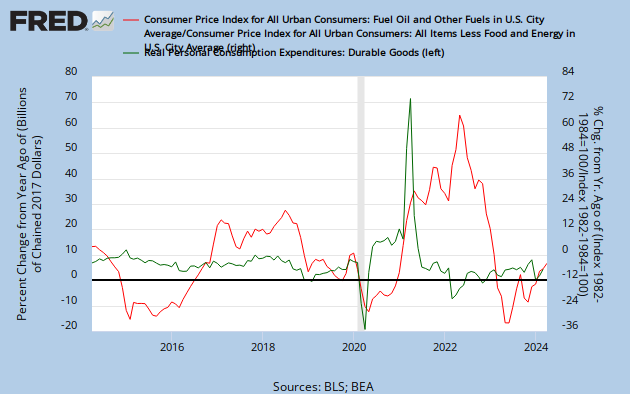
Given that the argument is that more spending on fuel causes less spending on other goods, purchases of durable goods should go down in response to an oil price spike. However, a quick look at the time series suggests otherwise.


As noted by Ritwik, we need to look at durable goods spending in contrast to the amount fuel inflation exceeded regular inflation. So in the graph, blue is the real level of PCE on durable goods, while red is the fuel/oil component of the CPI divided by the part of the CPI less food and energy. From this we do see that although there are some times where oil prices go in the opposite direction of real purchases of durable goods, in general they move together. We can get a more precise image of this by looking at year over year growth rates:


As well as a running correlation of the two graphs. The correlation at any given time looks at the 12 months before the given month including the given month as well as the twelve months after. The thick lines are the thresholds for statistical significance.


This suggests that while rising oil prices sometimes hurt the economy, such as in early 2004 or early 2008, rising oil prices can also be a sign of a recovery, such as in 2009 and 2010.

The mistake the news article makes is that it starts from the price change in oil and then tries to figure out what happens to demand in other goods. Instead, one should proceed from demand and derive the change in price. If the factor pushing up fuel prices is a general increase in income and aggregate demand, that means the gas price rise is a part of a general rise in the price level, meaning purchases of other goods actually increases with the rise in gas prices. However, if the reason gas prices rise is because oil refineries in the Middle East are shut down, crimping aggregate supply, then the rise in the relative gas price would reduce demand for other goods, lowering the overall standard of living in the economy.

This kind of analysis is also powerful in microeconomics when answering the classic question of "what happens to consumer expenditure on other goods if the price of gas rises?" To give a full answer, we have to know what causes the price increase. If the reason gas prices rise is because supply contracts and lowers the equilibrium quantity transacted, then people will buy fewer other consumer goods. But if the reason gas prices rise is because higher incomes push up demand, then we should expect people to buy more consumer goods.

In Econ 101, one could possibly get around the problem by pointing out that a rise in income would cause a general rise in the price level, not the relative rise that is important in microeconomics. However, this does not mean we can reason from a price change in microeconomics.

First, sticky prices for durable goods means that a rise in income will directly increase the relative price of fuel, but this change will still predict an increase in durable goods purchases.

Second, a change in preferences towards something that requires large amounts of gas, such as roadtrips, would increase the relative value of gas while also increasing demand for restaurant food and hotel rooms.

The problem is that price changes are not exogenous; they happen as the result of changes in supply and demand. Outside of corner cases*, there is no such thing as "ceteris paribus, the gas becomes relatively more expensive." Quantity changes always accompany price changes, and supply and demand determine the two. In the case of monetary policy, we should look towards the recent rise in commodity prices with approval, as it is a sign that policy is working by increasing demand and stabilizing nominal GDP.

Wednesday, September 12, 2012

Never Reason from a Price Change

In introductory microeconomics, professors introduce the concepts of substitute and complement goods. In my Econ 101 class at the University of Michigan, the professor stated the concept as:
If two goods are substitute goods, an increase in the price of one increases the demand of the other.
If two goods are complementary goods, an increase in the price of one decreases the demand of the other.
This might make sense in most situations, but my Sumnerian senses are tingling -- why are we reasoning from a price change? What is causing the price of one good to increase, and how does this change whether the demand of the other good to increase or decrease?

Let us first consider the case of substitute goods. If two goods are substitutes for each other, it seems logical to consider that if supply in the second good contracted, pushing prices up, then people would substitute out of that second good and increase demand for the first good. If cars become harder to produce and become more expensive, it's logical that the demand for bicycles will increase. However, does this hold up if the price change was because of a demand shock? If cars became more expensive because demand increased, it seems peculiar to think that the demand for bicycles also increases. Just because it's a price change doesn't mean it's the price change you were looking for.

A similar scenario plays out in the case of complement goods. If two goods are complements, it seems logical to consider that if the supply for one good increases, then the price decrease would increase the demand for the second good. If tortilla chips become easier to make, we can expect the demand for salsa to increase. But does the same hold true if it was a demand shock that caused the price change? If people start demanding more potato chips, pushing up the price, what do we expect will happen to the demand for chip dip?  We would expect it to increase -- directly contrary to what the definition suggests.

Reasoning from a price change fails because it neglects whether the price change in one good is from a change in production technologies or from a change in preferences. If it's a change in technology, the standard analysis applies. However, if it's a change in preferences, we need a more nuanced view that encompasses both modes of analysis.
If two goods are substitute goods, an increase in the equilibrium quantity of one decreases the demand of the other.
If two goods are complementary goods, an increase in the equilibrium quantity of one increases the demand of the other.
So in the market for cars and bicycles, if the equilibrium quantity of cars increases, whether from a supply expansion or a demand contraction, then the demand for bicycles will decrease. This is true regardless of what happens to the price of cars. Similarly, if the equilibrium quantity of potato chips increases, then the demand for chip dip increases -- regardless of where the price for potato chips go. This makes sense because it encompasses the lay person view of substitutes and complements. If I ride my bike more, I drive less. If I eat more chips, I buy more salsa.

The fact that this isn't taught on the first pass around is understandable -- you don't want to confuse the auditorium of 300+ students with a model of both supply and demand when you're introducing the demand curve. But it does pose a problem when there are exam questions such as "Does an increase in price of a complement good raise the demand of the original good?" To which I have to say, "it might". A possible solution is to ask "Holding the demand of a complement good constant, does raising its price raise the demand of the original good?" This would be more comprehensive, and those who understand can better answer the question, while those who don't understand can forget about the first clause and just answer the second question.