Wednesday, August 1, 2012

Money Market Funds and Monetary Policy

A middle ground between Beckworth and Garcia

Recently there's been an interesting back and forth between David Beckworth of Macro and other Market Musings and Cardiff Garcia on the interaction of monetary policy, interest on excess reserves (IOER), quantitative easing, and money market funds, as well as the implications for policy. Garcia puts forth the argument that paying interest on excess reserves is a key mechanism keeping yields on treasuries above zero, which maintains the solvency of money market funds. As a result, cutting interest on excess reserves would be dangerous because it would effectively disable a $2.7 trillion industry that plays a critical role in fodern financial intermediation. This would lead to zero rates on deposits, withdrawal of cash from banks, and massive money hoarding. On the other side, David Beckworth argues that the regime change embodied by a reduction in IOER along with a committment to NGDPLT would spur safe asset creation and allow money market funds to stay afloat in spite of zero IOER. So, yes, while an incremental decrease in IOER would have a negative effect, if only it is combined with a large enough policy change it will be expansionary.

I have previously written on the relationship between money market funds and conventional monetary policy tools such as quantitative easing. The core of the argument is that, in this world of nonlinear expectations, policy results become non-linear and non-monotonic as well.

A major problem with this scenario is that the market response function becomes highly nonlinear. With no policy action the market contracts. With some policy action the market contracts further. Only with outsize policy action are private agents convinced of a stable future NGDP target, and do collateral chains continue to expand. In this situation, it would be hard for a central banker to tell how many asset purchases "would be enough". Consequently, a credible NGDP target becomes even more important. First, it facilitates private safe asset creation. Second, it assures the market that the Fed won't end up in the middle where collateral chains contract and monetary expansion fails to raise output or prices. This is a critical argument in favor of NGDP targeting in an increasingly complex world. In spite of all of the complications in modern finance and banking, stable nominal expectations can help smooth those problems over and maintain the processes of safe asset creation. 

So can lowering IOER improve MMF solvency? Only if, as I have written above, it can translate into higher trend nominal GDP growth. In other words, reducing IOER translates into concrete committments about the future money supply, ala Woodford. Beckworth does point out such a channel:

Here is my take.  The FT Alphaville story fails because it ignores the broader effect of the Fed lowering the IOER.  Such an announcement, if credible, would send a loud signal to markets of more monetary stimulus.  And if done right, this signal would have a huge impact because lowering the IOER is tantamount to saying the Fed is going to permanently increase the monetary base.  A permanent increase in the monetary base implies a permanently higher price level and permanently higher NGDP level down the road.  In other words, lowering the IOER would permanently raise expectations of future nominal spending and income.  As a result, demand for financial intermediation services would increase today as firms, households, and governments planned for the higher level of NGDP.  The increased demand for credit would raise financial firms' net interest margins and more privately-produced safe assets would appear.  No doomsday for MMF and a recovery ensues.

But does it? What I think is missing from the discussion is the importance of zero. When IOER approaches zero while deposit rates are low, there is a non-zero probability for the FT Alphaville scenario to play out, and people start taking out the money as currency and hoarding it. While this adds to the monetary base, it cripples the money supply. Beckworth argues that "demand for financial intermediation services would increase today as firms, households, and governments planned for the higher level of NGDP" but I find that doubtful. Financial markets move quite fast. So if many money market funds suddenly broke the buck and there was another run on the banks, the effect would be severe and immediate. In the words of Garcia.

David assumes that the the signaling effect would be enough to raise companies' demand for loans, and that this would raise banks' net interest margins (meaning that banks wouldn't have to play the MMF funding/excess reserves arbitrage). Even if he is right, this would surely take time, whereas an MMF breaking the buck or a run on MMFs by nervous investors can happen extremely quickly. See: 2008, September.

On the other hand, the real economy inherently contains lags and would respond second. For as much as money market funds are risky ventures, they do help a lot of businesses with payroll and inventory financing. As a result, such a hit to the financial sector would undoubtedly reduce the expectation that nominal GDP was on path to being restored. At this point, if the expectation is uncertain, IOER would not function as an effective regime shift. This is what differentiates lowering IOER from FDR's bold move off of the gold standard. While lowering IOER can have an ambiguous effect, there was no such ambiguity for the gold standard. Inflation expectations were going to go up, real interest rates went down, and investment increased. This, of course, ignores the fact that there was nowhere near a well developed system of shadow banks and money market funds in that era.

Even if IOER was an effective regime shift, the credibility of the new regime is still an issue. If IOER is going to release so much currency, and if that currency really was going to be spent instead of just hoarded, then there could be a massive burst in nominal GDP. If the public does not see such a massive boost in nominal GDP as something the central bank could credibly maintain, then how would the nominal GDP target be credible?

So are there any alternatives? I think the role in IOER in maintaining solvent balance sheets should not be underestimated. It is keeping money market funds afloat, and as a consequence much of the modern financial intermediation sector. Without these banks, much of the buying and selling of treasuries would be hurt, and monetary transmission would be reduced. However, we do need more expansionary monetary policy and must chart a path forward. One proposal is to engage in quantitative easing until a certain dual threshold, such as 7% unemployment or 3% inflation, is reached. Alternatively, the Fed could committ to forward guidance on interest rates while purchasing MBS or more long term treasuries to show its committment to low interest rates in spite of better economic conditions. This would accomplish what Beckworth calls for in committing to a larger future monetary base without jeopardizing the financial stability of money market funds. These would all increase expectations of nominal GDP as a result. But no matter the final option, we cannot neglect the role of IOER in maintaining the financial sector, the key mechanism of monetary transmission, and the possibility of effective monetary policy.

Tuesday, July 31, 2012

Chinese Food Safety: A Few Anecdotes

澳洲进口芥花健康食用油买一送一
自然健康芥花食用油百分之百非转基因

Imported healthy Australian canola oil, buy one get one free
All-natural, non-GMO healthy canola oil

-Selling pitch of canola oil company

Most of the time when somebody mentiones "food safety regulation" in the United States we have an image of senseless bureaucrats requiring firms to jump through hoops to be "certified". As a result, they raise the cost of food and damage the economy. As an alternative to government regulation, the reputation of the firms should be enough to direct consumers to the correct business, as embodied by this econ meme.

But how reliable is this system? I think it may be helpful to look at a few anecdotes from the Chinese situation. And since a picture is worth a thousand words, I'll start with three thousand:


This is the cover of an Australian all-natural canola oil brochure that was being handed out by some young employees outside of a supermarket. They were seated in a stall with their product, pictured below:


Inside the cover, there was this page outlining the health benefits of canola oil versus other kinds of oils:


My Chinese is a bit rough, but I would translate it as:
9. Foreign Expert Advice:

1. United States Food and Drug Administration (FDA):

Through rigorous scientific analysis, based on canola oil's high fatty acid percentage, it is recommended that daily consumption of canola oil be around 1.5 tablespoons (appox. 19 grams). This is effective in reducing the risk for coronary heart disease while not increasing total daily fat intake.

2. Australian Heart Foundation (NHF):

A large body of evidence has shown that use of oils with saturated fatty acid (SFA) content less than 7% sharple reduces the body's supply of bad cholesterol (LDL). Using canola, sunflower, or olive as the base for oils, butters, and other dairy products has already received the NHF's recognition, and they can replace the use of regular butter.
Do you trust the Western doctor in a white coat? What struck me about the brochure was how much it relied on the novelty of being foreign and imported to gain credibility. It's Australian, so it should be safe, and it's good for your health, just look at the evidence from foreign regulatory agencies!

This foreign credibility issue is also prevalent in the baby formula industry, as the 2008 milk scandal terrified parents about the prospect of their babies dying on count of tainted milk. As a result, imported milk formula is bought at a high premium, and people sometimes specially ask their visiting American relatives to bring some American milk formula back. The milk scandal has also resulted in some comical situations in which milk from New Zealand cows is marketed at a premium because it is seen as safer. Government officials then express their shame of Chinese milk not being healthy enough for Chinese people to drink, but there are still suspicions about safety.

The novelty of "foreign milk" touches on an important point about food safety standards. One country's food standards can have positive externalities on other countries; there's a international spillover effect rising from sanitation regimes. Because the FDA has done the work of certifying the benefits canola oil and fatty acids, Chinese consumers can benefit from the peace of mind that Canola oil does have health benefits and is not some quack cure that a Chinese vendor is lying about. This is an especially big deal in China, as it's very hard to verify quality of products. When firms lie, it's hard to control them, and you're never too sure if the government official making the ruling didn't "win" a few million RMB from "card-playing" before approving the product. Consequently, the regulatory regimes from developed countries have spillover effects in China and, I suspect, other developing countries as well.

The fact that the vendor emphasized Australian canola oil also shows why domestic food regulation is necessary, and why the reputation argument is not sufficient. One firm's bad quality has a negative externality on other firms. Once one milk company was found to be producing lethal product, all other domestic milk companies suffered as well. As a result, each firm pays an inefficiently low amount of attention to food safety. This is the point of food regulation, to internalize this externality and try to force each firm to prevent damaging the reputation of others. You see this on the restaurant-chain level as well. A good reason for a chain, such as Taco Bell, to make sure all of its franchises follow health guidelines is because if a news story erupts about one unsanitary Taco Bell, the reputational damage can spread to all Taco Bells. Because coordination costs are higher for independent restaurants and food sellers, regulation can take the place of enforcing safety standards. This way, people can trust their food and not be forced to look abroad when satisfying basic food needs. Note that these reputation externalities make the pigouvian solution, penalizing every instance of bad food quality, less effective. If a firm under-estimates the risk of a safety problem, which is highly likely from what we know about cognitive psychology, this would cause an inefficiently high amount of reputational harm to other firms. There needs to be some intervening factor, possibly market based or separate from the current FDA, before the food is even delivered.

Of course, this is not a full fledged argument to justify every single food regulation. Most of the time, businesses can be differentiated from each other and the bad practices of one do not necessarily have to raise suspicions about others. Just because a Taco Bell is not very sanitary does not mean the Asian Express down the road has to be judged. And maybe lemonade stands shouldn't need over 60 days to be liscenced. But when the problem is serious (babies dying from kidney stones in the case of milk), or hard for individual consumers to verify, regulation can improve welfare, both at home and abroad.

Saturday, July 28, 2012

Two Chinese Sayings

And two economic reflections
Recently, I've been traveling in Hubei, visiting family, and enjoying inland China (without much Internet or economics blogging). In some conversations, two sayings popped up that reminded me of two core economic concepts: the efficient market hypothesis and the danger of prediction. First, the EMH:
"人不认货,钱认或"
"People can't judge goods; money judges goods"
A serious problem with shopping in inland China is that it's extremely hard to judge the quality of goods. Some of the greatest examples are clothing shops. How do you judge which clothes is better than others?
One strategy is to go with certain branded clothing, but it's difficult to tell if they're the actual brand. However, this isn't always reliable because it's hard to tell if the product is fake or real. Remember, this is the land of China, where I-Pad advertising schemes are ripped off to sell smaller "U-Pad" (you-Pad) educational tablets; clothes are even easier to replicate. Clothes are also problematic because there's a serious asymmetric information problem. Only the tailor can know if the cloth will start fraying or if the color will bleed out. Traditional solutions for this "used-car problem", such as risk-free returns, don't function well because it's tough to know if the seller actually recognizes returns. As a result, sometimes the only judge of quality is to make sure that the store looks large enough to signal a rich company, and to make sure the price of the clothes is high enough to signal high quality. Thus, the quote. Buyers may not have the ability to recognize good clothes from bad, but money, the price of the good, certainly does not discriminate.
A second quote:
"淹死的都是会水人"
"Those who drown are all swimmers"
The theory behind the quote is that because only swimmers have the confidence to step into dangerous waters, the ones who drown are almost always swimmers. Those who cannot swim take extra precautions, and thus are less likely to end up among the drowned. The forecasting analog would be "those who are surprised are all forecasters".
This is one of the central problems of forecasting; you always run the risk of being blindsided, and when the decision is high-stakes, the danger is even higher. When planning a picnic with your significant other, the forecasting of whether it will rain (hopefully) is not an extremistan decision; whether it rains or not, the result should be mild. However, when working with highly leveraged financial products, the danger of prediction becomes more apparent. While you are most likely right; the danger of being wrong can be a bit too much to bear. Don't use prediction to form the basis of a fragile decision, a decision that can be fundamentally altered by landing on the wrong side of uncertainty. Because of this, I'm skeptical of prediction markets to truly estimate probabilities. Even if they are as good as, if not better, than professional forecasters, they're still no replacement for robust preparations. No matter how good of a swimmer you think you may be, it might still be good to take a lifeboat when the waters get rough.

Tuesday, July 17, 2012

Monetary Policy: A Blunt Club or a Surgeon's Scalpel?

And a reason why NGDP futures are a critical credibility tool

Should monetary policy be viewed as a blunt club or a surgeon's scalpel? While we often discuss central banks credible actions to accurately hit a policy target, there is less discussion on whether central banks can precisely hit a target. Because while both blunt clubs and surgeons' scalpels can wound and hurt, a club "beats around the bush" while a scalpel (ideally) targets a specific, well defined area. In the language of monetary policy, we know central banks can raise the level of nominal GDP growth, but can they precisely control the magnitude of the increase? How much of a base injection does the central bank do to make the potatoes hot enough without burning our fingers? This precision problem is at least as important as the accuracy problem because it is a key reason for why explicitly declaring a five percent nominal GDP level target is not sufficient. Because there are real costs of extremely high inflation, the central bank is likely to shy away from policies that might "accidentally" lead to excessively high inflation. If economic variables become more volatile, the lack of monetary policy precision can become a major barrier to monetary policy accuracy.

The core of my argument starts from a mechanics-credibility theorem, which states that if policy does not have a concrete mechanism, it can not be credible. This theorem means raising nominal GDP can be credible. We know that central banks have an infinite number of ways to inflate: currency depreciation, asset purchases, forward guidance, nominal GDP futures targeting, among other options.

However, what does the theorem say about policies to raise nominal GDP to a specific, precise level? What do we have to guarantee this? A typical market monetarist response would be that expectations bridge the gap. Because private agents believe that the central bank will raise nominal GDP to reach trend growth, the market will do the work for the central bank. They will invest in riskier assets, hire more people, engage in more research and development projects, and other ventures up until current nominal GDP returns back to the trend line. Once we're back at trend growth, the central bank can just moderate the economy without too much work because the perfectly credible declaration will induce the market to stabilize itself. 

Although this logic is appealing, it is nonetheless circular. According to this line of argument, a precise target is credible because the central bank will inevitably hit the target, but the reason the central bank is precise is because it is credible. Before we can wave the magic wand of expectations, we need to show that there exists a vanilla, "elbow grease" monetary action that can credibly hit a target with both accuracy and precision.

In normal times, the relationship between the short term nominal interest rates is reasonably stable, and central bankers can manipulate the short term rate quite effectively to stabilize nominal GDP. This is a game that the Federal Reserve has played for the entire Great Moderation. However, once the economy is in a liquidity trap, the short term rate loses its effectiveness, and other more drastic measures are needed. Now that we're in uncharted territory, here is where the precision problem arises.

Take asset purchases for example. As noted by Miles Kimball, these asset purchases can have large effects, if implemented on a large scale. There are certain monetary frictions that allow quantitative easing to break out of the liquidity trap, but for those frictions to exert an appreciable effect quantitative easing must take place at a large magnitude. A specific friction that I see is Kiyotaki and Moore's liquidity friction, which states that the bonds central banks purchase are not as liquid as the cash that central banks dish out. Bonds cannot be sold as quickly, so the large stock of bonds represents a promise that the central bank will maintain a higher monetary base in the future. This is how the central bank gets around the Woodford, "double the monetary base in this period and all subsequent periods" credibility problem. While central bank declarations of a future elevated monetary base may not be seen as credible in light of inflation targeting, committing to large scale bond purchases commits the central bank to a brief period of above average inflation by locking in the larger monetary base. In the words of Brad DeLong:

But purchasing bonds for cash has another effect. Cash is a perfect substitute for short-term Treasury bonds now. It won't always be the case. When interest rates normalize, the price level will be roughly proportional to the high-powered money stock. Not all of today's purchases of bonds for cash will be unwound when the economy exits the zero lower bound. If we believe that the high-powered money stock will be roughly $1 trillion after exiting the zero lower bound, and if we believe that a fraction λ of marginal bond purchases won't be unwound, then an extra $100 billion of quantitative easing boosts the expected price level ten years hence by 1%--and boosts expected inflation after the next decade by an average of 0.1%/year. That is enough to spur higher spending and a more rapid and satisfactory recovery.

The problem with this approach is that it is not robust to shifts in expectations. Working with Brad's terminology, λ is positively correlated with the scale of bond purchases. As a result, expected inflation is non-linear with respect to bond purchases. Initial bond purchases may not raise inflation expectations by much, but past a tipping point at which λ start rising quickly, inflation expectations could drastically shift. Even if such bond purchases occur at a steady rate so as to avoid sudden changes, expectations can still suddenly shift if an unforecasted shock occurs. If key economic parameters, such as money velocity, become increasingly unstable, expectations fragility will only grow worse. An example of this kind of "expectation fragility" is with the Swiss National Bank's currency floor. While the fundamental value is below the floor, we get suppressed volatility. Once the fundamental value rises, even if it's purely because of static, there can be lots of chaos as a previously fixed price is now allowed to move. In the context of monetary policy, given the large stock of currency reserves, a slight unforecasted rise in inflation expectations can be the trigger for a massive investment reallocation.

Lars Svensson, in his paper on a "foolproof" way to leave a liquidity traps, also highlights this uncertainty:

It is difficult to determine how large an open-market operation would be needed to reduce the long interest rate, because of difficulties in estimating the determinants of the term premium of interest rates (that is, the difference between long and short interest rates and its dependence on the degree of substitutability between short and long bonds). However, Bernanke (2002) has proposed an elegant operational solution to this problem. The central bank simply announces a low (possibly zero) interest-rate ceiling for government bonds up to a particular maturity, and makes a commitment to buy an unlimited volume of those bonds (that is, potentially the whole outstanding volume) at that interest rate. This commitment by the central bank is readily verifiable – since everyone can verify that the central bank actually buys at the announced interest rates – and achieves the desired impact on the long interest rate, without a need to specify the precise magnitude of the open-market operation required. The central bank may have to buy the whole outstanding issue of the long bond, though.  

In the absence of an expectations mechanic, there is a wide range of uncertainty on the policy response. Other forms of unconventional monetary policy, including currency depreciation or forward guidance, all suffer from this "how much is too much?" problem. Once you inject a few non-linearities into the stories, and have market expectations change at unknown threshold, you realize that prospects for precision are grim.

When the monetary policy result is uncertain, central banks are less likely to use the tools to raise nominal GDP. They may fear excessively high inflation or other side-effects of over-expansionary monetary policy, and choose to be "cautious" and live with high levels of unemployment instead. This is the reason why limits in precision can become limits in the accuracy or effectiveness of monetary policy.

A historical counter-example to this theory of uncertainty would be FDR's dollar devaluation program, which Scott and Marcus Nunes have shown to be very effective in restoring both the price level and output during the Great Depression. Yet I  don't find their example to  contradict my argument about the imprecision of monetary policy at the zero lower bound. Perhaps FDR got lucky. Perhaps the price level was already so depressed that you would have needed hyperinflaiton. Perhaps, back then, finance was not as tightly coupled and the investment effects of getting out of treasuries wouldn't have been as strong. Nonetheless, in our faster, more leveraged, more volatile world, this granularity and imprecision of monetary policy is a bigger impediment.

Scott Sumner often uses Australia as another example, pointing out that their monetary base to nominal GDP ratio is much lower than that in the United States. This shows that Australia has not had to inject as much money into their banking system to stabilize nominal GDP, demonstrating that the stabilizing nominal GDP growth should not be very difficult. But Australia is unique in that it never was at risk of the zero lower bound. While part of this may have just been good monetary policy, it still leaves open the possibility of a large, unforecasted shock that puts a county at the zero lower bound.

However, one form of nominal GDP targeting seems to sidestep these problems: nominal GDP futures targeting. This would allow market participants to instantly improve estimates of future inflation by bidding on futures contracts. Their bidding one way or another would immediately translate into changes in central bank open market operations such that nominal GDP always stays on track. This approach sidesteps the non-linearity of expectations because it allows the market to aggregate all the necessary information and automatically has the central bank adapt to the new found information. Even if expectations did shift in response to unforecasted shocks, the policy response would be immediate and taken in decentralized steps as individual investors bid on futures contracts. In this case, mechanics-credibility theorem is satisfied because the mechanic by which the Fed earns its nominal GDP credibility directly interacts with market expectations while avoiding the circularity problem. Market expectations of nominal GDP feed into futures market volumes, which directly changes the monetary base. The market answers the questions of "how much" with the level it thinks is "just right".

This is one of the key advantages of an nominal GDP futures targeting regime relative to a conventional "wait-and-see" regime. It cements in credibility, and rolls with the waves of external volatility. In a sense, it floats like a butterfly and stings like a bee. It takes monetary policy from the world of "Bernanke Smash" to "Sumner Slice", and allows for greater accuracy and precision in the control of a central nominal aggregate: nominal GDP.

Thursday, July 12, 2012

Monetary Axioms II: The Movement of Expectations with Respect to Shocks

Pity that these concepts are "counter-intuitive"

I quite enjoyed my last definition/proposition/lemma/theorem post, and although many of the statements were axiomatic or self-evident, they led me to an interesting realization about current nominal GDP growth, credible monetary policy, expected future nominal GDP growth,  and interest rates.

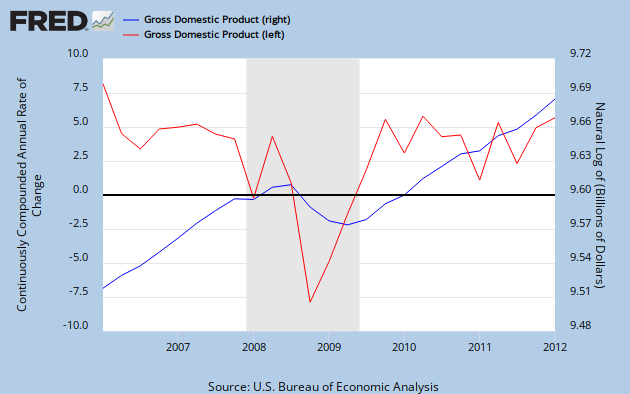
While we often talk about nominal GDP gaps, I would like to start the drawing and theorem process by looking at graphs of nominal GDP growth. Below is a graph of log nominal GDP (right) and continuously compounded annual rates of nominal GDP growth (left), both reported quarterly.

Inline image 1

In terms of calculus, nominal GDP is the level of the variable, whereas the growth rate is the instantaneous derivative. Note that although the level falls significantly from its previous trend, the growth rate returns to a value that's similar to its pre-crisis trend. However, even a temporary shock in the growth rate can cause a permanent fall in the level if there is not a restoring amount of growth after the shock.

By looking at the growth rate, we can determine the size of the output gap by integrating, or looking at the area. The integral of the growth rate minus the integral of the trend rate is the size of the output gap, as shown in the stylized diagram below in which trend growth is simplified, without loss of generality, to 0%.


From this, we can see that growth rate targeting can leave large gaps in the actual level. Since the central bank moves the growth rate to the precrisis rate of 0, it leaves the output gap. This can be corrected by level targeting, which tries to get the level of the variable back to pre-shock trend growth. This entails a period of growth above 0 to balance the output gap. How much higher? For how long? Mathematically, the integral of the curve over this time period should be zero. Graphically, it means that the higher rate must be sustained until the blue area (positive growth) minus the red area (negative growth) equals zero. This means the red and blue areas should be the same.


By the calculus definition, the average of a function over an interval is the integral of the function over the interval divided by the size of the interval. In this context, it means that the average growth of nominal GDP over the entire period is zero, the original trend growth rate. We have therefore successfully targeted the level of nominal GDP.

To start looking at credible nominal GDP targeting in this framework, let's define some time lengths:

Definition: The crisis time (c) is the period of time starting with the formation of the output gap to the conclusion of the policy response.

Definition: The expectation horizon (e) is the period of time that economic agents forecast and use to determine their expectation of future nominal GDP growth.

For the discussion below, I will assume that before the negative shock, economic agents were unable to forecast the shock; this is the reason why the credible level targeting didn't solve the shock before it happened. However, once the shock takes place, economic agents are fully aware of the time path of nominal GDP growth that occurs as a result of the shock and policy response. Importantly, agents know that the central bank is committed to level targeting, and that this declaration is credible. This means that the private sector knows the areas, red and blue, will be the same in the end. 

In reality, these would all be expectations. But I will accept the rational expectations hypothesis that expectations match the reality for the purposes of this benchmark model.

Let us start with a special case, in which the expectation horizon is equal to the crisis time, as pictured below.


What is the expectation of economic agents of average nominal GDP growth over the expectation horizon at time to? As both areas are equal to each other, the integral over the expectation horizon is zero, so average expected nominal GDP growth is also zero. No surprise there. But what about at some time in the middle of the output gap, say at tm? The integral is then positive! The integral is represented in the graph below by the blue area minus the pink area (note that trend growth is zero after the policy response). As you can see, the blue area is larger, making the integral positive. Because  expected average nominal GDP growth is the interval divided by the expectation horizon e, the expectation of nominal GDP growth also becomes positive.

As a result, if monetary policy is perceived as credible enough to solve the shock in the same interval as the expectation horizon, a current negative nominal GDP shock manifests itself in increased expectations of nominal GDP growth over the expectation horizon. The graph would look something like this:

A similar result is obtained if the expectation horizon is greater than the crisis time (e>c). Just move to+e to the right, and both the nominal GDP growth and the expectation curves return to zero at to+c.

This result might seem puzzling, as this hardly seems like what happens in real life. To get to "real life" monetary policy, imagine a world with highly inertial policy, such that the crisis period is longer as policy takes more time to respond and the output gap lasts longer as a result. We would be in a world such as that below:

From here, the growth expectation at time to is the value of the pink area divided by e. Although e is chosen such that to+e is to the left of the policy response, as long as e is less than c, the expectation will start out negative. The expectation curve moves forward in a different manner compared to the e=c case. The expectation does become positive when the [to, to+e] interval only covers the blue portion. As a result, the expectation over the period looks like this:

Note that the exact curvature is dependent on the function for the shock and the expectation horizon. But it should be noted that the max/min of the expectation curve should not go past the max/min of the actual path for nominal GDP growth.

Flipping the directions of the output gap and policy response gives us the result for a positive aggregate demand shock, and they are, predictably, the opposites of the ones we obtain for a negative shock.

This long and winding road then allows us to conclude the following:

Theorem: Given a monetary regime that has a credible nominal GDP level targeting policy:
  1. If the crisis period is greater than the expectation horizon, expectations of nominal GDP will be procyclical to current nominal GDP growth.
  2. If the crisis period is less than or equal to the expectation horizon, expectations of nominal GDP with be countercyclical to current nominal GDP growth.
This gives us a yardstick to judge if a monetary policy is credibly level targeting for a variety of expectation horizons. Most importantly, if treasuries of varying maturities are correlated with expected nominal GDP growth over the treasuries' time periods, then we can look at the movement of treasuries to judge forecasts of crisis lengths in credible level targeting regimes. The treasuries with yields that rise have maturities beyond the crisis period, while the treasuries with yields that fall have maturities within the crisis period. This also solves the data problem, as we now can find out the market's observations about current GDP growth by looking at its expectations of future NGDP growth.

Although the model outlined above discusses level targeting, it can be extended to rate targeting as well. Think of rate targeting as a form of level targeting whose "policy response" is to hope a positive shock comes the other way in the future. In effect, rate targeting is level targeting with an extremely long crisis period. As a result, shocks to nominal GDP growth in a rate targeting regime almost fall into the first case of the theorem for most expectation horizons. By this theory, current yields on long term treasuries betray a very negative outlook on future nominal GDP.


As this model uses interest rates as a way of gauging expectations, they work the best when interest rates are allowed to float and communicate information. If these interest rates were targeted, the central bank would be suppressing a key source of information. This is another advantage of a NGDP futures level targeting regime versus an interest targeting regime. High interest rates won't be confused for "tight money" if the interest rate is determined by the market.


This post should remind us that Market Monetarism is a world of non-linear causality and counter-intuitive movements in both expectations and interest rates. Except they wouldn't be counter-intuitive and these arguments would be self evident if policy actually targeted the level of nominal GDP. Alas, the Fed does not. A great shame, for both both our learning of intuition and suffering in this nation.

Edit (7/13/2012): Fixed the grammar in the last three paragraphs, no substantive change in the message.

Wednesday, July 11, 2012

Axiomatic Monetary Credibility

Credibly defined and extended

We spend a lot of time discussing the credibility of monetary policy, but there is a lack of firm axioms that define when monetary policy is credible or, more importantly, how we can tell when it's not. This post is an attempt to formalize some of these definitions, lemmas, and theorems, which may later lead to some interesting proofs.

One of the simplest investigations of this credibility problem is Kyland and Prescott's analysis of dynamic inconsistency. The model points out why monetary authorities always have incentives to  excessively inflate. If the private sector expects price stability, then a burst of unexpected inflation is likely to boost real output in the short run. The central bank then has an incentive to renege on its promise for price stability and inflate, even though it contradicts with the original goal of price stability! The central bank, at any given point, would want price stability for the future, but would want to inflate now. This is why the situation is called "dynamic inconsistency". In maximizing welfare, the central bank's current actions are inconsistent with its future planned actions. As a result, agents in the economy learn to not trust the central bank's promises of low inflation, breaking down the Philips curve relation as inflation is always rationally expected.

How does a central bank get around this credibility problem? Barro and Gordon show that, if the central bank keeps inflation low in good times, then private sector agents are more likely to believe that the central bank will always keep inflation low. Through repeated games, the private sector learns that the central bank is committed to the inflation target, and the central bank no longer has an incentive to renege. The repeated interactions shape private sector expectations of future inflation as well.

Barro and Gordon, in spite of their insightful analysis, do not provide a rigorous definitions. Later reviews characterize their view of credible policy as "policy which the private sector believes will be carried out in the context of a particular reason that might lead them to believe that it will not." But let us first define what the central bank is doing. Suppose that the central bank is targeting a policy variable, which has both a value and a time. This is the starting point for the following two definitions:

Definition: A policy variable is an economic indicator, whether level or rate, at a given point in time.

Definition: A target is the desired value or range of values for a policy variable.

Then credibility needs to incorporate the policy variable concept and expectations. I propose:

Definition: A credible policy is a policy that aligns expectations of the policy variable(s) with the target.

So a credible inflation target is one that aligns expected inflation over the course of a year with a point target, such as 2%, or an interval, such as between 1 and 3 percent. A credible nominal GDP level target results in expectations that NGDP next year will be at a level that meets a 4.5% trendline. A credible exchange rate floor aligns expectations of the instantaneous currency value with the floor value.

The Swiss case is a good example for credibility because the floor is holding in spite of increased asset purchases on part of the SNB. So short term fundamentals haven't affected the exchange rate. For inflation targeting, the stability of long run inflation expectations is a good example. Given credible inflation targeting, one would expect inflation expectations to resemble the Cleveland Fed figure below.

Inline image 1

Note that although the short term expectations are very high, they quickly converge back to around the long run target of 2%. In spite of the temporary shock to the price level, economic agents are confident that monetary authorities will push the price level back down to the long run target. In both of these examples, shocks have no effect on long term expectations. This suggests a lemma:

Lemma: If the central bank follows a credible policy with a predetermined policy target, current conditions can only move expectations of the policy variable within the policy target.

This lemma is just a trivial application of the definition. The credible policy guarantees that the expectation of the policy variable stays within the policy target. Because the policy target is predetermined and unchanged by current conditions, then the expectation of the policy variable still stays within the same policy target. However, current conditions may move the expectation within the interval.

Now we turn our attention towards how credibility is established. If credibility is established through Barro and Gordon's repeated game mechanism, then there must be a history of hitting the target for policy to be credible. How long does this history need to be? It seems that it is highly dependent on how often a central bank can prove itself. The Swiss National Bank has no problem convincing investors it'll defend the currency floor; forex markets tick every second of every day. But for a central bank to show that it can hit a NGDP target consistently, the task seems a bit more difficult. Nonetheless, it is probably true that the central bank needs time and repeated iterations to show that it can hit a target.

Proposition: Monetary policy credibility is obtained through the central bank repeatedly hitting its target.

The following is a proposition on the nature of policy variables, such as inflation, nominal GDP, or exchange rates

Proposition: Policy variables are occasionally subject to long lasting shocks in the absence of policy.

This implies that other factors beyond an individual central bank's policy affect policy variables. Inflation, in a world where it's not targeted, is subject to various pressures, whether trade balances, velocity fluctuations, or loose fiscal policies. A cursory look at any Fred graph shows that inflation can be volatile even with intervention, suggesting that the fluctuations would be larger without policy.

Theorem: If policy does not have a concrete mechanism, it can not be credible

Proof: Assume policy is credible without a mechanism. The volatility proposition implies the system will be subject to a shock. A shock to the system causes the policy variable to deviate from its planned path. Policy has failed to control its target. By repeated interations, policy is no longer credible. The contradiction implies the assumption is wrong.

This is a reason why central banks during the gold standard could credibly promise to bring prices down, but could not promise to always bring prices up. The interest rate has no upper bound, so central banks could always pull money out of the economy. But once the central bank started lowering interest rates to boost prices, gold outflows would devastate its balance sheet. The gold standard example is particularly illuminating because it shows how credible policies in certain areas lead to "incredible" policies in others. Because the gold peg was credibly sustained, price stability could not be credible. Shocks to the price level could not be controlled because there was no longer a specific mechanism to control prices. By similar logic, India's attempts to stop the devaluation of the rupee are not credible because there's no infinite forex intervention that can stop the rupee's slide without also contracting monetary policy. Given that the Reserve Bank of India has shown no signs it wishes to tighten monetary policy, the forex intervention is not credible because the mechanism is not infinite.

These credibility problems extend across all "impossible trinities", whether it's Fleming's capital mobility, independent monetary policy, exchange rate peg trinity, or Rodrik's deep integration, sovereignty, and democracy trinity. Those trinities are impossible because there is no mix of mechanisms that can control all three of those at the same time. To take Fleming's example on the conduct of international monetary policy, if a currency peg, as a side effect, keeps domestic monetary conditions stable, then the currency peg mechanism is not conflicting with the independent monetary policy mechanism. As a result, a policy with all three is credible. Now that we're talking about combinations of policies, let us establish some definitions.

Definition: A policy bundle is a set of policies that each try to hit their own targets.

Definition: A credible policy bundle contains a set of credible policies.

This leads to a lemma:

Lemma: If a target is added to a policy bundle, if the mechanism for the new target prevents the functioning of a previous mechanism, the policy bundle is not credible.

Proof: Once a new mechanism negates a previous mechanism, that policy is no longer Fully Credible. Then by definition, the Policy Bundle is no longer credible.

This listing of ostensibly obvious statements provides a framework of more rigorous treatments of market monetarism. Given the major criticism of market monetarism as policy without a well defined model, working our way up from these basic propositions forces us to outline our collective assumptions that can form the basis of larger models.

Thursday, July 5, 2012

Two Notes on China

First, a terrifying, almost hilarious quote on inland China's construction industry:

However, some fear that buyers of its concrete mixing machines are doubling up on their debt by using new machines as collateral for further loans. The concrete mixing companies are then selling their ready mixed concrete on credit to cash-strapped property developers.
Analysts at Jefferies in Hong Kong, who went to Jiangsu province to study the concrete market in April, say that more than half of the concrete machines sold in the first quarter by Zoomlion had not even been switched on. Customers were putting the machines in storage and only wanted them to generate cash that they need to pay salaries, electricity bills and buy raw materials. 

There's no way that can end up badly.

Second, an interesting ad I saw while reading the (online) New York Times:


Translation:

Euro falling? You can make money from this fall!
In a world of a collapsing Euro, stumbling stock market, fiercely rising oil prices, ballooning gold, how do you make money? At Xianqiquan (company name) dealer, make fast returns - in less than hour earn back 85% of your investment!

Forex traders are everywhere! This followed up with catching a random cellphone conversation snippet that began with "The American economy isn't doing that well" made for an interesting evening.