Showing posts with label Price. Show all posts

Friday, September 21, 2012

Never Reason from a Price Change: Commodity Price Edition

The Federal Reserve's historic announcement of open ended QE3 has sent the stock markets soaring, both at home and abroad. However, there's a persistent concern that QE3 will hurt the economy through higher commodity prices. However, this view is misplaced and violates a fundamental rule of macroeconomic analysis: never reason from a price change.

Consider the following news article:

WASHINGTON (AP) — Higher gas prices are crimping consumer spending and slowing the already-weak U.S. economy. And they could get worse in the coming months. 
The Federal Reserve this week took steps to boost economic growth. But those stimulus measures are also pushing oil prices up. If gas prices follow, consumers will have less money to spend elsewhere. 
The impact of the Fed's actions "is likely to weigh on the value of the U.S. dollar and lift commodity prices," said Joseph Carson, U.S. economist at AllianceBernstein. "We would not be surprised if (it) fueled more inflation in coming months, squeezing the real income of U.S. workers."
Given that the argument is that more spending on fuel causes less spending on other goods, purchases of durable goods should go down in response to an oil price spike. However, a quick look at the time series suggests otherwise.


As noted by Ritwik, we need to look at durable goods spending in contrast to the amount fuel inflation exceeded regular inflation. So in the graph, blue is the real level of PCE on durable goods, while red is the fuel/oil component of the CPI divided by the part of the CPI less food and energy. From this we do see that although there are some times where oil prices go in the opposite direction of real purchases of durable goods, in general they move together. We can get a more precise image of this by looking at year over year growth rates:
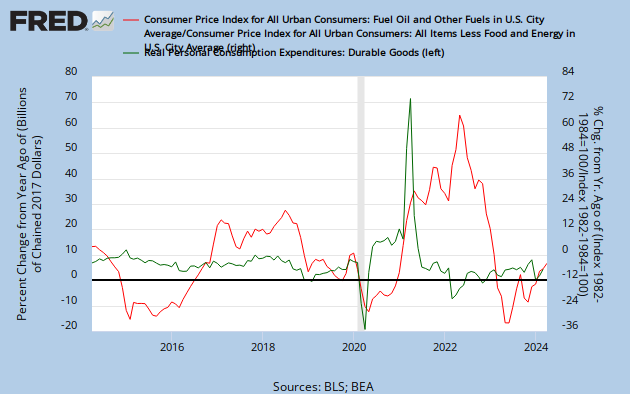

As well as a running correlation of the two graphs. The correlation at any given time looks at the 12 months before the given month including the given month as well as the twelve months after. The thick lines are the thresholds for statistical significance.


This suggests that while rising oil prices sometimes hurt the economy, such as in early 2004 or early 2008, rising oil prices can also be a sign of a recovery, such as in 2009 and 2010.

The mistake the news article makes is that it starts from the price change in oil and then tries to figure out what happens to demand in other goods. Instead, one should proceed from demand and derive the change in price. If the factor pushing up fuel prices is a general increase in income and aggregate demand, that means the gas price rise is a part of a general rise in the price level, meaning purchases of other goods actually increases with the rise in gas prices. However, if the reason gas prices rise is because oil refineries in the Middle East are shut down, crimping aggregate supply, then the rise in the relative gas price would reduce demand for other goods, lowering the overall standard of living in the economy.

This kind of analysis is also powerful in microeconomics when answering the classic question of "what happens to consumer expenditure on other goods if the price of gas rises?" To give a full answer, we have to know what causes the price increase. If the reason gas prices rise is because supply contracts and lowers the equilibrium quantity transacted, then people will buy fewer other consumer goods. But if the reason gas prices rise is because higher incomes push up demand, then we should expect people to buy more consumer goods.

In Econ 101, one could possibly get around the problem by pointing out that a rise in income would cause a general rise in the price level, not the relative rise that is important in microeconomics. However, this does not mean we can reason from a price change in microeconomics.

First, sticky prices for durable goods means that a rise in income will directly increase the relative price of fuel, but this change will still predict an increase in durable goods purchases.

Second, a change in preferences towards something that requires large amounts of gas, such as roadtrips, would increase the relative value of gas while also increasing demand for restaurant food and hotel rooms.

The problem is that price changes are not exogenous; they happen as the result of changes in supply and demand. Outside of corner cases*, there is no such thing as "ceteris paribus, the gas becomes relatively more expensive." Quantity changes always accompany price changes, and supply and demand determine the two. In the case of monetary policy, we should look towards the recent rise in commodity prices with approval, as it is a sign that policy is working by increasing demand and stabilizing nominal GDP.

Wednesday, September 12, 2012

Never Reason from a Price Change

In introductory microeconomics, professors introduce the concepts of substitute and complement goods. In my Econ 101 class at the University of Michigan, the professor stated the concept as:
If two goods are substitute goods, an increase in the price of one increases the demand of the other.
If two goods are complementary goods, an increase in the price of one decreases the demand of the other.
This might make sense in most situations, but my Sumnerian senses are tingling -- why are we reasoning from a price change? What is causing the price of one good to increase, and how does this change whether the demand of the other good to increase or decrease?

Let us first consider the case of substitute goods. If two goods are substitutes for each other, it seems logical to consider that if supply in the second good contracted, pushing prices up, then people would substitute out of that second good and increase demand for the first good. If cars become harder to produce and become more expensive, it's logical that the demand for bicycles will increase. However, does this hold up if the price change was because of a demand shock? If cars became more expensive because demand increased, it seems peculiar to think that the demand for bicycles also increases. Just because it's a price change doesn't mean it's the price change you were looking for.

A similar scenario plays out in the case of complement goods. If two goods are complements, it seems logical to consider that if the supply for one good increases, then the price decrease would increase the demand for the second good. If tortilla chips become easier to make, we can expect the demand for salsa to increase. But does the same hold true if it was a demand shock that caused the price change? If people start demanding more potato chips, pushing up the price, what do we expect will happen to the demand for chip dip?  We would expect it to increase -- directly contrary to what the definition suggests.

Reasoning from a price change fails because it neglects whether the price change in one good is from a change in production technologies or from a change in preferences. If it's a change in technology, the standard analysis applies. However, if it's a change in preferences, we need a more nuanced view that encompasses both modes of analysis.
If two goods are substitute goods, an increase in the equilibrium quantity of one decreases the demand of the other.
If two goods are complementary goods, an increase in the equilibrium quantity of one increases the demand of the other.
So in the market for cars and bicycles, if the equilibrium quantity of cars increases, whether from a supply expansion or a demand contraction, then the demand for bicycles will decrease. This is true regardless of what happens to the price of cars. Similarly, if the equilibrium quantity of potato chips increases, then the demand for chip dip increases -- regardless of where the price for potato chips go. This makes sense because it encompasses the lay person view of substitutes and complements. If I ride my bike more, I drive less. If I eat more chips, I buy more salsa.

The fact that this isn't taught on the first pass around is understandable -- you don't want to confuse the auditorium of 300+ students with a model of both supply and demand when you're introducing the demand curve. But it does pose a problem when there are exam questions such as "Does an increase in price of a complement good raise the demand of the original good?" To which I have to say, "it might". A possible solution is to ask "Holding the demand of a complement good constant, does raising its price raise the demand of the original good?" This would be more comprehensive, and those who understand can better answer the question, while those who don't understand can forget about the first clause and just answer the second question.