Showing posts with label Eurozone. Show all posts

Sunday, June 24, 2012

A Currency Union by any Other Name

...still suffers from the same adjustment problems

Recently there's been a spurt of discussion on the part of Simon Johnson and Paul Krugman on Optimum Currency Areas and productivity growth, and Nick Rowe is still a bit confused. Why should productivity growth differentials matter? Nick lists out a variety of thought experiments and finds no satisfactory answer. As he says, "There must be something else. Some other hidden (to me) assumption they are making. What is it?" With some thought, I believe the "something hidden" is something that market monetarists (including Nick Rowe) have written extensively about: nominal GDP.

Why nominal GDP? Because it's the "something" that can link "productivity differentials, current account deficits, and exchange rate regimes".

First, let's talk about the relationship between higher productivity growth and higher nominal GDP. At least within the United States, productivity growth has a strong correlation with nominal GDP growth. A 1 percentage point in YoY multifactor productivity predicts about a 0.66 percentage point increase in nominal GDP growth. This observation is likely compounded by the Balassa-Samuelson effect, which would imply higher inflation in the regions with higher productivity growth. In terms of the AS/AD model, if the AD curve has a price elasticity of greater than 1, positive AS shocks boost nominal GDP. Fiscal policy is not an answer, as politicians are rarely going to pull back during a boom. And if monetary policy intervenes to cool down the growth, this puts the brakes on nominal GDP growth for the rest of Europe, thus compounding the asymmetric shock problem. Either way, a permanent productivity differential can lead to permanent nominal GDP growth differentials, even if the central bank targets mean nominal GDP growth.

Nominal GDP also can help explain exchange rate regimes and current account deficits. As Scott often reminds us, "You decide whether a currency is under or overvalued by looking at whether aggregate demand is at an appropriate level." And what measures aggregate demand? Nominal GDP. Consequently, if we shift discussion to nominal GDP growth rate differentials, we can talk more intelligently about exchange rate issues. The rate of nominal depreciation of one country's currency vis-a-vis another should equal the difference between the first country's NGDP growth rate and the second country's NGDP growth rate. Thus, if one country has lower NGDP growth than the second, the currency of the first should also depreciate. However, this cannot be the case in the present environment. As Evan Soltas has noted, the Euro has recreated the world of the gold standard. The Euro prevents currency depreciation. Instead of depreciating currencies, we have falling nominal GDP. Countries like Spain and Greece are forced to grind through internal devaluations, imposing massive costs on their citizens.

By refocusing on nominal GDP, a lot of the questions Nick and others are asking become much clearer. Why does a permanent differential in productivity growth matter? Because it implies a permanent differential in NGDP growth, which causes pressures for an exchange rate to change. But because the euro pegs the exchange rates all together, the pressure manifests itself as internal devaluation, which carries very severe negative consequences on count of sticky wages/prices and safe asset shortages. Why does a permanent differential in productivity levels not matter as much? Because if productivity growth rates are the same, there is no differential in nominal GDP. Therefore there's no pressure for currency adjustment. Productivity growth may not force trade deficits, but it can still cause nominal GDP differentials.

Why do fiscal transfers matter? Because in a gold standard world, fiscal transfers between regions (countries) can affect regional NGDP growth. Fiscal transfers are a crude way of "taking" aggregate demand in one region and putting it in another. Fiscal transfers do what domestic central banks can not; stabilize country level NGDP growth. This is politically justifiable if shocks are temporary and distributed among the countries. But when one country has permanently higher real growth and nominal GDP growth, that country will be permanently paying transfers to the others. This is the political problem to which Krugman and Johnosn refer. These permanent NGDP differentials necessitate a one-sided transfer union, which we do not have. As a result, we see the painful process of internal devaluation in periphery countries.

A narrative in terms of nominal GDP also subsumes discussions about unit labor costs. By the New Keynesian business cycle model, lower nominal GDP growth rates arise because of higher real wages or labor costs. So the lower nominal GDP growth in the periphery raises the real wage, rendering the periphery uncompetitive. This is then a more concrete reason why internal devaluation is the only option in a world without transfers or national currencies. Unit labor (and capital) costs need to adjust.

We can now try to answer Nick's thought experiment on a country filled with both low-productivity "Greeks" and high-productivity "Germans", If you separated them, you would observe that the Greeks would have lower growth in nominal production relative to the Germans. This would manifest itself in a growing income gap over time. But what keeps countries together? First, there's "labor mobility". There's no reason  why the Greeks have to stay Greek; maybe they can intermarry and become high-productivity Germans. Second, there's "transfer payments", along the lines of social welfare. High productivity Germans are taxed to pay transfers to the low productivity Greeks. And as in the currency union, the Germans will likely complain about having to subsidize the laziness of the Greeks. If the Greeks can't fight for these policies in the sober halls of Parliament, they can threaten an "exit".This is the basic story behind nationalist secession.

Friday, June 22, 2012

Eurozone Breakup Probabilities

Quick, look at the prediction markets!

The Intrade prediction markets currently predict a 30% chance that one country will leave the Euro by the end of 2012, a 59% chance that one country will leave by the end of 2013, and 60% chance that breakup will happen by the end of 2014. Looking at the graphs for the period since June 10, one can see that the June 17th election results brought down the two nearer term probabilities by a substantial amount, while the longer term 2014 probability barely moved.

It's also helpful to look at the spreads between the 2013 and 2012 prices and between the 2014 and 2012 prices.


From the graph of the spreads, it's very obvious that the markets perceived the recent election as just "kicking the can down the road". Longer term probabilities diverged from the near term ones, but the longer term probabilities converged to each other. From this data, it seems that the markets perceive the probability of a breakup by 2014 is almost equal to the probability of a breakup by 2013. Either way, things look bleak for the Eurozone.

Friday Roundup

Some more bond vigilante-unsustainable debt commentary for the UK. The analysis is peculiar because the question is why so many people are willing to invest in UK bonds now. If expectations for the future are dour, why would investors have faith now? This may be linked to the story on a possible bubble in US government bonds. Current demand for safe assets is because of collateral needs; once the economy recovers borrowing costs are going to skyrocket.

Koo takes a close look at Eurozone fiscal and monetary union dynamics, and concludes that neither system deals with balance sheet recessions effectively, especially as they are often asymmetric shocks. An interesting point is that monetary policy, when it tries to ease the impact of these shocks for certain states (ie Germany), the cheap credit causes new problems in other countries. For as much as the ECB pursues "Deutschland über alles", there may be nothing left to be over if the monetary union doesn't develop a system of interstate transfers.

Demand for safe assets doesn't necessarily lead to a shortfall in aggregate demand...only if monetary policy can function as an offset. Is the German current account surplus sucking up your country's growth? Not if your central bank holds tight to a nominal aggregate and keeps growth on track. Just as Scott Sumner says, if your central bank is doing a good job, there are no "depression economics"; fiscal policy doesn't boost output, and current account deficits don't hurt growth. The article does outline a pretty scary chain of events for why demand shocks matter

If demand still fails to materialise, economies go on to restructure via the supply-side.
A vicious circle ensues as capacity is reduced at the expense of the least efficient businesses. Unemployment rises. The economy contracts.
All the while those who still have wealth are encouraged to hoard even more, a fact which only exentuates the contraction in broad money supply, preventing liquidity from reaching those who would most likely be prepared to spend.

Is there really that much regulation holding back the natural gas energy boom? It doesn't look like it. If anything, regulation looks to be too lax, with large scale environmental concerns just shoved under the rug. The NYT piece does bring up an interesting point. Companies, at this point, have an incentive to just get the gas out as fast as possible, before the regulations start coming into effect. Sounds like a dangerous starting point with massive first mover advantages.

Greater transparency in European repo markets would be helpful, but to what extent would it actually solve anything? No doubt more aggregate statistics would help with systemic regulation, but there's still concern that unknown unknowns could crop up. Especially since there's no legal way to force every piece of data from firms, there could always be off-sheet risks building up. And when individual transactions can lose billions of dollars, these unknown risks could break the bank.

Also on the transparency front, European governments are resisting shifts to more transparent accounting standards. It looks like many European states, especially Germany, are concerned about hidden pension debts that may rise to the surface. This does not bode well for the Eurozone in the medium-term, even if national leaders can't wade through the politics to an agreeable solution.

On the topic of the Eurozone, there's an interesting new VoxEU article on the tragedy of the commons problem with regard to the ECB and the peripheral central banks. In a nutshell, the authors argue that since national banks could determine what collateral was considered "safe", they would have an incentive to be too lenient on their own banks in order to gain an advantage in lending costs in the Eurozone. In effect, each national bank's action had a negative risk externality that would be born by the entire Eurozone. This means that fiscal solutions to the crisis are not sufficient. The problem goes deeper, starting with the conflicting incentives of sovereign central banks and the European central bank.

Thursday, June 21, 2012

Drachmatic Monetary Policy

The trauma of drachmatazation and how monetary policy could be conducted

A recent blog post from Evan mentioned some of the problems in drachmazation, and as my list of thoughts steadily grew longer, I thought I would explicate them more fully in a blog post.

In his post, Evan mentioned that:

To get the new drachma and circulation and to phase out the euro, the government could offer a favorable initial exchange rate for depositing cash as an incentive  -- say, by establishing an initial one-to-one official convertibility rate, pledging to maintain that for a month, and then scheduling progressive official devaluations for which euro could be returned at banks for new drachma. The Bank of Greece would then exchange new drachma for euros with commercial banks at the official rate, using the euro to pay off some of the early-maturity debts partially in euro, partially in new drachma. 

I find this to be an interesting point, but I think his arguments about the legal status of the Euro are a bit more important. Without a legal mandate that the Euro can't be used in the future, there would truly be no incentive for people to go exchange their euros in the transition. If the conversion rate did not offer enough drachmas for every Euro, then not enough people would go. If too many drachmas were offered, then there would be additional inflationary pressures. Moreover, if the borders controlling capital inflow were porous, foreigners could go in and exchange their euros for drachma at the favorable rate. However, if capital controls are tight enough and the legal mandate for the use of the Euro certain, then domestic Greeks would have an incentive to exchange Euro for drachma, while foreigners would have no incentive to do so.

Evan concludes his post on possibilities for the future of Greek monetary policy. As a market monetarist is wont to do, he floats the idea of an NGDP target to limit the inflation expectations when the Greek government becomes dependent on the central bank for financing. While it sounds good in theory, this is an important example of where NGDP targeting fails in stabilizing crises. If the Greek government is going to be in such bad shape after the exit, what guarantee do we have that any of the data will be reliable? If it's not even certain who's withdrawing money and what currencies are being spent, how does one measure the net value of all the transactions to get an NGDP number? Given the turmoil, it's also unlikely that a deep NGDP futures market would be established, so there would be no way to evaluate whether NGDP is on trend or not. Once it becomes logistically impossible to maintain a credible NGDP targeting, all of the expectations-based arguments used to support NGDP level targeting start to buckle. If the public suspects that the central bank may overshoot, they can go with the momentum and send NGDP off its trend. The same would be true if there were expectations that NGDP was falling and the central bank wouldn't respond quickly enough. Although, in the end, the level target would function, the lack of true credibility would make for wild short term gyrations. In this situation, a composite inflation and rate change of employment target might function better, as quick statistical surveys could get a snapshot of these statistics. This data consideration is a very important point once NGDP targeting starts to spread to other countries. If financial markets aren't deep enough for NGDP futures targeting, and quarterly NGDP statistics are hard to verify, it may be better to work with what we have with regards to inflation and unemployment data.


Friday, June 8, 2012

Friday Roundup

China is not much of a global economic leader. China doesn't see financially protecting Europe as critical for its own economy; it feels that is is segmented enough to protect itself. This also shows how China is not willing to provide global public goods (ie stable finance). It is no economic hegemon, and therefore doesn't act in a way conducive to global economic coordination.

There's been a series of good posts from FT alphaville on the issues facing European finance. Given the meteoric rise and fall of finance in Europe, one has to wonder why the markets didn't price in the risk. The most plausible answer? There was too much that they could never have known; markets were too opaque. This should be a lesson for people who think they can "calculate" the optimal level of risk. You know too little about probabilities to make a surefire judgment; you should resort to looking at fragilities instead.

Banking union? Not likely. International economic coordination is hard, and Europe isn't quite up to it. There's just too many different interests at play for a banking union to work; who would we hold responsible to pay? Banking is a market that extends beyond governance, which makes it almost impossible to solve the problems with capital flight and get the Euro on solid footing.

China is slowing down further: steel edition It's really quite staggering how many different factors are converging at the same time: China bleeding into Australia, India slowing down, and then the Eurozone is falling apart. We have no idea how bad it's going to get, which makes the fragility of all financial systems particularly worrisome.

Global equities fall on the announcements of one Federal reserve chair. Asia was counting on further easing, and the fact that Bernanke didn't come out clearly in support of it is not good news. The announcement really marks how the United States truly is a monetary superpower; a tentative decision on QEIII is enough to send markets roiling. These are the kinds of problems that make me really wish that monetary policy was done in a more rule-based fashion that took into account the gigantic output gap. Perhaps something like NGDP targeting...

More on the safe assets story and the fiscal cliff. This shadow banking dimension is something I want to investigate going forward because it seems to be a new channel for traditional fiscal and monetary policies. Shadow banking seems to make fiscal policy more powerful as it improves the stock of collateral, whereas it makes monetary policy more problematic as stocks of collateral are bought up.

An interesting look at the linkages between Europe and the United States. I think the finance data coupling indicates that the relationship really goes beyond simple export statistics. This is an interesting problem from the concepts of "opacity", because we really don't know the extent of the connection. All that we know is that there are hints of financial coupling, which might make the Eurozone contagion problematic for the United States.

Tuesday, May 29, 2012

Eurozone: Hegemony, Unpredictability, and Complexity

The Eurozone crisis: implications for global integration and democratic deliberation


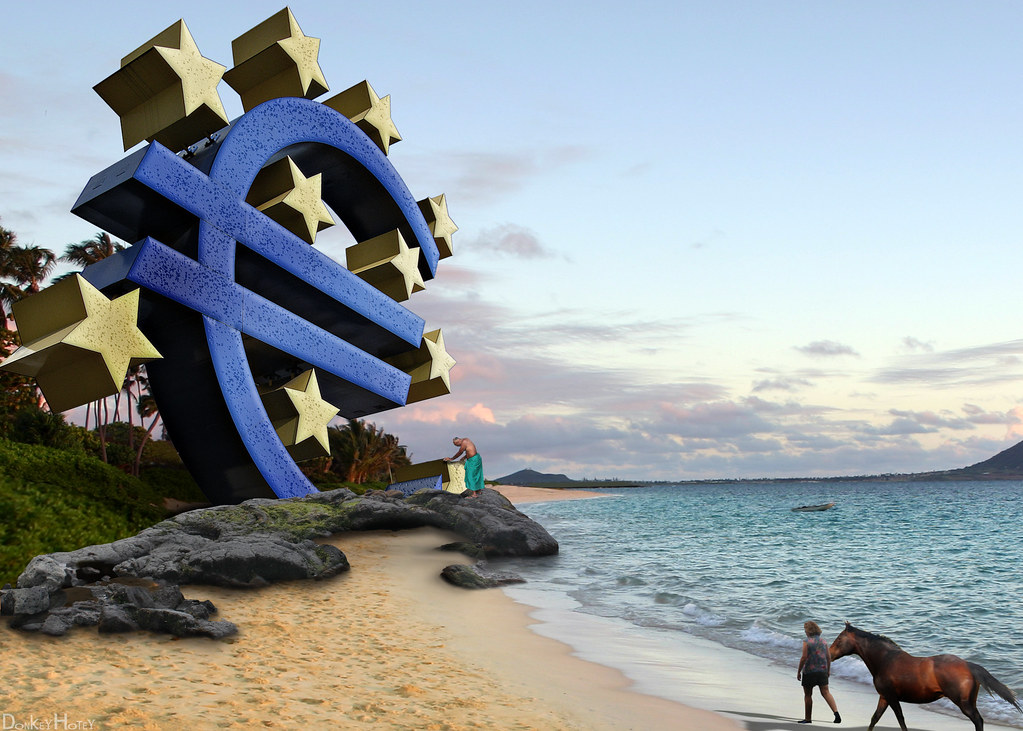
(Photo credit to DonkeyHotey)


Recently there have been political analyses of the political constraints in the Eurozone and the realm of international economic coordination. In short, these articles remind us that the nation state is not yet dead, and that the various dimensions of domestic politics need to be incorporated in any grand vision of a deep globalization. Cowen's NYT article also has some golden lines about the evolving global regime. First is that a power vacuum makes international coordination increasingly difficult:

We are realizing just how much international economic order depends on the role of a dominant country — sometimes known as a hegemon — that sets clear rules and accepts some responsibility for the consequences.  For historical reasons, Germany isn’t up to playing the role formerly held by Britain and, to some extent, still held today by the United States.  (But when it comes to the euro zone, the United States is on the sidelines.) 
THERE appears to be a power vacuum, and the implications are alarming. We may be entering a new world where international cooperative arrangements, in environmental areas as well as finance, are commonly recognized as impossible.  If the core European nations cannot coordinate effectively, what can we expect in dealings with China, Russia and other countries that have less of a common background and understanding?
However, if international coordination is likely to fail from going too deep and being too fragile, this suggests that the move towards more globally robust regimes needs to take place through small scale acts of coordination that respect national sovereignty and borders. Instead of global trade or financial regulation, enough friction needs to be built into the system to allow it to grow organically with less fragility. This is one of the reasons why I'm favorable towards capital controls. They do have a role in moderating financial crises, even if a substantial portion of their impact comes from directing funds towards other states. But if they are well designed, they can help immensely with macroprudential stabilization. By this "costs of coordination" argument, I am also very skeptical of further integration through the WTO. Global tariffs have gone down substantially. Going forward, the returns from further global liberalization are very low.

Secondly, his article highlights the fact that governments, even democratic ones, can make decisions that are detrimental to their populations. This is particularly pertinent when we are thinking about how the Euro came together. Even in 2010, after initial Greek debt troubles, essays were still being published trumpeting the virtues of greater integration and currency arrangements. We really can't predict, yet all of our political systems depend upon low levels of uncertainty. This is terrifying under an evolutionary interpretation, as the only reason countries are around now is because had past decisions been wrong, we wouldn't be able to have this conversation.

Wednesday, May 23, 2012

A Look Back Through the Lens of Complexity: "Bigger is Better"

When fears about the Euro were not always so well developed


Recent developments in Europe have created fears that Greece will soon exit the Euro. The spectacular way that the Euro has failed has led some to wonder why the Euro came together in the first place. Interestingly, the concern about a systemic Eurozone crisis did not really register when the Greek crisis started. Perhaps there were some musing that the crisis could spread, but it seemed that people believed that there would be a rescue package and that the crisis would pass. Size would come to the rescue, and an economy larger than that of the United States, the EU would end the threat of financial contagion.

If only they were right.

We now see massive capital outflows from the periphery and a frighteningly fast flight to quality within the Eurozone. But wasn't size supposed to blunt these impacts? While this narrative of "strength through fragility" seems hopelessly naive now, it's interesting to note that even in May/June of 2010 Foreign Affairs published an article by Richard Rosecrance extolling the benefits of size and larger currency arrangements in an era of turbulent capital flows. Rereading the essay, many of the key passages remind us how hindsight is 20-20, and that the narrative of the day can often push policy in the wrong direction.

The essay starts with a description of the Asian financial crises that roiled markets in the late 1990's as a justification for larger economic zones and currency areas;
But eventually the trading-state model ran into unexpected problems. Japanese growth stalled during the 1990s as U.S. growth and productivity surged. Many trading states were rocked by the Asian financial crisis of 1997-98, during which international investors took their money and went home. Because Indonesia, Malaysia, Thailand, and other relatively small countries did not have enough foreign capital to withstand the shock, they had to go into receivership. As Alan Greenspan, then the U.S. Federal Reserve chair, put it in 1999, "East Asia had no spare tires." Governments there devalued their currencies and adopted high interest rates to survive, and they did not regain their former glory afterward.

Russia, meanwhile, fell afoul of its creditors. And when Moscow could not pay back its loans, Russian government bonds went down the drain. Russia's problem was that although its territory was vast, its economy was small. China, India, and even Japan, on the other hand, had plenty of access to cash and so their economies remained steady. The U.S. market scarcely rippled. 
Small trading states failed because the assumptions on which they operated did not hold. To succeed, they needed an open international economy into which they could sell easily and from which they could borrow easily. But when trouble hit, the large markets of the developed world were not sufficiently open to absorb the trading states' goods. The beleaguered victims in 1998 could not redeem their positions by quick sales abroad, nor could they borrow on easy terms. Rather, they had to kneel at the altar of international finance and accept dictation from the International Monetary Fund, which imposed onerous conditions on its help. In the aftermath of the crisis, the small trading states vowed never to put themselves in a similar position again, and so they increased their access to foreign exchange through exports. Lately, they have proposed forming regional trade groups to get larger economically, by negotiating a preferential tariff zone in which to sell their goods and perhaps a currency zone in which to borrow cash.
The story of the Eurozone has shown us that increasing lending through large currency zones is a fool's errand. Private capital flows to the periphery destroyed the PIGS' competitiveness even though they were being quite fiscally conservative. The ability to borrow easily in good times has actually worsened situations, as at the first sign of debt troubles capital can quickly move out of the periphery states, again forcing them to "kneel at the altar of international finance and accept dictation from the International Monetary Fund."  Comically, Greece has been forced to accept "onerous conditions" from Germany for their help in the bailouts. While larger currency areas may secure cheaper funding in the short run, long run capital prospects don't improve.  In a sense, the larger currency area is a form of manufactured stability. It allows volatility to be restrained in good times, only to become fearsome in times of crisis. It's a blowup strategy, with all of the risk in the far left tail.

Moreover, a common currency area actually prevents a country from pursuing the other solution to sudden financial shocks: higher trade in goods. While the Asian economies faced the problem that "the large markets of the developed world were not sufficiently open to absorb the trading states' goods", Greece is facing the exact opposite problem. Past capital flows have left the economy severely overvalued and other markets may be willing to buy Greek goods, if only Greece could devalue its currency!  To worsen the problem, fears about Greece's debt situation lowers global equity values, further reducing global demand for Greek goods! A common currency area takes away from the external devaluation adjustment mechanism and therefore only aggravates the problems that small countries face in financial crises.

The fact that there is no adjustment mechanism makes the larger market available to each state less useful.  According to Rosencrance:

The 27 states that now compose the European Union will soon be accompanied by almost ten others, making Europe stretch from the Atlantic to the Caucasus. Member states have benefited from participating in an enlarged market extending beyond their national borders. The absence of tariffs in the EU allows greater cross- border commercial cooperation, which promotes specialization and efficiency and provides consumers in the member states with cheaper goods for purchase. Over time, as economists such as Andrew Rose and Jeffrey Frankel have shown, such trade zones increase their members' trade volume and GDP growth. There are also administrative advantages: southern and eastern European states with less advanced economies have found help and tutelage from veteran EU members and have not been allowed to fail (even if their fiscal policies have been reined in). 
But when Germany is running a massive current account surplus vis-a-vis virtually every other member of the Eurozone, the cross-border commercial cooperation is a joke. The cheaper German goods for purpose are only that way because of past capital flows that rendered periphery states uncompetitive. Given the horrendous costs of internal devaluation and the low likelihood that it would restore problems with capital structure, any possible microeconomic efficiency from trade is being swamped by disastrous levels of youth unemployment and civil unrest. When there's no transfer union, these asymmetric effects of trade flows on the different countries become incredibly important. We can no longer say "Europe is benefiting", we instead see the periphery on the verge of a full-fledged financial contagion.

It is also interesting to note that Rosencrance also makes an institutional argument here. Through the interaction of the "responsible" core states with the "irresponsible" periphery states, the periphery states will be brought up to the core states' level of institutional maturity. However, large capital flows promoted by a common currency rendered these kinds of supply side reforms unnecessary, and this institutional shift never happened. And as the Eurozone drama is unfolding, it is quite possible that some periphery states will be allowed to fail as the "help and tutelage from veteran EU members" abandons them.

In addition to these new harsh economic realities, the political realities of the situation don't seem to match up with Rosencrance's arguments either. According to the essay:
The peaceful expansion of trade blocs today, moreover, is likely to bring outsiders in rather than keep them out. It has done so in Europe and to some degree in North America and Asia as well. Self-sufficient trade blocs are impossible and will not be sought after. The key to a successful trade group, in fact, is that as it grows, it attracts sellers from the outside. 
What would China, India, and Japan do if the United States and the EU formed a trade partnership? They would not find an Asian pact a satisfactory rejoinder to the transatlantic combination. Since the major markets of the world are located in Europe and North America, Asian exporting nations would have to continue to sell to them. And if Japan eventually joined the partnership, the stakes for China and India would rise. China and India might not be significantly challenged if they could substitute domestic sales for exports. But even they, as big as they are, could not do so entirely. However important Chinese consumption becomes, it will not be able to sop up all the goods that China currently exports to technologically advanced and luxury markets in Europe, the United States, and Japan. To avoid falling behind, Beijing and New Delhi would need a continuing association with markets elsewhere.

What all this means is that the patterns of global politics and economics that have prevailed for the last half millennium are increasingly outmoded. During that period, eight out of the 11 instances of a new great power's rise led to a "hegemonic war." With a potential Chinese challenge looming in the 2020s, the odds would seem stacked in favor of conflict once again, and in other eras it would have made sense to bet on it. 
Yet military conflict is not likely to occur this time around, because even if political power sometimes repels, today economic power attracts. The United States does not need to fight rising challengers such as China or India or even to balance one off against another. It can use its own market capacity, combined with that of Europe, to draw surging protocapitalist states into its web. 
During the Cold War, the economic force of the West eventually surpassed and subverted even the heavy industrial growth of the Soviet economy. In the 1980s, the attractions of North Atlantic, Japanese, and even South Korean capitalism were a critical factor in Soviet leader Mikhail Gorbachev's decision to renew his country's economic and political system -- and end the Cold War. They also helped stimulate Deng Xiaoping's reforms in China after 1978.
Now that the formula for capitalist economic success has become widely understood and been replicated, Western economic magnetism will stem not just from the triumphs of individual economies but from their development as an increasingly integrated group. The expansion and agglomeration of economies in Europe -- and perhaps also across the Atlantic -- will serve as a beacon for isolated successes such as those in Asia.
The argument here seems to be that larger scale economic integration would be a virtuous cycle and therefore serve to moderate international conflict. As a result of integration in certain regions, other states will be forced to integrate with them, creating a unified global trade and financial regime. However, if large economic regime are important to this process, doesn't this just heighten the fragility embedded in the international system? This is especially vivid for the Euro now as, if anything, the collapse of the Eurozone would severely discredit the argument that open, integrated, western economies are the correct way forward. The failure of agglomeration would serve as a deterrent to the "isolated successes such as those in Asia."

A look back on such essays about the Euro serves as a reminder on how limited our capacity for prediction really is, and how the common narrative at any given time can hide the fragilities that persist in complex systems. The reasons behind large scale political developments such as the EMU are often opaque and create economic regimes whose faults are only revealed to us later. It is for this reason that our awareness of fundamental fragilities within economies is incredibly important. We do not know what we are truly doing, so we must strive towards a system that is robust to our errors.

Monday, May 14, 2012

Grexit Opacity: Why Are We Predicting Again?

Do we know how much we don't know?

(Photo credit from Reuters)

With the recent Greek elections, there's been a lot of talk about a possible Greek exit (or the cutely named "Grexit") from the Euro.  What has struck me about the situation is how much of it is still "up in the air".  You know, with  436M dollar bonds lying around to be paid and high levels of uncertainty on what the EUR/USD exchange rate will end up as.  Much of it will be dependent on the political resolution in Greece, but also on political resolve in core countries such as Germany and France.

But time is running out.  If the breakup is going to work, it needs to be a surprise, but with European integration as is it's hard to imagine how Greece would be able to prevent capital flight.  Moreover, if they decide to break from the Euro, the other periphery countries would have a great incentive to leave the Euro as well, leaving only Germany to deal with the loss of so much Euro denominated debt.  Immediate losses could easily reach 400 billion in initial bank losses.

To me, this all illustrates how little we truly know about the way highly interconnected and leveraged economies work.  How do you build a model in which economic conditions in Greece endogenously create the political conditions over many rounds, endogenously weakening the political situation in Germany to create a contagious financial crisis over Europe?  There is no analytically tractable way to solve that system!  Moreover, we know about these factors now that there's been so much turmoil, but how was one supposed to be able to forecast all these issues beforehand?  I also see this as a worrying issue about NGDP targeting.  While, in the long run, NGDPLT makes sense, the real question is how the credibility is established in the short run.  If unanchored expectations can have so much impact on the interpretation of debt, it seems terrifying that so much of the global economy would become pinned on the monetary decisions of a few.  It just creates a whole new host of unknown possibilities.  We can barely work with the unknowns that we know about; I dread to think of the unknown unknowns that still remain.

The presence of those unknowns is also asymmetric.  There is likely nothing left that will manage to make Greece substantially better.  Had there been a quick fix, it would have already been tried.  Even if Germany decides to massively shift to increase Eurozone NGDP (which would also make Germany overheat by a large amount), it wouldn't be a cure-all; serious debt and supply-side issues would still remain.  We're reasonably certain of how good it can get; we have no idea how bad the left tail can go.

We can't continue down the path of development like this.  Antifragile solutions need to be found.

Friday, April 27, 2012

Escaping from the Golden Fetters

An intermediate to currency disunion

The prospects for the Eurozone look bleak.  CDS spreads are going up, large countries have downgraded debt, politics is turning against fiscal consolidation, and the central bank still feels trying to save the Euro would jeopardize (what's left of) its credibility.  This has led to widespread pessimism about the long-run sustainability of the Euro, including from my fellow soon-to-be-undergraduate blogger Evan.  But, we must remember that "The long run is a misleading guide to current affairs. In the long run we are all dead. Economists set themselves too easy, too useless a task if in tempestuous seasons they can only tell us that when the storm is past the ocean is flat again."  Our goal for the endgame of the European economy is irrelevant if sovereign debt crises interrupt our theorizing.  Especially given the precipitous state of several other key economic powerhouses, such as India and China, adding a large scale currency adjustment hardly seems like a credible option.  The sheer physical demands of such a transition would make it nigh impossible to create an orderly transition.

Thus, even if all the nations are bound by the "golden fetters" of the Euro, simply abandoning the fetters is not a sufficient answer.To begin this walk away from the abyss, there needs to be more room for national policy in a continent that is otherwise deeply integrated.  The apparent struggles of the Eurozone are a particularly interesting case of what Dani Rodrik calls for in a path to a saner globalization.  We cannot let the perfect become the enemy of the good, and therefore let a potentially destabilizing deep integration get int the way of the many beneficial forms of shallower integration. Nations are different; why shouldn't their laws be the same?  In the words of Rodrik:
We have to think of these differences not as aberrations from the norm of international harmonization, but as the natural consequences of varying national circumstances.  In a world where national interests, perceived or real, differ, the desire to coordinate regulations can do more harm than good.  Even when successful, it produces either weak agreements based on the lowest common denominator or tougher standards that may not be appropriate to all.  It is far better to recognize these differences than to presume that they can be papered over given sufficient time, negotiation, and political pressure (The Globalization Paradox, 262).
Too often, attempts at harmonization result in policies that are "one size fits none."  Interest rates or macroprudential requirements may be too high in one polity, too lower in another, thereby aggravating the procyclical tendencies for both.  Stricter fiscal pacts and banking unification won't help; if anything, they would likely worsen the situation.

So if the Euro isn't going away in the short run, then there needs to be a way to introduce frictions to give national governments "policy space" to adjust.  This is where national macroprudential policies and potentially capital controls come into play.  Even if Eurobonds and enhanced lender of last resort capabilities are necessary, they need to be paired with policies that can ensure that the question of liquidity does not evolve into a question of later solvency.  Without national policy space, differing unit costs of capital and labor can evolve into serious financial issues, replicating the current European debt crisis.

This kind of financial segmentation would be even more appropriate given the dangerous roles of private capital flows in promoting the current crisis.  Private capital, freed from exchange rate risk and in search for higher yields, would flow from core banks to the periphery.  However, due to the poor institutional underpinnings of the periphery, there was no proper way to organize that capital (interfluidity).  In the time of adjustment, the common currency then prevents any kind of external devaluation that otherwise might have blunted the highly procyclical capital flows.  Since the currency cannot self adjust the capital flows, the governments may have to take a stronger role in ensuring that destructive capital flows don't distort national economies.

Eventually, when things have stabilized, the Euro can be steadily phased out  But with the current uncertainty and chaos, that option hardly seems viable.

Update 4/29/12:


New article from the economist that discusses the prospects for financial integration:
Breaking that interrelationship requires a number of things, Lord Turner argues. He would like to see Eurobonds that can, among other things, act as a risk-free asset that liberates banks from the “wrong-way risk” of holding their own sovereign’s debt; and he argues, too, for a pan-euro-zone approach to bank resolution, deposit insurance and supervision. National authorities should, he thinks, have responsibility for pulling “macroprudential” levers designed to prick booms before they get out of hand.
A much more integrated euro-zone banking system is a logical response to the euro crisis, but boy will it be difficult. Just imagine the implications. A big European supervisory authority that excludes Britain, the continent’s biggest financial centre; a system that would see taxpayers in creditor countries backing the banks of debtor countries; a process that could end up with supervisors in Frankfurt telling the Spanish, say, they cannot have more credit. Thorny stuff, but still better than the direction in which the euro zone is now travelling.
 But why are we trying for force all European countries into the same financial straitjacket if they're, quite obviously, Not The Same?